


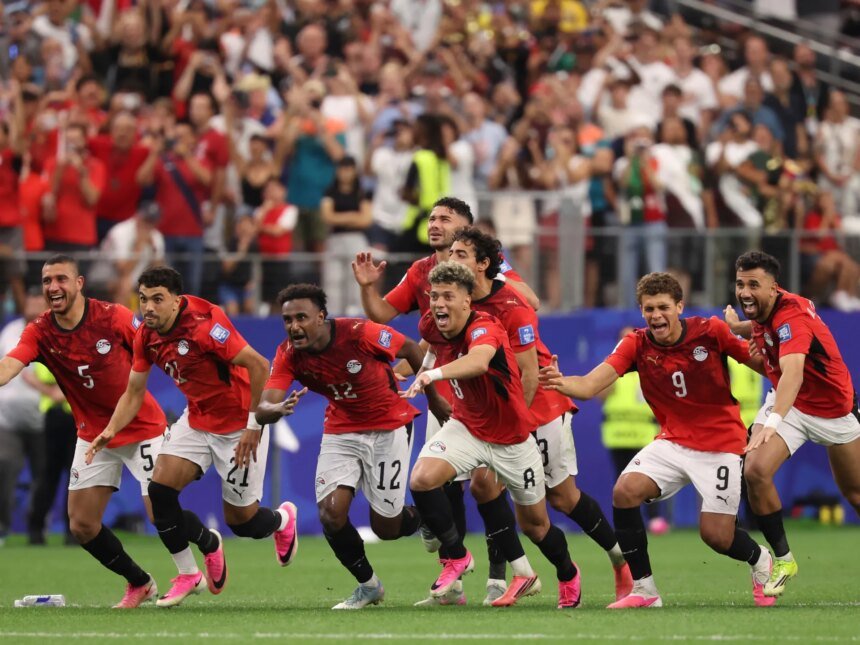
The Egyptian national team needed 120 minutes before its historic qualification to the quarter-finals of the World Cup was decided on penalties at the expense of Australia, in an unprecedented achievement for the Pharaohs, who reached this round for the first time in the history of their participation in the World Cup. In the next round, the Egyptian team awaits the winner of the confrontation between Argentina and Cape Verde, in a test that will be the most difficult so far in its tournament journey.
In this next report, we will try to analyze the most important technical and tactical aspects that made this achievement possible, and the most important strengths and weaknesses that appeared during the match.
Read also
list of 2 itemsend of list
Egyptian realism in the first half
The first half was largely equal, both in terms of possession and opportunity creation, a clear indication of a close level.
Despite this balance, the “Pharaohs” succeeded in exploiting one of the set pieces, after Imam Ashour followed the rebound from a free kick and headed it into the net, giving Egypt an important advantage before the break.
On the other hand, the Australian team tried to return to the match through constant pressure, but it lacked decisiveness and the final touch inside the penalty area, ending the first half late with a goal without a response.
An own goal brings Australia back
Australia entered the second half in a better manner after absorbing Egyptian pressure in the first minutes, and continued to search for the equalizer, with a clear reliance on set pieces, which constituted its greatest source of danger.
After a series of free kicks and corners, the equalizer came when defender Mohamed Hani, under pressure from the Australian attackers, accidentally turned a cross into his own goal.
After that, the pace of the match declined clearly, and neither team succeeded in imposing its control during regular or extra time, although Egypt had a relative advantage in possession, while the Australian team seemed more inclined to reach penalty kicks.
An Australian injury turned into a tactical gain
The injury of Australian winger Jordan Boss at the end of the first half seemed to be a strong blow to the Australian team, especially since he was one of its most prominent players in the group stage, and was famous for his continuous attacking runs from the right corridor.
But the irony is that his departure forced the Australian coach to redistribute the offensive roles, which reflected positively on the team’s performance.
In the first half, Australia relied almost entirely on the right front, which made the Egyptian defense anticipate the direction of most of the offensive attempts.

After the switch, the offensive structure became more balanced between the two sides, and some periods even witnessed a superiority of attacks coming from the left side, which confused the Egyptian defensive organization and reduced its ability to anticipate the source of danger.
This change also contributed to limiting Egypt’s offensive effectiveness, as the “Pharaohs” only made one attempt during the first 35 minutes of the second half, a clear indication of Australia’s success in imposing a tactical balance.
The successful Egyptian alternative
The Egyptian national team coach made an influential substitution in the 67th minute, when he brought on winger Haitham Hassan instead of Mostafa Zico, in a move that gave the “Pharaohs” different offensive solutions at a time when the match gradually began to tend toward a physical and tactical conflict.
Since his entry, Haitham Hassan imposed himself as one of the most prominent players in the match, after he used his great speed and skills in individual confrontations to repeatedly confuse the Australian defense.
The position he occupied became a constant source of concern for the opponent, as he succeeded in winning several individual confrontations and penetrated the defensive lines more than once, forcing the Australian players to retreat to their areas to protect the spaces behind the full-back.

Before his entry, the Australian team was experiencing its best period in the match, after it regained control of the midfield and began to advance in greater numbers towards the attack in search of the winning goal. But the entry of Haitham Hassan changed the balance of power, as the Egyptian team became more capable of keeping the ball and launching counterattacks, while the Australian team was forced to reduce its offensive momentum for fear of exploiting the spaces it was leaving behind its defense.
Although Haitham Hassan did not score or make a goal, his influence was clear from a tactical standpoint, as he restored balance to the Egyptian team and forced the opponent to change his style, becoming one of the most prominent trump cards that contributed to dragging the match to penalty kicks, where the “Pharaohs” decided it in the end.
Schubert is a source of safety
Goalkeeper Mustafa Schubert continued to perform at exceptional levels, and played a pivotal role in the Egyptian team’s qualification to the quarter-finals, after he was a safety valve in the face of Australian pressure, especially during the second half and extra time, when the tempo of the opponent’s attacks increased in search of the decisive goal.
Schubert showed great calm when dealing with crosses and direct shots, and he also excelled in his positioning on more than one occasion, which enabled him to spoil a number of Australian attempts before they turned into realized opportunities.
His importance was not limited to making saves only, but with his consistency and confidence he gave a sense of reassurance to the defense line, which found behind it a goalkeeper capable of intervening at the right time and correcting any defensive lapse.
As the match extended to 120 minutes, Schubert maintained his focus despite physical and mental exhaustion, and continued to direct his teammates and organize the back line, which helped the Egyptian team withstand the Australian pressure until the final whistle of regular and extra time.

Egyptian calm and stability
When the match went to penalty kicks, it seemed clear that the Egyptian team was the most mentally prepared. Despite the enormous pressure that accompanies these decisive moments, the “Pharaohs” players showed a great deal of calm and confidence, and treated each kick as an independent task, far from the tension that often resolves such confrontations.
All Egyptian shooters succeeded in converting their kicks into goals, which reflects the high concentration and emotional stability that the players displayed in the most sensitive moments of the match. They did not show signs of hesitation or haste, but rather executed the kicks with confidence, putting the Egyptian team in a comfortable position as the series of kicks progressed.
On the other hand, the Australian team could not bear the same pressure, after missing two kicks, which gave the Egyptians the advantage and confirmed that the difference in such situations is not related to technical aspects only, but rather to the ability to control nerves and make the right decision under the most extreme pressure.
This scene also reflects the work done by the technical staff in psychologically preparing the players, as the Egyptian team entered the penalty shootout with the mentality of a team confident in its ability to decide, and not a team afraid of losing everything it had built within 120 minutes.
The result was a practical translation of this consistency, with a well-deserved victory (4-2), without missing a single kick, so that the Egyptian team achieved a historic achievement by qualifying for the quarter-finals for the first time in the history of its participation in the World Cup.