Published on 6/29/2026
|
Last update: 22:00 (Mecca time)
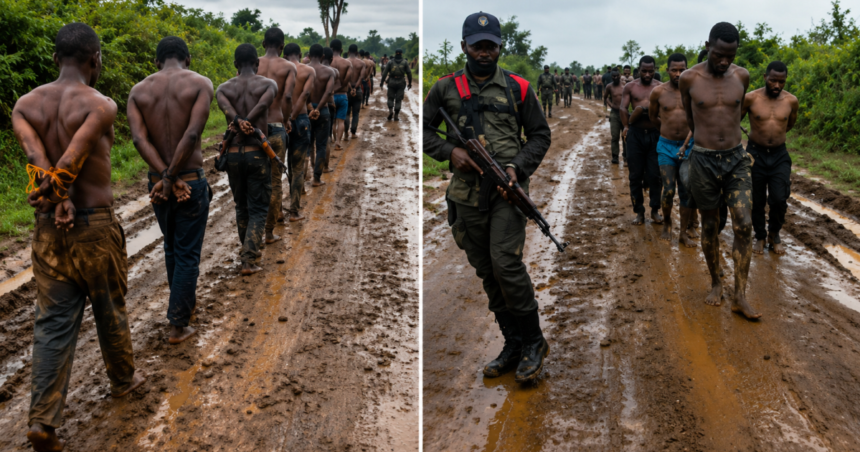
A short video clip showing handcuffed men walking on a muddy road under the guard of security personnel has become a widely spread material on the X and Facebook platforms, after it was attached to allegations that it documents the enslavement of black Africans by Arab Muslims in an African country.
The video quickly went out of context into a broader discourse that accused the media, leftist movements, pro-Palestine demonstrators, the United Nations, and the Pope of silence, in exchange for exaggerating the narrative of the progress of Muslims and Arabs as a collective party to an alleged crime.
The Al Jazeera Network’s Open Source Unit tracked the video’s spread, and monitored how influential accounts re-published it in similar formats, before it turned from a context-unknown scene into a widespread narrative. It also examined the allegations accompanying it, and tested their veracity by reverse searching the video and returning to the local sources that first published the scenes.
The beginning of the spread
The allegation began to spread through a unified narrative that was repeated in dozens of posts on the “X” platform, where the “Caroline Levitt Fans” account stands out as one of the oldest accounts that published the video within the narrative “Modern Slavery” on June 23, 2026, using wording that said: “This is modern slavery: Muslims enslave Christian black Africans,” accompanied by a request to “pray for African Christians.”
The post achieved wide spread, with more than 922,000 views, even though the account defines itself as a satirical or critical account, and not a field news source.
Read also
list of 2 itemsend of list
On the same day, similar formulations appeared on smaller accounts, including “Stupidity Radar,” before the novel was republished on June 24 via the account of “Ferenz Kelemen, the Global Explorer,” and then through other accounts that adopted almost the same phrase, such as “Bishnoi Ugarsayn.”
But the most prominent turning point came on June 25, when the “Dr. Maalouf” account – known for publishing extremist right-wing narratives towards Muslims – published the clip in a more circulating form, which said: “Why doesn’t anyone care? In Africa, Arab Muslims enslave black African Christians.” The tweet achieved about 2.8 million views, becoming the most widely spread version later on “X” and “Facebook.”
How did the novel move?
After the “Dr. Maalouf” account’s post, the wording turned into a ready-made template that was copied or modified by multiple accounts. Accounts such as “Al-Raqib News Network,” “Bazma Islam,” “Rosanna Report,” “Bio Fong,” and “Briska” published almost the same wording, keeping the basic elements: “Black African Christians,” “Arab Muslims,” “Media silence,” and “United Nations and Pope silence.”
The “Knights Templar International” account also emerged within the recycling wave, with a similar mobilization speech about “the silence of the world” and “the targeting of Christians in Africa.”
On the other hand, other accounts repurposed the passage within different political contexts. The “Just Jane” account presented it as evidence in the American debate about slavery and identity, while the “Chakraborty” account included it in a broader Indian right-wing discourse that links the present with historical narratives about Muslims in India.
What does the verification say?
The Open Source Unit’s reverse search on the video clips showed that the clip is neither recent nor related to the circulating narrative, as the official account of the “Kivu Morning Post” platform published the clip on May 14, 2026, indicating the arrest of about 100 civilians from South Kivu in the Kunda area of Irumu District in Ituri Province of the Democratic Republic of the Congo.
The “Moise Pavoa” page also published the clip with the same details, without any reference to “enslavement” or a religious dimension to the incident, but rather as an arrest linked to a local security context.
The local Radio Okapi website reported that more than 100 people were arrested on May 13, 2026 in the village of Kunda, on the grounds of their arrival in the area to work in agriculture and prospecting for gold, and they were transferred for investigation by the local authorities.
Thus, the video does not provide any evidence for the common claim, as it does not document a slave market or a kidnapping with a religious dimension, but rather shows an incident of mass arrest in a complex security context within eastern Democratic Congo.
The way the clip is circulated reveals a recurring pattern in visual misinformation campaigns, where a shocking scene is taken out of its context, and then a ready-made narrative is attached to it that exploits elements of identity, religion, and race.
An arrest scene in the Congo was transformed into a narrative that talks about “Islamic enslavement of Christians,” before it was repurposed within multiple political and religious spaces, from the Western debate over identity, to the anti-Muslim Hindu discourse, all the way to discussions related to the Palestinian issue.
What does the interaction map reveal?
The interaction map prepared by the Al Jazeera Network’s Open Source Unit indicates that the novel did not spread randomly, but rather through a network of accounts that recycled the same claim in similar formats.
The sample includes 348 accounts and 326 interaction relationships, and clear blocs emerged within it that contributed to reproducing the novel, most notably the accounts of “Caroline Levitt’s Fans,” “Dr. Maalouf,” “Knights Templar International,” and “Just Jane.”

These accounts played varying roles between early promotion, public amplification, and political repurposing, which contributed to transforming the clip from a limited visual material into a widespread digital narrative.