Published On 1/7/2026
|
Last update: 11:55 (Mecca time)
The failure in the World Cup was no longer just a sporting defeat for Germany and Italy, but rather it turned into an indicator of deeper economic, political and social crises, according to two readings published in the New York Times and Newsweek, which concluded that the decline of the two teams reflects the radical transformations experienced by the two largest powers in Europe.
The New York Times says that Italy’s absence from the World Cup finals for the third time in a row was a shock in a country that considers football a part of its national identity. The Italian national team, crowned with four world titles, is now excluded from the largest tournament, at a time when the country is facing a sharp decline in population, demographic aging, stagnant economic growth, and a continuing migration of young talent.
Read also
list of 2 itemsend of list
The report quotes Italian writer Aldo Cazzolo as saying that what is happening reflects “the spirit of our country that does not always live up to its potential, and not just in football,” indicating that the sporting failure has become a symbol of a broader national crisis.
The report notes that football represents a rare moment of unity for Italians, with one fan saying: “We only feel Italian when Italy plays in the World Cup,” while even cultural or tourism successes fail to create the same sense of common identity.

Germany…from success to doubt
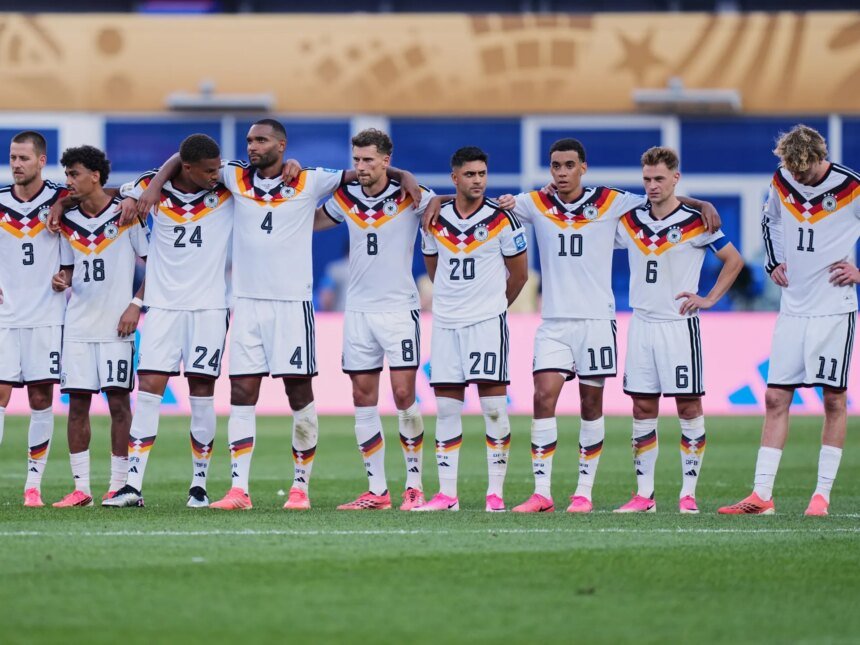
In the same context, Newsweek believes that Germany’s early exit from the 2026 World Cup is nothing but an extension of a decline that began since it won the World Cup in 2014, when many considered that the country was entering the “century of German success.” But after 12 years, the picture changed radically.
The head of the Ifo Institute for Economic Research, Clemens Fuest, says, “The team’s decline reflects the decline in economic performance and political cohesion in Germany,” explaining that the economy has effectively stopped growing since 2019, while European reports describe the recent years as a “lost decade.”
Newsweek explains that the war in Ukraine, high energy prices, US customs duties, and Chinese competition have weakened the German industrial model, especially in the automobile sector, which represents the mainstay of the economy, while companies face the challenges of transitioning to electric cars and the decline of their share in global markets.
At the same time, the country is witnessing an increasing political division with the rise of the right-wing Alternative for Germany party, and immigration has become the most divisive issue, in a scene radically different from the era of former Chancellor Angela Merkel, when Germany was described as Europe’s political and economic leader.
The magazine believes that Berlin is still a major economic power and possesses strong institutions, but it is no longer the undisputed European model, as was the case a decade ago.
Germany is witnessing an increasing political division with the rise of the right-wing Alternative for Germany party, and immigration has become the most divisive issue, in a scene radically different from the era of former Chancellor Angela Merkel.
Economic and demographic challenges
The two newspapers agree on the basic idea that football results alone do not explain the reality of countries, but they reveal aspects of their condition. In Italy, weak investment in youth, education, and sports has led to the decline of the national team, while Germany is suffering from an economic slowdown, industrial pressures, and political polarization, which in turn has been reflected in the performance of its national team.
The New York Times concludes that saving Italian football depends on addressing the country’s structural problems, and not just changing coaches or sports officials, while Newsweek believes that restoring Germany’s position requires deep economic and political reforms, because the current crisis goes beyond the borders of the green rectangle.
Thus, Italy’s absence or Germany’s early exit is no longer just sports news, but has turned, in the eyes of the two newspapers, into a metaphor for Europe facing accumulated economic, demographic and political challenges, which have made the glories of the past more present than the present’s confidence in the future.