Published on 6/30/2026
|
Last update: 7/1/2026 00:48 (Mecca time)
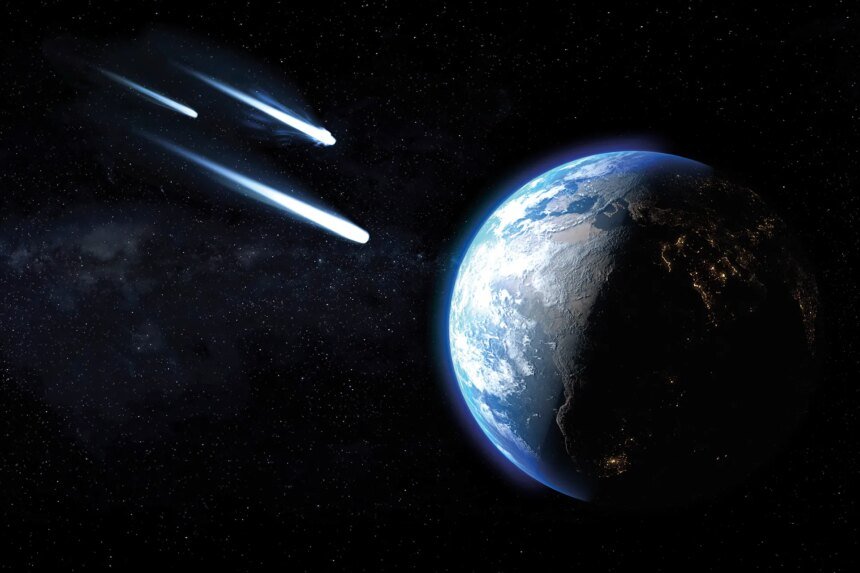
Today, June 30, the international scientific community celebrates World Asteroid Day amid widespread media and research interest.
The roots of this astronomical occasion go back to an official resolution issued by the United Nations General Assembly in 2016, based on a joint proposal submitted by a consortium of prominent scientists and filmmakers led by British astronomer and physicist Brian Mee, to make this day commemorate the largest asteroid impact the Earth has witnessed in modern history.

The famous Tunguska meteorite exploded in Siberia on June 30, 1908, destroying about 80 million trees over an area of 2,000 square kilometers without any warning. Today, this event takes on a completely different news nature. Scientists announce that the era of terrifying cosmic surprises is about to end due to advanced monitoring systems.
Read also
list of 2 itemsend of list
From the Tunguska disaster to monitoring the last seconds
Science has come a long way since that historic Siberian catastrophe. While our planet was completely exposed in the past, recent reports from NASA’s Planetary Defense Coordination Office show a radical shift in human capabilities.
Experts at the Jet Propulsion Laboratory of the California University of Technology confirm that ground-based radar systems recently succeeded in monitoring and catching seven small asteroids while they were still in deep space, and determined the time and place of their fall to the second before they hit the surface.

Perhaps the most prominent of these asteroids is “TC3-2008”, which disintegrated over Sudan, all the way to the “RW1-2024” asteroid, which burned up peacefully over the Philippines, turning the sky into a spectacle of green mass only 8 hours after it was observed, which proves that monitoring networks have become working as living shields.
The Russia shock and the birth of vigilant networks
This technological transformation did not come by chance, but was the result of major shocks that redirected scientific research. In 2013, the Chelyabinsk meteorite struck Russian airspace, causing about 1,500 people to be injured by window debris due to the explosive shock wave resulting from the meteorite exploding in the air.
Regarding this, space scientist Lindley Johnson, retired Inspector General for Planetary Defense at the US Space Agency, said: “The Russian meteorite was a real alarm bell that woke humanity from its slumber, and proved that the risks are not theoretical but real and require collective action.”

It was then discovered that this object came from the “blind spot” towards the sun, which blocked the view of night telescopes. In response, the International Asteroid Warning Network was established to coordinate efforts between global observatories, and advanced telescopes such as the James Webb space telescope of the American and European space agencies were introduced to negate the hypothetical dangers of modern asteroids such as 2024 YR4, which has been shown to be completely safe.
Tame giants and change cosmic destiny
The long track records of the Center for Near-Earth Object Studies indicate that scientists have succeeded in taming the space giants that have occupied the media for years.
The famous asteroid “Apophis”, which has a diameter of about 370 meters and caused global panic with the possibility of colliding with Earth. Updated radar calculations have proven that it is completely safe for the next 100 years, and it will even pass in April 2029 at a very close distance under satellite orbits for millions of people to see with the naked eye as an exciting scientific event.
The historic DART mission also succeeded in colliding with a space asteroid and deliberately distorting its orbit in the depths of space, which practically proved that the fate of destructive objects is no longer left to cosmic chance, but is now subject to intelligent human will and intervention.

In conclusion, “World Asteroid Day” goes beyond being a mere celebration of dry orbital numbers and calculations, to become a profound human philosophical pause in which the greatness of the human mind and the value of continuous exploration is evident.
These telescopes and space shields are an embodiment of the cognitive responsibility placed on us, and gratitude for the research instinct that drives us to secure the future of future generations. We do not look at the sky tonight with fear of dinosaurs that surrendered to their deaths in surprise, but rather with the eyes of a conscious civilization that realizes that science is the light that dispels the darkness of the unknown, and that striving to explore and protect the universe is the highest duty of man and the greatest manifestation of his intellectual superiority.