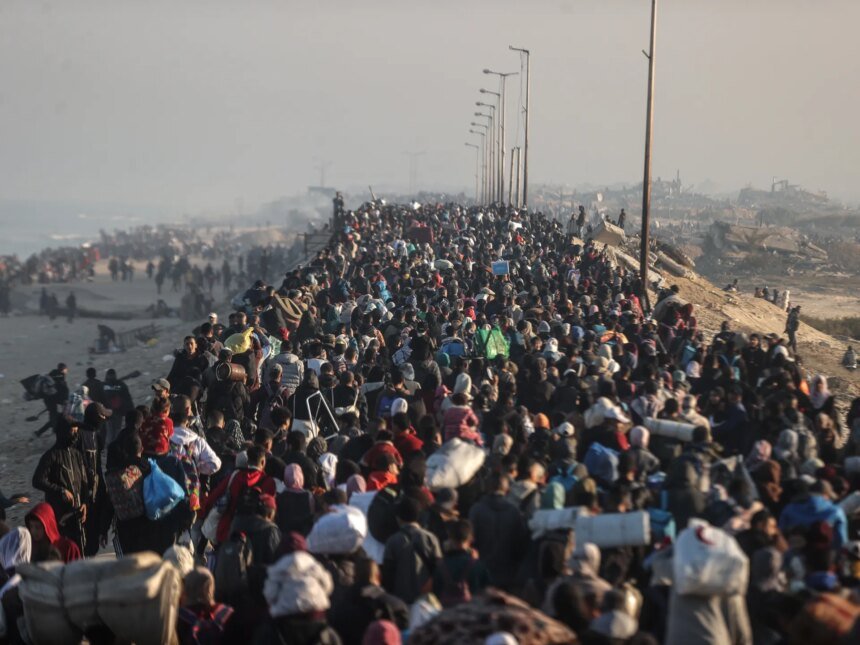
The goal has not changed, only the name has changed. After months of failure to find a single country that would agree to receive Palestinians from the Gaza Strip, and after a widespread international rejection of the term “voluntary immigration,” Israel returned to reviving the same project, but this time under a new title, the “Freedom of Movement Plan,” in an attempt that seems closer to repackaging the displacement project in terms that are less objectionable and more marketable to the international community.
The transformation revealed by the Israeli “Channel 13” is not limited to a linguistic change, but rather reflects an implicit Israeli recognition that the previous term has become a political and diplomatic burden, after international parties considered it a cover for a process of forced displacement that conflicts with international law, which prompted a number of countries to refuse to cooperate with Tel Aviv in this file.
According to the Israeli channel, the occupation issued instructions to officials of the security services in the Mossad to stop using the term “voluntary migration” and to adopt the term “freedom of movement plan” in all official meetings and correspondence.
Reviving a plan that never left the drawers
Israeli sources believe that changing the vocabulary may contribute to radically changing the position of some countries, and give the plan a new opportunity after it faltered.
However, the Israeli recognition itself reveals the essence of the issue, as Channel 13 quoted an Israeli official as saying that Tel Aviv seeks to lead a process that leads to the departure of the largest possible number of residents of the Gaza Strip, based on the conviction that this will serve any future arrangements for the Strip.
The channel acknowledged that changing the name represents a clear attempt to address the difficulties facing the project on the international scene, and to encourage cooperation with other countries.
The re-presentation of the project came days after an urgent meeting called by the new head of the Israeli National Security Council, Shmuel Ben Ezra, with the participation of representatives of the army, Mossad, Shin Bet, and the Ministry of Defense, to discuss what was described as “encouraging voluntary migration” of Gaza residents.
For its part, Haaretz newspaper revealed that Mossad representatives admitted during the meeting that they have not yet succeeded in finding any country willing to receive the residents of the Gaza Strip, an admission that reflects the magnitude of the impasse facing the plan despite months having passed since its launch.
The meeting raised the astonishment of the security establishment itself, as this file had not been opened for months, after it had been raised repeatedly before without moving to the implementation stage, as a result of the absence of international partners and widespread political rejection.
This failure was reinforced by a series of previous Israeli attempts that did not achieve results. In March 2025, the Political and Security Ministerial Council approved the establishment of the “Directorate for the Voluntary Relocation of Gaza Residents,” before Defense Minister Israel Katz announced the establishment of the body charged with arranging transportation operations by land, sea, and air to third countries. However, the project remained a dead letter.
Haaretz also revealed last April that Prime Minister Benjamin Netanyahu’s advisor for international affairs, Caroline Glick, had made contact with the separatist region of Somaliland and the Democratic Republic of the Congo, in an attempt to find destinations to receive Palestinians, but did not achieve any breakthrough.

From failure of implementation to changing vocabulary
In addition, Channel 13 acknowledged that the political and security systems in Israel place high hopes on the project, and that changing the terminology represents an explicit attempt to overcome international obstacles and not a review of the idea of displacement itself.
Not only does the project face Palestinian rejection, but it also clashes with an Arab and international position that rejects any arrangements based on displacing the population of Gaza or changing the demographic reality of the Strip.
Even inside Israel, Haaretz quoted a member of the Knesset Foreign Affairs and Security Committee as saying that the plan “lacks political and international feasibility,” in light of the refusal of the Arab countries and the international community to recognize or cooperate with it, considering that Netanyahu continues to present it despite its lack of chances of success.
On the other hand, some Israeli officials link the revival of the project to broader political understandings, including what was reported about unannounced understandings between Netanyahu and US President Donald Trump, but this hypothesis has not been officially confirmed.
For her part, Israeli Minister of Innovation, Science and Technology Gila Gamliel said on Monday that she had presented to the Israeli government a plan to displace Palestinians from the Gaza Strip, noting that the Mossad had joined in its implementation.
In an interview with the Israeli Channel 7, Gamliel, a member of the security cabinet, explained that what she described as the “political initiative” she had prepared regarding the “voluntary migration” of the residents of the Gaza Strip is in advanced stages of implementation.
She said: “I prepared this plan and presented it to the cabinet, and it is about to be implemented, and Mossad has now joined the operation to manage this effort optimally.”
The Minister touched on the Israeli military operations in the Gaza Strip, stressing that the Israeli army currently controls more than 60% of the Gaza Strip, adding: “We will continue to advance until we achieve the goal of the war, which is that Hamas will no longer control the Gaza Strip, neither militarily nor politically.”
She added that the Gaza Strip “could become a good opportunity for settlement in the future, once voluntary migration takes place,” as she put it.
Gamliel did not reveal the names of the countries to which the Palestinians of the Gaza Strip were supposed to be transferred within the plan, nor did he clarify the nature of the role that the Mossad would assume or the mechanisms for implementing this proposal.

Resistance foils plans
On the ground, Israel’s calculations appear more complex than what political discussions reflect. Despite the widespread destruction that affected about 90% of the civilian infrastructure in the Gaza Strip, and the fall of more than 73,000 martyrs and about 173,000 injured since October 2023, the Palestinians cling to remaining in their land, and continue to reject displacement projects under various names.
During the war, Israel put forward a series of ideas to reshape the demographic reality in the Gaza Strip, including the “Generals’ Plan,” the “Humanitarian Islands,” and re-settlement in northern Gaza, leading to the “Gaza Riviera” project proposed by US President Donald Trump, which is based on transferring residents to third countries and transforming the Gaza Strip into an investment and tourist area.
But all of these proposals collided with two basic factors: international rejection on the one hand, and the Palestinians’ insistence on staying and returning to their areas despite the extent of the destruction on the other hand.
Regarding this, the researcher specializing in Israeli affairs, Ahmed Al-Haila, confirms that replacing the term “voluntary immigration” with “freedom of movement” is nothing more than an Israeli attempt to “beautify the ugliness and justify the crime,” stressing that changing the names does not change the essence of the plan or its goals.
Speaking to Al Jazeera Net, Al-Haila said that if Israel were truly keen on freedom of movement, it would not have continued to close the crossings to civilians, students and patients, and prevented the entry of humanitarian aid, noting that international reports and testimonies confirm that what is happening in the Gaza Strip represents a continuation of a policy aimed at displacing the Palestinians.
Al-Haila links the timing of reviving these proposals to internal political considerations in Israel, considering that Prime Minister Benjamin Netanyahu seeks to compensate for his failure to achieve what he described as “resolution” in Gaza, the West Bank, Lebanon and Iran, by re-proposing displacement projects that resonate with the far-right audience, in a way that serves his electoral calculations and strengthens his political base alongside the extremist religious parties.
Al-Haila rules out the success of these projects, pointing out that the Palestinians have thwarted previous attempts at displacement, as they did after the catastrophes of 1948 and 1967, and that, despite the humanitarian catastrophe and the lack of life in the Gaza Strip, they are still clinging to their land, which makes the fate of this plan, in his opinion, no different from the fate of its predecessors.