Published on 6/30/2026
With the start of the knockout rounds in the 2026 World Cup, the eyes of football fans are turning to an irreplaceable stage, as winning becomes the only way to continue competing, while stumbling means the end of the journey.
The knockout round matches differ from the group stage, as there is no room for point calculations or compensation of results. The losing team leaves the tournament directly, while the winner continues on its way to the next rounds.
Read also
list of 2 itemsend of list
If the original time of the match ends in a draw, the confrontation extends to an additional time of 30 minutes, divided into two halves, and if the result remains unchanged after 120 minutes, the finalist will be decided by penalty kicks.
Many believe that the fatigue accumulated during the match reduces the players’ ability to implement offensive plans, which makes extra time less effective, but the history of the World Cup presents a different picture.
Statistics indicate that extra time was a real turning point in a large number of matches, as 52 out of 73 matches that extended to extra time witnessed a change in the result, at a rate of 71.23%.
These numbers reflect the fact that the extra half hour often witnesses changes, whether due to teams rushing in search of the qualification goal, or as a result of physical errors that appear with a decline in fitness in the final minutes.
Penalty kicks remain the last card
Although extra time succeeds in changing the course of many matches, it does not necessarily mean that qualification is decided before reaching penalty kicks.
The numbers reveal (before the 2026 World Cup) that 35 out of 73 matches that resorted to extra time ended in penalty kicks, after the tie remained intact after the full 120 minutes had passed, which means that nearly half of the extra time matches in the history of the World Cup ended in a penalty shootout.

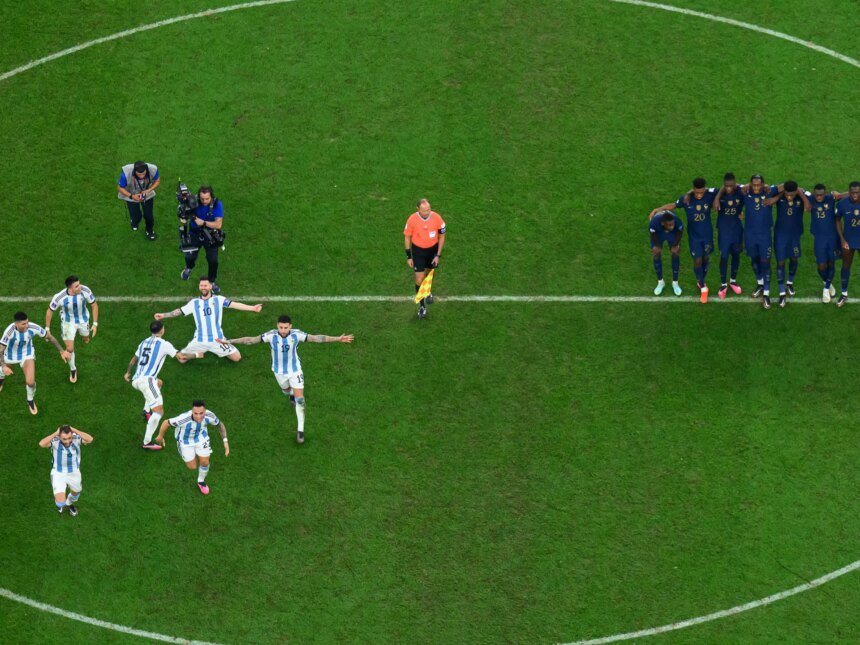
One of the most prominent examples of this is the final held in Qatar 2022 between France and Argentina, as the two extra periods ended in a 1-1 draw after the match ended in a 2-2 draw, before penalty kicks decided the identity of the champion.
The golden goal…a rule that created immortal moments
The history of the World Cup recalls one of the most exciting rules, which is the Golden Goal rule, which was applied in only two editions of the tournament: France 1998 and South Korea and Japan 2002.
This rule stipulated that the match end immediately after the first goal was scored during extra time, and the team that scored it would be declared the winner immediately, without completing the remainder of the match time.
Despite the short period of application of this system, only 4 matches were decided in this way, to remain engraved in the memory of football fans.
4 goals made history
The 1998 French Championship witnessed the scoring of the first golden goal in the history of the World Cup, when Laurent Blanc scored the winning goal for France in the 114th minute against Paraguay, leading his country to the next round.
In the 2002 South Korea-Japan Championship, Henry Kamara scored a goal in the 104th minute, giving Senegal a victory over Sweden in the round of 16.
Ahn Jung-hwan also scored a historic goal with his head in the 117th minute, giving South Korea victory over Italy in one of the most exciting and controversial matches of the tournament.

As for the fourth and final golden goal, Ilhan Mansiz scored with a half-volley in the 94th minute, leading Türkiye to the semi-finals at the expense of Senegal.
Clear regulations govern overtime
To avoid any confusion on the field, the FIFA regulations for the 2026 World Cup clearly set out the procedures governing extra time and penalty kicks in Article Fourteen.
The regulations stipulate that extra time consists of two halves, each lasting 15 minutes, preceded by a short 5-minute break after the end of regular time.
There is also no rest period between the halves of extra time, as the players are obligated to remain on the field during the period between the halves.
If the tie continues after the end of extra time, the decision goes directly to penalty kicks.
Before kicks were taken, the match referee made two lots; The first determines the goal against which all kicks will be taken, except in emergency cases related to security or poor playing field, while the second lottery determines the team captain who chooses whether his team will take the first or second kick, noting that the International Federation recently decided to amend the two-lot system for greater fairness.