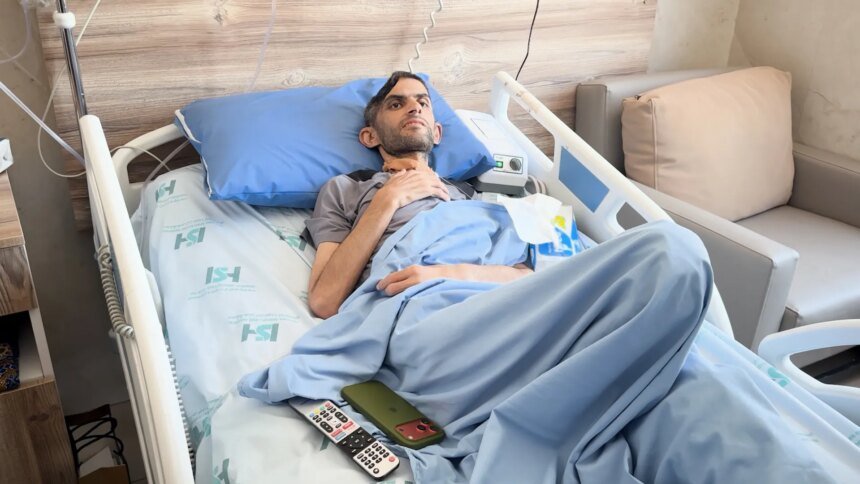
fetal- Inside Room No. 318 on the third floor of Ibn Sina Hospital in the city of Jenin in the northern West Bank, Palestinian journalist Mujahid Bani Mufleh has been lying in bed for about a month, after a long treatment trip in hospitals in the city of Ramallah, after suffering a cerebral hemorrhage following his liberation from Israeli occupation prisons.
Mujahid was arrested from his home in the town of Beita, south of Nablus Governorate, in mid-2025, and remained in captivity for six months, during which he suffered various forms of psychological and physical torture, starvation, and medical neglect.
Read also
list of 2 itemsend of list
Only two days after his liberation, in January of this year, he suffered a brain hemorrhage that required him to be transferred to the hospital and undergo surgery to stop the bleeding, but as a result he entered a coma that lasted for two months before he began a long treatment journey as a result of complications from the brain hemorrhage, which caused him to lose the ability to walk and eat.

136 days without talking
Inside the treatment room, Mujahid’s three children gathered around his medical bed, and around them were a number of visitors and relatives. With his right hand, Mujahid tries to caress his six-year-old youngest daughter, Arab, as he has lost the ability to move the left half of his body. When words are difficult for him, he writes to those around him what is on his mind.
“To lose the ability to express what I felt, that was one of the most difficult things for me,” Mujahid told Al Jazeera Net, describing the 136 days he spent in the hospital unable to speak.
He added: “I realized that the Mujahid who went to prison was different from the Mujahid of today. The occupation deliberately broke my will with torture, starvation, and intimidation. I knew that everything I was exposed to was with the aim of destroying Mujahid, the journalist, but today I realize that I must adhere to the profession more, to convey what I saw to the world.”
Mujahid gets tired of talking, as he was able to utter the first word after five months of forced silence, just three days ago, so he chooses to continue the dialogue in writing.
Prison did not change my conviction
He wrote on a white piece of paper that he placed next to him: “My psychological defenses collapsed. I remained convinced that my brother was martyred in prison, and my conviction did not change even after I was liberated, despite my family’s assurance that my brother Asadullah was fine. What I saw in prison led me to be convinced that my brother had not survived. I was not convinced that he was still alive until a short time ago, after his lawyer visited and assured me that he was fine.”
Mujahid Bani Mufleh has been working as a journalist for 15 years, and worked for years on the “Ultra Palestine” website before his arrest.
Noha Al-Sharafa, the journalist’s wife and his companion since the beginning of his recovery journey, speaks to Al Jazeera Net about Mujahid’s need for a long journey of physical and occupational therapy, in addition to medical treatment, as he lost more than 25 kilograms of weight.
Today, Noha is awaiting the doctors’ decision to determine the date for the operation to restore the skull bone that was cut off after the cerebral hemorrhage.
Until now, Mujahid cannot walk, and moves around using a wheelchair, and needs help with his personal affairs, but he is much better than before, his wife adds.
She adds that since his admission to the hospital, Mujahid has been eating through a tube connected from the nose to the stomach, in addition to losing feeling and control in his left hand and foot. He can only use his phone with his right hand and write briefly on it.

Life in hospitals
According to Noha, Mujahid’s difficult health condition directly affected the entire family, especially his three children who are forced to spend most of their time in the hospital, so she rented an apartment close to the hospital due to the difficulty of moving to and from her home due to Israeli checkpoints and settler attacks on the roads.
There are many details that are very difficult for the family to live with on a daily basis, such as the children’s distance from their social environment, their presence among patients and doctors on a daily basis, and the difficulty of family visits, in addition to the burden placed on Noha’s shoulders. “But we have no choice but to be patient until he regains his health and well-being.”

Unprecedented violations
During the last three years, specifically after the war of extermination on the Gaza Strip, the medical conditions of prisoners released by the occupation after their arrest during or before the war increased, and they needed treatment after their release from prison.
While the world today, Friday, commemorates the “International Day in Support of Victims of Torture,” prisoner institutions in the West Bank and Gaza Strip record thousands of cases of people who were subjected to systematic torture using various psychological and physical methods, and even sexual violations.
According to the Addameer Foundation in the Gaza Strip, the occupation introduced a new method of torture in various prisons after October 7, which consisted of “psychological torture, deprivation, starvation, and threats to kill or arrest and kill relatives, leading to sexual assault on relatives of detainees.”
The director of the institution, Alaa Skafi, spoke to Al Jazeera Net about cases similar to enforced disappearance, which include concealing information related to the whereabouts and detention of detainees, and documenting testimonies of released detainees who reported that they were detained inside wooden coffins for more than four days, to make them feel that they were buried alive, before returning them for investigation again.
Torturing prisoners and their families
Skafi explains that hundreds of cases were subjected to sexual harassment or complete nudity, in addition to forcing a number of detainees to wear diapers with the aim of breaking them psychologically.
Addameer Foundation confirms that torture is not limited to detainees, but has observed the occupation deliberately killing and torturing their families, in addition to recording cases of killing prisoners after their arrest and deliberately luring prisoners into homes and buildings and then blowing them up and killing the detainees inside them.
According to Skafi, the kidnapping of nurse Tasnim Al-Hams to blackmail her father, Dr. Marwan Al-Hams, and his arrest represents a dangerous precedent in the methods of the occupation, in addition to the threat to rape relatives of detainees and their wives, and to rape detainees with police dogs.
Skafi says: “During the repression operations carried out by soldiers inside the cells, detainees are subjected to beatings with batons and rifle butts, in addition to throwing tear gas, which sometimes led to the martyrdom of prisoners during these raids.”
Restriction until amputation
Addameer Foundation’s documentation included cases of amputation of the limbs of released prisoners as a result of their restriction for long periods of up to several months, especially in Sde Teman prison, where the majority of Gaza Strip prisoners were held.
Regarding the Convention against Torture, Skafi explained that despite the occupation’s signing of the agreement and its commitment to its provisions, the practices documented by lawyers for prisoners’ institutions and human rights institutions, in addition to the testimonies of released prisoners, confirm that the occupation is using systematic methods of torture.
He pointed to the adoption of laws to circumvent the provisions of the agreement and to give torture practices an internal legal cover, citing the adoption of the law to execute prisoners after the seventh of October 2023, in addition to the enactment of the law on force-feeding of prisoners on hunger strike, and other laws that allow the Prison Service to practice physical and psychological torture methods against prisoners and extract confessions from them.
Systematic torture
On June 26 of each year, the world commemorates the International Day in Support of Victims of Torture. It aims to recall the absolute prohibition of torture and redress the harm inflicted on its victims. It also highlights violations and calls for holding perpetrators of torture accountable in various parts of the world.
On this occasion, Palestinian human rights organizations highlight the ongoing violations against prisoners and detainees in prisons, and demand an end to the policies of medical neglect, cruel treatment, and impunity.
The head of the Prisoners’ Club in the West Bank, Abdullah Al-Zaghari, speaks to Al Jazeera Net about a radical shift in the methods of torture against prisoners in conjunction with the war of extermination in Gaza, indicating that his practices can be considered part of the genocide to which the prisoners are subjected.
Legitimization of torture
Al-Zaghari confirms that although the occupation passed laws legalizing torture against prisoners years ago, the testimonies coming out of prisons were shocking to world public opinion, and were classified as “systematic methods practiced under the guidance of the highest Israeli political and security levels, down to the youngest jailer.”
These methods include sexual assaults, rape, deprivation of food, not allowing prisoners to relieve themselves, in addition to the use of loud music, and stripping them as part of what the prisoners describe as mass torture parties, which constitutes a flagrant violation of international conventions and human rights.
According to Al-Zaghari, the International Day Against Torture represents an opportunity to confirm that the occupation has established torture as a form and tool of genocide against prisoners, and that it disavows all human and moral values and challenges the international community, ignoring all human rights conventions.
To date, the number of prisoners in the occupation prisons has reached about 9,500, including 93 women and 400 children, and 1,400 prisoners whom the occupation classifies as “illegal combatants,” in addition to 3,500 administrative detainees under a secret file without charges or trials.