Published on 6/27/2026
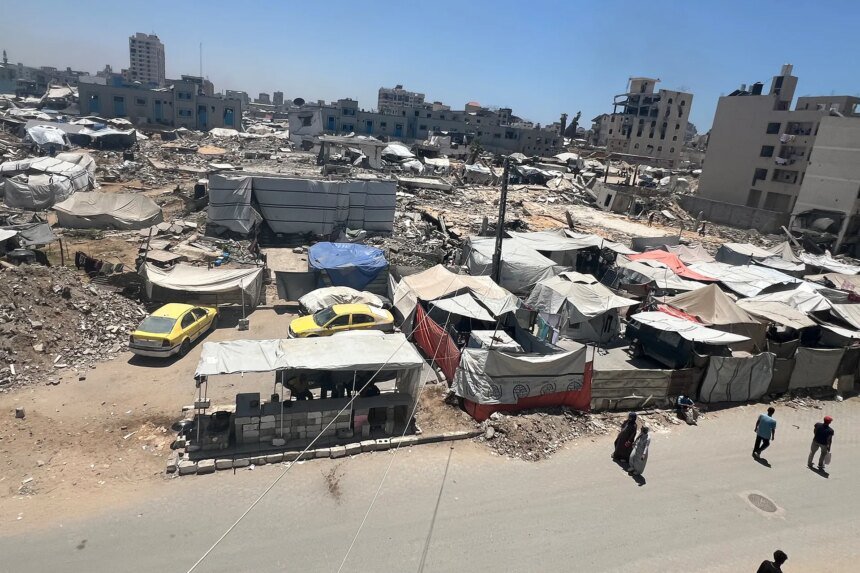
Under the weight of fear of stray bullets that now threaten the displacement camps in the Gaza Strip daily, and with the tents unable to provide protection from the harsh summer heat and the bitter cold of winter, the young man Khalil Abu Ramadan thought of an alternative that would provide him and his family with the minimum amount of protection.
He had an unusual idea in the environment of displacement, which was to build a mud room with simple local materials, perhaps providing a minimum level of safety and stability amid a reality open to danger and harsh climatic conditions.
Repeated displacement and losses
The idea of building was not a quick decision for a digital content creator, but rather came after a long journey of displacement, as Khalil describes, during which he and his family moved more than 25 times between different areas of the Gaza Strip, while losing the photography tools and equipment that he relied on to create content.
He says that he found himself in a tent that could not withstand rain or wind, and did not provide any feeling of stability, even in the simplest details of daily life.
At one point, Khalil returned to thinking about returning to content creation, but this time from a different angle, reflecting the reality of displacement itself.
He chose a semi-destroyed place, the remains of a demolished room covered in rubble, and began re-cleaning it and preparing it for filming using only his phone, after making a primitive camera holder out of stones stacked on top of each other.

A tent is no longer enough
With the continuation of daily threats, especially in areas near what Israel calls the “yellow line,” where stray Israeli bullets are common, the idea moved from documentation to searching for a practical solution.
For the young man, the tent was no longer a sufficient option, but rather a fragile space that could not withstand winter or danger, which prompted him to think about building a mud room that would be more durable.

Advice from a friend
Abu Ramadan says that he sought the help of a young man, who has traditional experience in construction that he inherited from previous generations, and he advised him that the best option in these circumstances is to build a circular room of mud, using available local materials, as it is less expensive and more durable compared to fragile tents.
The work actually began by collecting clay from lands designated for this purpose, transporting it to the site, and then gradually shaping it to build the walls.
The process was slow and arduous, relying on manual effort and limited capabilities, but for Khalil, it was a step towards creating a safer space amid a reality that does not provide many options.
In light of the continuing displacement and the change in places of residence, he does not bet that the room will completely change reality, but he considers it an attempt to alleviate the harshness of daily life, even if temporarily.