Published on 6/25/2026
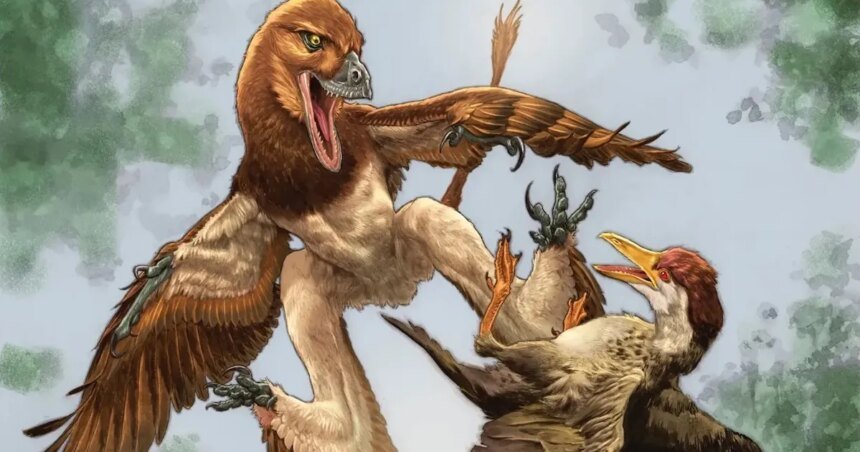
An international team of paleontologists announced the discovery of a new type of feathered dinosaur in northwestern China, which likely glided between trees on four feathered limbs, and may have preyed on some early birds that lived about 120 million years ago.
The new dinosaur was named “Xian Changmenensis”, and its remains were found in the Changma Basin in Gansu Province in China, a fossil site that has been famous for years for its abundance of ancient bird remains, but it had not previously provided a confirmed fossil of a non-avian dinosaur.
This creature belongs to the group of microraptors, which are relatively small dinosaurs from the dromaeosaur family, the same family that includes the famous velociraptor.
However, the cinematic image of the Velociraptor, as it appeared in the “Jurassic Park” films, is highly misleading. These animals were not bare-skinned reptiles. Rather, many of them were covered with feathers, small in size, fast moving, and closer in appearance to a strange predatory bird than to a huge lizard.

Interesting objects
What makes microraptors particularly interesting is that some of them had long feathers not only on their forelimbs, but also on their hind limbs, so that they appeared to have four wings.
That’s why researchers describe the new dinosaur as a “tetraptera,” not in the sense that it flew like modern birds, but because it may have used its feathered limbs to glide between trees, in the manner of a flying squirrel, or to control its jumps and movement in an environment rich in trees, water, and small prey.
According to the study, which was published in the Annuals of Carnegie Museum, what scientists found is not a complete skeleton, but rather parts of the shoulder girdle and the left front limb, including bones such as the shoulder blade, humerus, radius, and ulna, while the wrist and palm are absent.
Despite this deficiency, the anatomical details of the bones were sufficient to distinguish the animal as a new species and place it within the group of microraptors.

Top of list
Before this discovery, the Changma site was mainly known as a cemetery for ancient birds. Excavations there revealed more than a hundred partial skeletons of birds that lived in the Early Cretaceous period, some of which preserved traces of soft tissues such as feathers, skin, and claw sheaths.
Among the most famous of these birds is Jansus eumenises, an ancient bird that was relatively close to modern birds, but amid this bird richness, researchers wondered about the predator that was at the top of the food pyramid in this region.
The reason for this question is that scientists found at the site strange collections of broken and compressed bird bones, similar in shape to the “pellets” that modern owls eject after digesting their prey.
The owl, as it is known, swallows its small prey and later expels masses of bones, feathers and undigested parts. The presence of similar masses in Changma suggested that an ancient predator hunted birds and left behind these remains, but the predator itself remained absent from the fossil record.
Here, “Xianchangmensis” appears as a strong candidate to solve the mystery, as it is the only non-avian dinosaur found so far at that site, and it was a carnivore, and larger in size than most of the birds preserved there.
Researchers estimate that its wingspan may have reached about one and a half metres. This size does not make it a giant in the dinosaurian sense, but it does make it a significant predator in an environment filled with small and medium-sized birds.
However, the discovery does not provide conclusive evidence that this dinosaur actually ate these birds, as scientists did not find, for example, the remains of birds inside its gut, as sometimes happens in exceptional fossils that preserve the animal’s last meal, and no clear tooth marks were discovered on the bird bones.
So researchers are treating the discovery with caution, only as it is the “best candidate” so far, not the guilty culprit in preying on birds in this region millions of years ago.