After examining 85 studies and 7 million people around the world, a review published in 2024 showed that “exercise may reduce the risk of premature death by up to 40%.” “It turns out that physical activity is more important for long-term health than we previously thought,” Gregor Mielke, a senior lecturer at the University of Queensland’s School of Medicine in Australia and a co-author of the review, told CNN.
“Movement is medicine,” so exercise enhances your mental and physical health. But experts strongly warn against rushing into exercise without paying attention to the fact that “some common exercises may be more harmful than you expect,” especially if you suffer from lower back problems.
Read also
list of 2 items
end of list
Below are examples of 8 common exercises that may put your back at risk – according to experts – along with effective and suitable alternatives to help you maintain the strength and safety of your body.
Traditional abdominal exercises
Despite their widespread popularity, it may seem surprising that traditional abdominal exercises top the list of exercises that pose a risk to the lower back. But Dr. Gbolahan Okobadjo, an orthopedic and spine surgeon in New York, explains to HuffPost that repeatedly bending the spine under pressure leads to “compression and rupture of the lumbar cartilage discs.”
Okobadjo recommends the “Dead Bug” exercise as a safer alternative. It is an exercise that strengthens the abdominal muscles, and at the same time maintains the health and comfort of the back.
It involves lying on your back and slowly extending the opposite arm and leg, keeping your lower back in contact with the floor.
Deadlift exercise
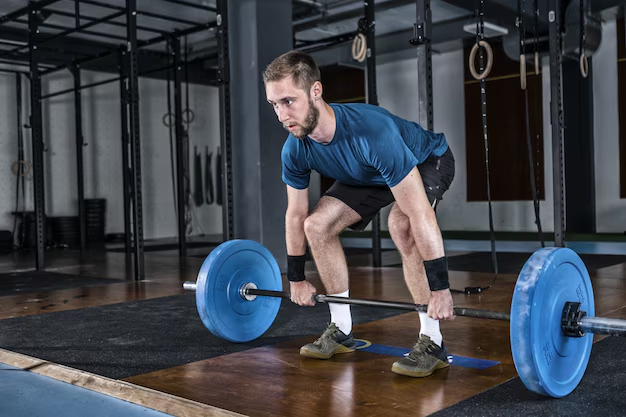
Dr. Andrew Bach, a physical medicine and rehabilitation specialist in Los Angeles, says that due to performance errors, such as spinal misalignment, poor hip movement, and overload; Deadlifting can generate high compressive forces on the lumbar spine, exposing it to the risk of injury, “especially at its lowest levels, where the fourth lumbar and first sacral vertebrae are.”
advertisement
Also, the deadlift does not have to be done incorrectly to be dangerous, and as spine surgeon Dr. Emily Mills explains, even when this type of exercise is done correctly, it is still very dangerous for the spine. “The forces acting on the cartilaginous discs of the lumbar spine exceed the safe limit, after lifting about 54 kilograms.”
For greater safety when performing the deadlift exercise, experts recommend using the Trap Bar, as it is “more suitable for the spine, allows a straighter position of the torso, reduces torque on the lumbar spine, and makes it easier for most people to maintain a straight spine,” according to Andrew Bach.
Emily Mills also recommends pelvic raises, or hip raises; As a healthy option, it is “safer for the spine than the deadlift, and works the same muscles.”
Pull the latissimus dorsi muscle behind the neck
It is an exercise that forces the neck to bend sharply under weight, which stresses the cervical cartilage discs that act as cushions between the neck vertebrae and the shoulder joint. The cervical spine is not designed to absorb heavy downward pressure in this position, “which makes nerve compression and cartilage damage a real risk over time,” Okobadejo says.
It is recommended to try pulling the latissimus dorsi muscle “from the front”, by pulling the bar up to the chest while tilting the back slightly, as a safer alternative.
Back squat with weights incorrectly
This exercise is very effective, but it may also be dangerous, because it may cause excessive pressure on the spine. It is a pressure that many may bear, but its danger increases “when the depth of the squat is very low, or when there is an excessive tilt of the torso forward, or when it is not possible to maintain a neutral position of the spine, which increases the pressure on the posterior elements and the discs between the vertebrae,” according to Bach.
To avoid any damage, Bach suggests the goblet squat, or squatting with a single dumbbell or kettlebell to help “keep the back straight.”
Wrong squat
Squats in all their forms, from deep, goblet, and sumo to wall and pistol, are considered one of the best exercises for the lower half of the body. But it may be dangerous for your spine when performed incorrectly, especially the deep and posterior types. According to Emily Mills, damage is more likely “when you don’t keep your back straight and arched, use heavy weights, or raise the bar too low.”
So, be encouraged to try stair climbers with weights, or reverse lunges; As a safer alternative, it “works the same muscles without putting pressure on your spine.”
Sitting on contortion machines
Sitting on a machine that allows you to twist back and forth may seem fun, “but your spine won’t be happy about it,” Okobadjo says. He explains that the lumbar spine is not designed to rotate under resistance, which makes doing this exercise a source of risk of “rupturing cartilage discs.”
Okobadjo recommends the Pallof Press as a safer alternative, where you pull a metal bar straight out from your chest and resist the pull, training your torso muscles to resist rotation, “rather than forcing it to twist.”
advertisement
Hamstring stretching exercise by touching your toes while sitting
Andrew Bach says that although sitting hamstring stretches are popular, “there is a risk of them being dangerous,” as those who do them tend to “arch the lower back, which increases pressure on the front and back cartilage.”
It often results in a “lumbar hunched over”, rather than properly lengthening the hamstrings; Which may contribute to “irritation of the cartilage or exacerbation of existing diseases.”
Alternatively, Bach suggests, “lying hamstring stretches,” using a belt or elastic band; As a safer alternative to “target lengthening of the hamstring muscles, while keeping the spine straight.” In addition to “the ability to bend the hip, without forcing the lumbar vertebrae to bend.”
Running long distances and high speeds for non-professionals
Resistance exercises are not the only ones that may cause spinal pain. Aerobic exercises (cardio) may also cause them, says Emily Mills, explaining that “running may be safe, but long distances and high speeds for non-professionals may cause repetitive pressure on the lumbar vertebrae and lower back.”
This pressure builds up over time, and may lead to “cartilage erosion, causing lower back pain and sciatica-like symptoms,” especially for people with no family history of lower back problems. Emily Mills believes that the safest alternative in this case is swimming, cycling, or using the elliptical exercise machine, which is a fixed device that combines movements similar to walking, running, and climbing stairs.