Published on 6/27/2026
Only a few days after the start of the 2026 World Cup, questions began to grow about the way the Video Assistant Referee (VAR) system was implemented, before within one week those questions turned into a state of confusion among fans, players and even analysts, due to a series of controversial decisions.
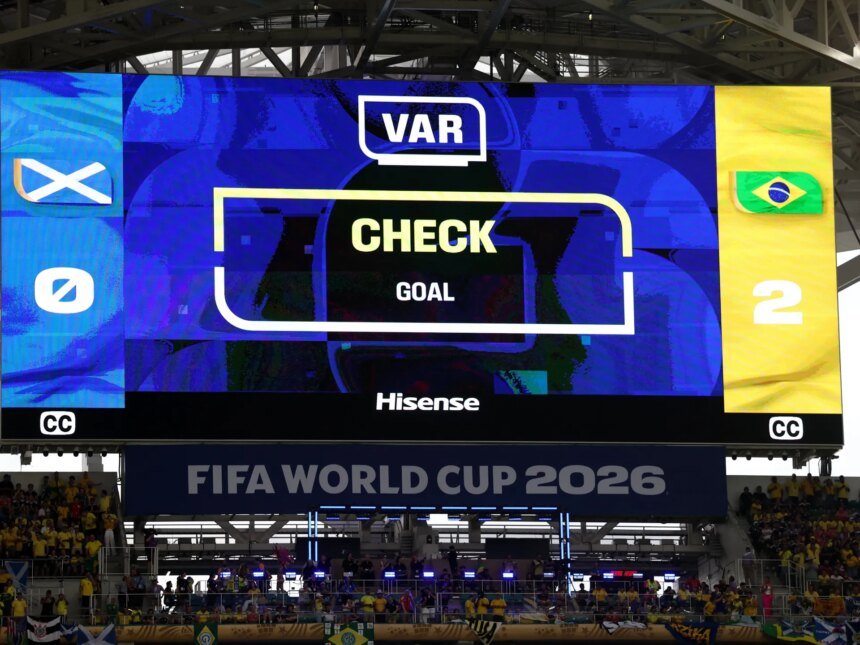
From the penalty kick that Ghana called for against England, to the disallowed goal for Brazil against Scotland, through to Germany’s opening goal against Ecuador, it seemed difficult to predict when the VAR would intervene and when it would be content with silence.
Read also
list of 2 itemsend of list
Despite this controversy, the numbers do not indicate a significant difference compared to the English Premier League. In the last season of the Premier League, the average VAR intervention amounted to about 0.29 times per match, compared to 0.28 in World Cup matches so far.

As for cases in which the referee had to review the shot himself via the side screen, the English Premier League recorded an average of 0.15 reviews per match, compared to 0.17 in the World Cup.
But the continuation of the tournament once again revealed how difficult it is to maintain consistent standards in the use of technology, especially with the difference in assessment of cases between referees.
The head of the FIFA Referees Committee, Pierluigi Collina, believes that football is a game that depends on contact, and that not every contact requires a violation. He also seeks to make World Cup matches faster and more streamlined, which forces video referees to adapt to this approach.
However, this trend makes defining the concept of a “clear and clear error”, which requires the intervention of VAR technology, more complex, and it is a dilemma that the English Premier League has also suffered over the past years.

In contrast, other tournaments adopt less stringent standards for video referee intervention, which leads to a greater number of reviews and gives fans a greater sense of consistency, albeit a departure from the original philosophy of the technique, which is based on correcting only major errors.
The Champions League is a clear example of this, with an average of 0.47 VAR interventions per match and an average of 0.36 screen reviews, much higher than the World Cup.
Handballs stand out as one of the most prominent examples, as the European Football Association (UEFA) adopts a more stringent interpretation, with less room for personal discretion, which makes VAR intervention more common when the ball hits a defender’s arm.
Decisions that sparked controversy
The wave of criticism began on Tuesday, when Ghana’s coach, Carlos Queiroz, confirmed that “the VAR technology went for coffee” after it ignored awarding a penalty kick to his team against England following an intervention by Ezri Konsa on Prince Kwabena Addo, in the match that ended in a goalless draw.
Many considered that the intervention was reckless and deserved a review by the video referee, which made the lack of intervention surprising.
The next day, Brazil had a goal disallowed during its 3-0 win over Scotland due to a foul called on Vinicius Junior on Jack Hendry. Observers believed that the decision this time came according to more stringent standards, although the shot suggested that Hendry was the one who collided with the Real Madrid striker.
Former international assistant referee Darren Cann said on the “Match of the Day” program: “There was a little contact before the ball was played, but I do not think it rises to the level of a violation.”
The controversy continued after Germany’s 2-1 loss to Ecuador.
Leroy Sane’s goal was awarded even though his teammate Aleksandar Pavlovic’s high shoe hit Pedro Vitti’s head, in a shot that many considered to require VAR intervention, but referee Tore Benso maintained his decision.
Former English goalkeeper Joe Hart said on the “Match of the Day” program: “Every player watching the tournament will immediately say that this intervention put the opponent in danger. It is a high shoe and a clear mistake. I think the decision was wrong.”

Immediately after the start of the second half, the referee awarded a penalty kick in favor of Germany after Kai Havertz fell after interference from Joel Ordonez.
But this time, the video referee, Joe Dickerson, intervened and informed the referee of a violation committed by Leroy Sane against Pedro Vitti in the middle of the field, so the penalty kick was cancelled.
Although the decision can be justified separately, especially since Viti appeared to have exaggerated the fall, the comparison with ignoring Pavlovic’s shot raised major questions about the consistency of standards.
Some even believed that the video referee may have tried to compensate for the previous error, but awarding a violation in one shot and ignoring another similar one seemed difficult to explain.

Do the big teams benefit?
Despite the abundance of controversy, the major teams were not greatly harmed by the video reviews.
The disallowed goal for Brazil and the penalty kick for Germany are the only two cases in which VAR decisions were against one of the favorites to win the title.
On the other hand, France did not get a penalty kick against Senegal after Sadio Mane intervened on Kylian Mbappe, even though the video referee recommended that it be awarded, before the main referee refused.
This decision also raised the astonishment of a large number of observers, reinforcing the impression that there was a clear discrepancy in the application of standards.
Pierluigi Collina, who supervises a team of 30 video referees working from the operations center in Dallas, finds himself facing a challenge to restore confidence in how the technology works.
Since the introduction of VAR technology, the constant slogan has been “less interference… for greater benefit,” but the application of this principle remains dependent first on the correctness of the decisions taken by the arena’s referees.
The more accurate the field decisions are, the less the role of video technology becomes. As for the recurrence of controversial cases, the policy of minimal intervention becomes more difficult, which seems clear in the World Cup so far.