Published on 6/27/2026
|
Last update: 02:09 (Mecca time)
It appears that the strikes carried out by American forces on Friday evening against some Iranian targets do not target further military escalation because they represent an application of the principle of an eye for an eye, according to military expert Colonel Nidal Abu Zeid.
The US Central Command announced the implementation of strikes against Iranian targets on Sirik Island near the Strait of Hormuz, and said that this was in response to the Revolutionary Guard targeting a commercial ship last Wednesday.
These strikes – according to the US Central Command – targeted missile and drone storage sites and coastal radar sites, and the Revolutionary Guard announced that it had responded to these attacks, which it said affected two watchtowers.
This is not the first time that Serik has been struck, but the targets that were announced are considered to be of high military value, according to what Abu Zeid said in an analysis for Al Jazeera.
High value goals
The observation towers on this island direct drones, while coastal artillery strikes targets at a distance of up to 40 kilometers, which means it can reach the location of the ship, which the Revolutionary Guard has neither confirmed nor denied responsibility for striking, according to the military expert.
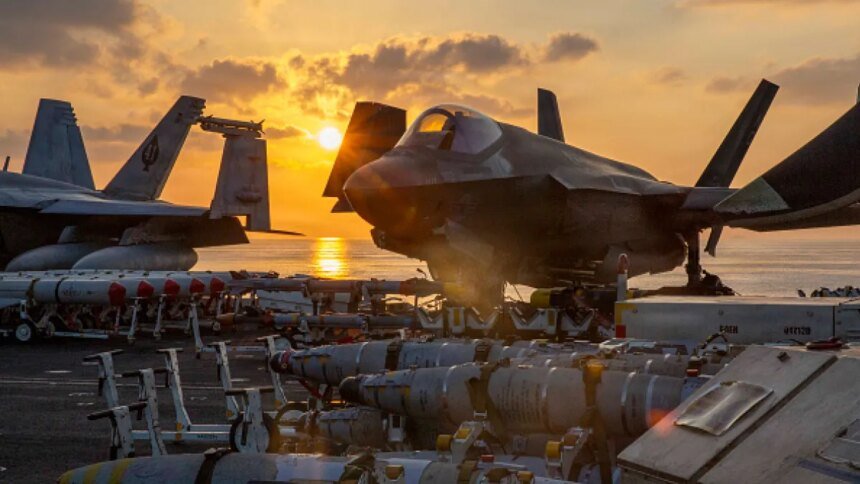
The attack was carried out from inside the aircraft carrier Abraham Lincoln, which is 250 kilometers away from Iranian shores, which means, in Abu Zeid’s opinion, that its movement on Thursday was operational and not routine.
An American official told Fox News that the military operations against Iran ended tonight, which reflects that the United States does not want further escalation and that it is applying the principle of an eye for an eye, according to Abu Zeid.
Limited escalation
It can be said that this new escalation is still limited to a certain ceiling, but the American talk about the end of operations means that the ball is now in the court of the Revolutionary Guard, which said that it will respond to this violation at the appropriate time and place.
The American strikes came after US President Donald Trump spoke about the Iranians targeting a commercial ship on the new route provided by the Sultanate of Oman in the Strait of Hormuz.
Information indicates that the American strikes targeted targets in the Taheravi area in the city of Sirik, which includes communications and surveillance towers and short-range coastal missile launch pads. Suhaib Al-Assa said on an interactive screen that they can strike any target in the Strait of Hormuz.
The US Central Command said that Iran’s dangerous behavior “undermined freedom of navigation in light of the increasing flow of trade through the Strait of Hormuz,” and that its forces “continue to provide support and coordination to secure the passage of commercial ships through the Strait.”
The ball is in Iran’s court
The Revolutionary Guard had warned against using any alternative routes in the Strait of Hormuz, and said that any route outside the routes identified by Iran “would be dangerous.”
The New York Times quoted an American official as saying that the American strikes came in response to Iran’s attack on a commercial ship, and not a resumption of large-scale combat operations.
The Revolutionary Guard is expected to respond to these strikes, according to Abu Zaid, who said that Iran is accustomed to always responding, and that the question currently revolves around the place and method of response.
The Revolutionary Guard may respond to the American aircraft carrier from which the strikes were launched, and then the escalation will be limited and the escalation will end, but this will not be the case if Iran targets Arab countries or perhaps Israel, as the military expert says.