While cargo ships were resuming crossing the Strait of Hormuz after the recent memorandum of understanding, an unknown missile hit a cargo ship off the coast of Oman, shuffling the cards again.
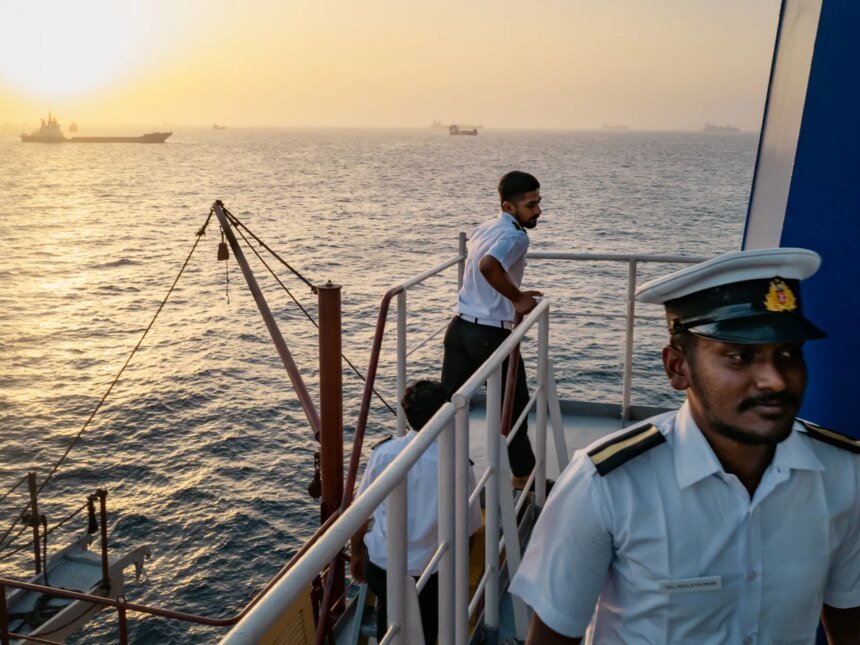
This sudden incident prompted the International Maritime Organization to suspend its urgent plans to evacuate more than 11,000 stranded sailors, leaving maritime tensions suspended amid unresolved concerns.
The latest attack has heightened concerns that tensions over navigation through the strait remain unresolved. Here are the details of what happened:
What are the scenes behind the recent attack and the political differences that sparked it?
In a surprise move, IMO Secretary-General Arsenio Domínguez announced that several crew members had already been evacuated, but the agency decided to temporarily halt the operation until the “necessary security guarantees” were in place for its participants.
The decision came after the UK Maritime Trade Operations Authority, a maritime security agency of the Royal Navy, said on Thursday that a cargo ship had been hit by an “unidentified projectile” about 7.5 nautical miles (14 km) southeast of the Omani coast of Daht. There were no injuries.
This incident comes despite a memorandum of understanding signed by the United States and Iran last week that ended hostilities and included provisions aimed at reopening the strategic waterway.
Iran imposed restrictions on passage through the strait in early March after the United States and Israel attacked it on February 28. In April, the United States imposed a naval blockade on ships linked to Iran trying to pass through the waterway.
Since the signing of the memorandum of understanding, commercial traffic through the strait has resumed, but major disagreements remain over which transit routes ships should use and whether Iran has the right to impose transit fees or taxes.
Oman and the International Maritime Organization have proposed a new shipping lane that would partially bypass waters under Iran’s direct control. Tehran rejected the plan, saying it was announced without consultation and raised safety concerns while mine clearance operations were still underway.
Although Iran did not claim responsibility for Thursday’s attack on the ship off Oman, it did not deny any role in the incident.

What prompted the United Nations to evacuate the sailors and how?
Following the outbreak of the US-Israeli war on Iran on February 28, Tehran and Washington imposed mutual restrictions on the passage of ships through the Strait of Hormuz, leaving thousands of sailors unable to leave ships trapped in the waterway.
More than a dozen sailors were also killed in attacks on ships, some with American missiles and others with Iranian missiles, and most of the dead were from India.
Even with the agreement reached last week between Washington and Tehran to end the conflict, more than 11,000 sailors are still stranded in the strait.
Announcing the evacuation plan on Tuesday, Dominguez said the operation would take place in “close cooperation with Iran, Oman, all other coastal countries in the region, the United States and the maritime industry.”
The Omani Ministry of Defense said that the operation, which had been under discussion for months, would be implemented in stages.
Denmark also announced on Tuesday that it would join a multinational naval mission led by France and Britain to help restore safe navigation through the strait.

Why was the ship attacked?
The Singapore-flagged cargo ship Ever Lovely was hit by what authorities described as an “unidentified projectile” while transiting the Strait of Hormuz on Thursday.
Ship tracking data from MarineTraffic revealed that the ship was following the southern shipping route proposed by the International Maritime Organization earlier that day, a corridor that passes near the Omani coast and was rejected by Iran.
The Ports and Maritime Authority of Singapore said that the ship has since completed its crossing of the strait and is continuing its journey, adding that all 21 crew members are fine.
The authority described the attack as “unjustified, indefensible and a violation of international law,” and said it was “deeply concerned.”
It called for all measures affecting international shipping to comply fully with international law, especially the United Nations Convention on the Law of the Sea, and not to jeopardize the safety of sailors and ships at sea.
The incident prompted the maritime organization to suspend evacuation plans for the stranded sailors, and Dominguez said the Ever Lovely ship “did not transit under the IMO evacuation framework.”
He added: “I have always reiterated that the safety of seafarers remains of paramount importance. Therefore, to ensure a coordinated approach and safe navigation, the evacuation plan will be temporarily suspended until further clarity is obtained.”
What did Iran do?
Although it is still unclear whether the attack was carried out by Iran due to the absence of any official statement denying or confirming this, the Revolutionary Guard had criticized the new shipping corridor announced by Oman and the International Maritime Organization, and warned that passage through the strait “is only possible via the routes announced by Iran,” according to what the Iranian state radio and television corporation reported.
Iranian Deputy Foreign Minister Kazem Gharibabadi said that safe passage through the Strait of Hormuz cannot be guaranteed for ships that pass through “vague arrangements, parallel routes, or making decisions outside the scope of Iran’s considerations as a coastal state.”
He said in a statement on the
Before that, Iran had first published its own map of approved shipping routes in April, directing ships to sail much closer to the Iranian coastline than before the conflict.
The Iranian Revolutionary Guards’ latest warning came after an oil tanker flying the Liberian flag crossed the strait on Thursday, using a route closer to the Omani coast.
On Friday, three more foreign oil tankers that attempted to cross the Strait of Hormuz “without authorization” were forced to turn back after a warning from the Iranian Revolutionary Guard, Iranian state television reported.
Analysts say that control of the Strait of Hormuz has long been one of Tehran’s most important sources of strategic influence, allowing it to exert pressure on the United States, whose economy is inextricably linked to global markets.
Why was the evacuation suspended?
Most likely, the halting of the evacuation is due to fears that Iran will implement what it says, as Al Jazeera English correspondent Rasoul Sardar Atash believes that Iran is ready to implement its warnings, especially after insisting on the need to coordinate with it when crossing the Iranian path or the proposed Omani path.
He said: “Yesterday, Oman announced new routes for the passage of ships. But then the Iranian Revolutionary Guard issued a statement saying that whether ships pass through Iranian or Omani territorial waters, they need full coordination with the Iranian authorities.”
Atash confirmed that a tanker was attacked with some projectiles in the Strait of Hormuz, and the Revolutionary Guard did not claim responsibility for the attack, but did not deny it.
What other differences remain?
Under the memorandum of understanding signed last week, Iran agreed that it “will make arrangements and make every effort to ensure the safe passage of commercial ships without any fees, for a period of only 60 days, from the Arabian Gulf to the Sea of Oman and vice versa.”
Although the agreement stipulates the necessity of resuming commercial activity immediately, it also recognizes that mines planted during the conflict must be removed first, noting that “mine clearance operations by the Islamic Republic of Iran will begin within 30 days.”
The agreement also provides for discussions between Iran, Oman and other Gulf states regarding future arrangements for managing navigation through the waterway. However, the agreement does not specify what will happen after the initial 60-day period.
Last week, Tehran announced that it would waive any transit fees during those 60 days while negotiations with the United States continue in Switzerland, raising the possibility of imposing fees if a broader agreement is not reached.
Iran’s chief negotiator, Mohammad Bagher Qalibaf, also hinted that Tehran does not intend to return to the situation that prevailed before the war.
“Hormuz will never return” to the way it operated before the conflict, he said. This proposal faced resistance from the United States and several Gulf countries.

Are ships still moving through the strait?
Commercial shipping has gradually resumed, although traffic remains well below normal levels, which had reached between 120 and 140 ships per day, before the outbreak of war.
According to figures from marine analytics company Kpler, 54 verified commercial or energy-related ships crossed the strait on Thursday, down from 70 verified crossings the day before.
Kepler added: “Movements dominated from west to east, while the Omani route accounted for the largest share of the identified corridors. However, the transparency of the route is still incomplete, as many dark or unknown crossings have been recorded.”
The company continued: “The reported missile strike on a cargo ship southeast of Dahit, Oman, adds new operational risks, underscoring the gap between improving material flows and still fragile maritime security conditions.”