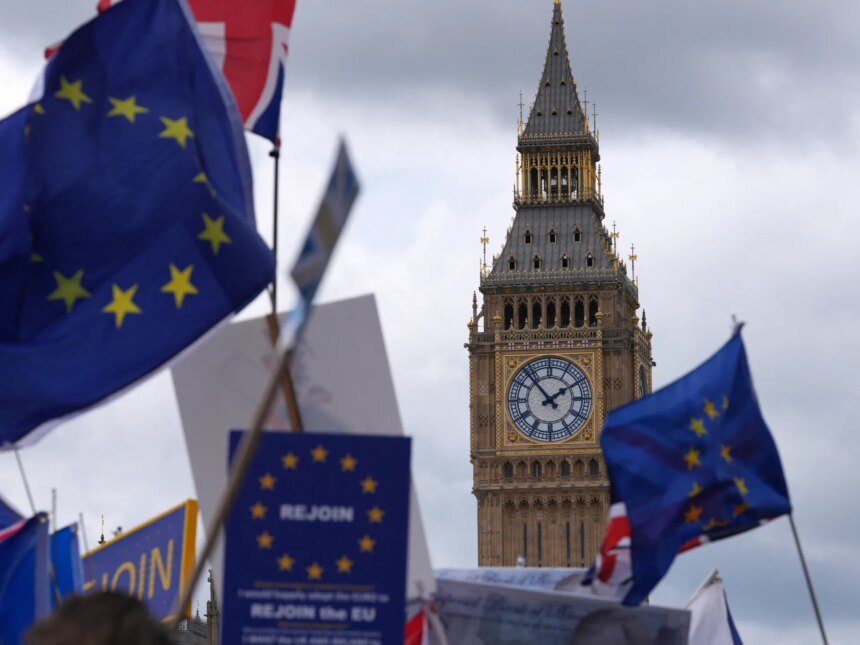
Ten years after the referendum to leave the European Union, the question is no longer limited to the cost of Brexit on Britain, but rather extends to the outcome of the experience for the European Union itself: Did it lose an irreplaceable economic partner, or did it succeed in redistributing part of the activities and financial weight within the continent?
The data reveal that the answer is not conclusive. The European Union did not emerge a net winner, but it also did not suffer a catastrophic economic shock like the one that befell the United Kingdom. The Union lost a partner that represented great economic, financial and political weight, but in return it absorbed the shock and redistributed part of the financial and investment activities within the continent, especially towards Paris, Frankfurt, Amsterdam, Dublin and Luxembourg.
Read also
list of 3 itemsend of list
Data from the British House of Commons Library indicate that
- In 2025, the European Union remained the United Kingdom’s most important trading partner, accounting for 41% of its exports and 50% of its imports.
- Britain’s exports to the Union amounted to 384 billion pounds, compared to imports from the Union worth 472 billion pounds, and a British trade deficit of 88 billion pounds.
- British goods exports to the EU in 2025 will decline by about 14% in real terms compared to 2019.
- Services exports to the Union rose by 28% during the same period.
This disparity between goods and services reflects the essence of the impact of Brexit, as trade between the two parties did not close, but it became more expensive and complex. The absence of customs duties did not prevent the emergence of non-tariff barriers, such as documents, rules of origin, border checks, and truck delays, which were factors that particularly weakened trade in goods, while British services were able to maintain greater flexibility.
European economic affairs researcher Rayan Rasoul believes that the outcome for the European Union is “mixed and fluctuating,” and leans slightly toward a marginal long-term loss, but it remains limited compared to what he described as the “real economic devastation” that befell the United Kingdom.
During his talk to Al Jazeera Net, Rasoul based this on estimates indicating that the British gross domestic product is about 6% to 8% lower than it would have been without Brexit, with a decline in investment, productivity and employment.
As for the professor of economics and international relations, Al-Sari believes that everyone is a loser, but to varying degrees. Britain lost more due to lower growth and investment and higher exchange costs, while some European capitals achieved sectoral gains, but they did not fully compensate for London’s loss as part of the single market.

Commercial complications
At the trade level, the damage was most evident in goods. The return to border procedures has raised the cost of exchange, especially for small businesses and intertwined supply chains in sectors such as automobiles, food, and industrial components.
Al-Sari pointed out in an interview with Al-Jazeera Net that companies that were supplying each other across the British-European border found themselves facing a new system of inspection and documents, after decades of free movement within the single market.
However, the European Union was not the most affected party. The European market is broader and more capable of redirecting trade, while Britain lost smooth access to a market that includes hundreds of millions of consumers, which prompted economic analyst Muhammad Ghazi Al-Marwah to confirm – in an interview with Al Jazeera Net – that Britain’s losses were greater, while the impact of Brexit on the Union remained “relatively limited and distributed between losses and gains.”
Data for the year 2025 show that the British deficit with the Union was concentrated in goods, as Britain exported goods to the Union worth 181 billion pounds sterling (about 244 billion dollars), and imported goods from it worth 318 billion pounds sterling (about 429 billion dollars), with a goods deficit amounting to 137 billion pounds sterling (about 185 billion dollars), while it achieved a surplus in services amounting to 49 billion pounds sterling (about 66 billion dollars).
Financial transfers
Financial services have been the most visible area in which some European cities have benefited. After Britain left the single market, financial institutions in London lost the right to operate automatically within the union, which prompted banks, asset management and insurance companies to transfer licenses, work teams and assets to within the continent.
Rayyan Rasoul considered that the union’s actual gain appeared here specifically, with the transfer of part of the assets of the British banking sector and tens of thousands of jobs to alternative European centers. But he asserts that what happened was not the birth of a “new London” within Europe, but rather the “fragmentation of financial centers,” as activities were distributed between Paris, Frankfurt, Dublin, Luxembourg, and Amsterdam.
Al-Marwah agrees with this assessment, as he says that Paris, Frankfurt, and Amsterdam partially succeeded in seizing some of the activities that were based in London, but they did not achieve the large gain that many expected after the referendum. As for Al-Sari, he believes that France and Germany benefited from the transfer of some financial decision-making centers, but he stresses that these sectoral gains did not turn into broad European profits.
City of London Corporation estimates indicate that British financial institutions have transferred about 40,000 jobs to European financial centers after losing what is known as “Financial Passporting Rights,” which allowed companies operating in Britain to provide their services freely within European Union countries. These jobs were distributed between Paris, Frankfurt, Dublin, Luxembourg and Amsterdam.

Limited gains
In the investment portfolio, the picture is more complex. Brexit caused some companies that were based in Britain as a gateway to the European market to move their headquarters or expand their presence within the union. But this was not enough to compensate for the loss of Britain as a huge investment attraction within the single market.
Rayan Rasoul pointed out that before the exit, the United Kingdom had a large share of acquisitions and foreign establishment projects within the European market, and that the decline in investments flowing from Britain to the Union meant that the Union did not fully compensate for what it lost in this relationship, but on the other hand, he spoke of smart internal transformations, as countries in Eastern and Southern Europe benefited from the redistribution of some investments, such as Spain, Poland, and Italy.
As for Al-Marwah, he believes that the attractiveness of the European Union to foreign investors has improved relatively, because some investments that were heading to Britain as a gateway to Europe are now heading directly to the countries of the Union, but he describes this improvement as gradual and limited, and not a radical transformation.
Although some European countries benefited from the transfer of part of investment activities after Brexit, the continent as a whole faces broader challenges in attracting foreign capital.
According to the European Investment Attractiveness Survey issued by Ernst & Young (EY), the number of new foreign investment projects in Europe declined by 7% during the year 2025 to 5,026 projects, the lowest level recorded in 11 years, in an indication of increasing investor caution towards European markets.
The data shows that
- France maintained its position as the largest destination for foreign investment in Europe despite the decline in the number of projects by 17% to 852 projects.
- Followed by the United Kingdom with 730 projects, a decrease of 14%, then Germany with 548 projects after a decrease of 10%.
- On the other hand, Spain, Turkey and Poland emerged among the European countries most capable of attracting new investments, which reflects a gradual shift in the investment map within the continent.
Data from the United Nations Conference on Trade and Development (UNCTAD) also indicate that foreign direct investment flows to Europe declined by about 58% in 2024 to reach only $182 billion, compared to $439 billion in the previous year, at a time when Asia and North America continued to attract a larger share of global capital.

Transfer of competencies
In the labor market, Brexit ended freedom of movement between Britain and the Union, so a portion of European workers left the British market or their interest in it declined.
Rayan Rasoul points out that the probability of a European worker choosing Britain as their next destination has clearly decreased, which has allowed continental labor markets to attract some talents who were historically heading to London.
But the European gain here is also relative, as the transfer of labor and competencies does not necessarily mean creating a large net value for the union, but rather reflects an internal redistribution of human capital.
On the other hand, Britain faced a shortage in some sectors, and replaced part of European immigration with immigration from countries outside the Union, especially in health, education, and services.
Migration data supports this shift, as the Oxford University Migration Observatory estimates that since 2022, more EU citizens have left the United Kingdom than have arrived.
- Net immigration of Europeans reached (minus 70,000) people during the year ending in June 2025, after about 155,000 European citizens left the country, while only 85,000 entered.
- The number of EU nationals residing in the UK fell by around 162,000 between mid-2021 and mid-2025 as a result of negative net migration.