Published On 4/23/2026
|
Last update: 15:31 (Mecca time)
Indonesian Finance Minister Purbaya Yudi Sadoa announced that his country plans to establish a system to collect fees from ships passing through the Strait of Malacca.
This came in statements he made yesterday, Wednesday, according to the Jakarta Globe newspaper, where he explained that his country is located on a vital path for global trade and energy, and despite this, it does not collect fees from ships passing through the strait.
He pointed out that Indonesia intends to implement this system in coordination with neighboring countries, within the framework of President Prabowo Subianto’s vision to enhance the country’s role in global trade.
He added that the plan is still in its preliminary stages, and may not be implemented soon, given the difficulty of reaching an agreement with the countries neighboring the Strait and the possibility of provoking reactions.
Opinion of neighboring countries
On the other hand, Singaporean Foreign Minister Vivian Balakrishnan said that the war is in… The Middle East Highlighted the importance of vital sea crossing points.
He added, according to what was reported by CNBC, that the right of passage is guaranteed to everyone, stressing that his country will not participate in any efforts to close or obstruct passages or impose fees on passing ships.
Malaysian Defense Minister Khalid Noordin also ruled out that the Strait of Malacca would face a similar situation To the Strait of HormuzEspecially considering that 80% of imports China of energy passes through the strait.
Nour El-Din said, in a previous statement to Al Jazeera Net, that the environment is different between the Straits of Hormuz and Malacca, referring to the sanctions and pressures it is exposed to. IranHe added: “I believe that Malaysia, Indonesia and Singapore do not face the same conditions that Iran faces, and therefore there is no reason for the Strait of Malacca to face the same situation, and the three countries adopt the principles of United Nations “Including freedom of commercial movement and navigation in the region.”

Following in Iran’s footsteps
The closure of the Strait of Hormuz has forced policymakers in Asia to confront questions about the security of other straits, including the Strait of Malacca.
The American-Israeli war on Iran once again highlighted the fact that the global economy moves not only through factories and financial markets, but also through narrow waterways that shorten distances and determine the cost of trade and the flow of energy and goods.
After the closure of Iran To the Strait of HormuzTraffic was disrupted in one of the most important oil and gas arteries in the world. The discussion about straits and maritime canals returned to the forefront, not only as geographical crossings, but as ruling nodes in the structure of global trade.
It seems that the Iranian move has begun to lead other countries, such as Indonesia, to take similar steps in the Strait of Malacca.
China may also extend its hand to the Strait of Malacca to expand its maritime influence, or become liberated Türkiye From the Montreux Agreements through the “Canal” project Istanbul“To create a corridor outside the existing frameworks, Ansar Allah (the Houthis) may seek to impose paid censorship in… Bab al-Mandab.
If such a precedent is achieved, it may be difficult to stop the restriction of freedom of maritime navigation that has remained quiet for decades thanks to international understanding to ensure the flow of goods and movement.
Strategic importance
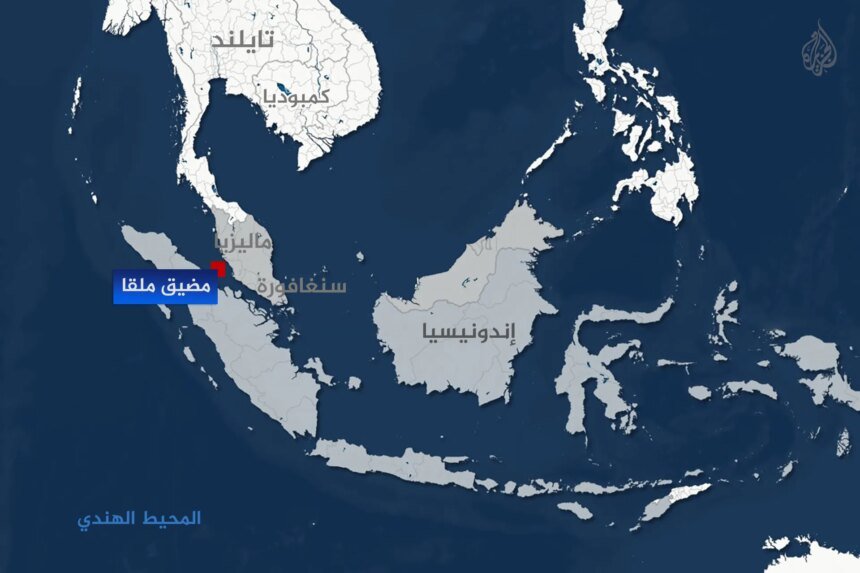
The Strait of Malacca, which is about 900 kilometers long, is located between Indonesia, Malaysia and Singapore, and connects the Indian Ocean. In the South China Sea. The three countries share supervision of it, and it is one of the busiest corridors in the world.
The Center for Strategic and International Studies estimates that about 22% of global maritime trade passes through this strait. This includes oil and gas shipments from the Middle East to the energy-hungry economies of China, Japan and South Korea, the world’s largest narrow waterway by oil transit volume.
In the first half of 2025, about 23.2 million barrels of oil per day passed through this strait, representing 29% of total seaborne oil flows. As for the Strait of Hormuz, it ranks second, as it witnessed the passage of about 20.9 million barrels per day.
The Strait of Malacca is also considered the shortest sea route between Middle Eastern suppliers and importers in Asia.
Data issued by the Maritime Administration in Malaysia showed that more than 102,500 ships, most of them commercial ships, crossed the Strait of Malacca in 2025. These ships include most oil tankers, but some giant ships avoid the strait due to draft restrictions and take an alternative route south of Indonesia.
This route allows the Strait of Malacca to be bypassed if it is closed, but it increases the journey time, which could delay shipments and raise prices.
Fears
The width of the Strait of Malacca does not exceed about 2.7 kilometers, which constitutes a natural obstacle, in addition to the possibility of collisions, grounding, or oil leakage.
Some parts of the strait are also relatively shallow, with a depth ranging between 25 and 27 metres, which imposes restrictions on the passage of larger ships, but even giant crude oil tankers that are more than 350 meters long, more than 60 meters wide, and have a draft of more than 20 metres, can pass.
Over the years, the Strait has been subjected to acts of piracy and attacks on commercial ships. The Information Exchange Center of the Regional Cooperation Convention to Combat Piracy and Armed Robbery against Ships in Asia, an organization established by the governments of the region, stated that last year witnessed an increase in criminal attacks to reach at least 104, but they decreased in the first quarter of this year.
The Center for Strategic and International Studies notes that the Iran crisis has highlighted long-standing concerns about how important straits such as Malacca would be affected if a conflict broke out in the South China Sea or the Taiwan Strait, where 21% of global maritime trade passes.
Authorities in Malaysia say the Strait of Malacca has also become a growing hotspot for illegal ship-to-ship oil transfers, where oil is transferred between oil tankers at sea to conceal its source.