Published On 11/5/2026
|
Last update: 13:28 (Mecca time)
“Project Freedom Plus” is defined as an expanded version of the previous American “Project Freedom”, which was limited to escorting commercial ships in the Strait of Hormuz and responding defensively when under direct attack.
The fundamental difference between the two versions lies in:
- America has shifted from a policy of protection to a policy of pre-emptive strikes, according to US military estimates.
- “Freedom Plus” would involve destroying Iranian threat platforms before they launch an attack.
- Expanding the scope of protection to include greater distances in the Gulf and the Arabian Sea.
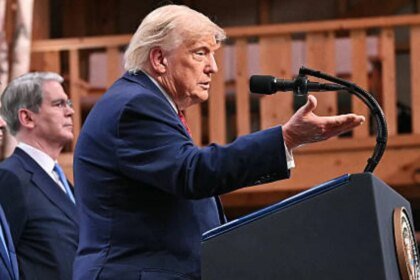
President Donald Trump’s proposal for this project comes amid an unprecedented navigation crisis in the Strait of Hormuz, where Kepler data reveal that ship movement has almost stopped.
Navigation did not record any ship crossing on the 7th and 8th of May, before only two ships crossed on the 9th of the same month, as one of them headed from Brazil to the Iranian port of Imam Khomeini, and the other left the strait to Pakistan.
According to American estimates, between 1,500 and 2,000 ships are currently stuck in the Gulf waters, while the US Central Command announced that it has redirected the course of 58 ships and disabled 4 other ships since the start of the port blockade. Some ships have also been targeted, in an indication that the entire Gulf region has turned into an undeclared arena of friction.
Greater escalation
According to a report prepared by journalist Ahmed Val Ould Eddine for Al Jazeera, the US President’s talk about the “Freedom Plus Project” reinforces his country’s move from a circle of protection to a circle of more escalatory management in the event that negotiations fail.
This falls within a military positioning led by aircraft carriers in the Arabian Sea, destroyers equipped with air defense systems, and reconnaissance aircraft and drones that do not leave the sky. The new project aims to deter Iran by threatening it with quick and advance strikes.
On the other hand, Ould El-Din explains that Iran is moving to redraw the rules of engagement on its part, as it strengthens its military presence with difficult-to-detect submarines, fast speed boats, and suicide drones.
These unconventional weapons aim to maintain pressure on American forces in the region without entering into an open confrontation, exploiting the nature of the shallow waters of the Strait of Hormuz and the passage’s congestion with civilian ships.
Cable weapon
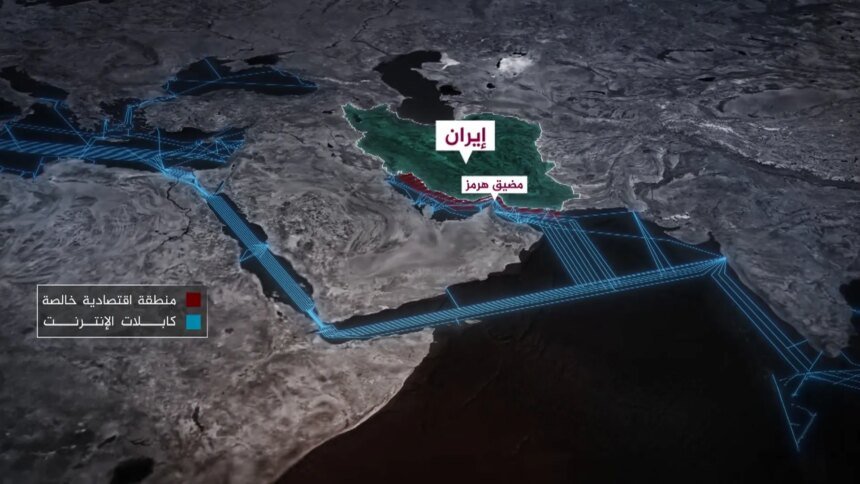
In contrast to the direct military escalation, media outlets close to the Iranian Revolutionary Guard are discussing a completely new idea, related to Tehran imposing fees on submarine cables extending at the bottom of the waters of Hormuz, which are fine fiber-optic cables coated with layers of steel, plastic, and copper to ensure the flow of the Internet. These cables constitute approximately 97% of the entire region’s communications, making them a vital digital artery.
The cables passing through the bottom of the Gulf also transmit about 30% of Internet traffic between Europe, Asia, and the Middle East, according to specialized estimates. In the same context, the pressure is no longer limited to oil tankers and their sisters only, but Iranian thinking has begun to extend to the digital infrastructure that crosses the bottom of the Gulf.
This threat, according to the report’s author, has enormous repercussions. Disrupting communications, the Internet, and finances on three continents, in a scenario that may be more painful than targeting oil itself, and opens a whole new front in the Hormuz conflict.
The American President had vowed to launch the aforementioned project if the negotiations with Tehran did not end according to what he hoped for.
The details of the “Freedom Project Plus” have not yet been fully revealed, which came after the cessation of the “Freedom Project,” which promised to liberate ships stuck in the Strait of Hormuz, while experts believe that it represents a development of the previous plan in Hormuz through the use of greater military force to impose control over the sea lanes.