Spain is witnessing an unprecedented escalation in a series of judicial investigations targeting figures close to Prime Minister Pedro Sanchez, turning into one of the most sensitive cases in recent years, sparking widespread controversy inside and outside the country, especially with the case reaching Sanchez’s wife, his brother, and a number of his most prominent former allies.
At the heart of this scene, accusations of corruption intersect with broader questions about the nature, limits, timing, motives, and impact of judicial moves on political stability in the country.
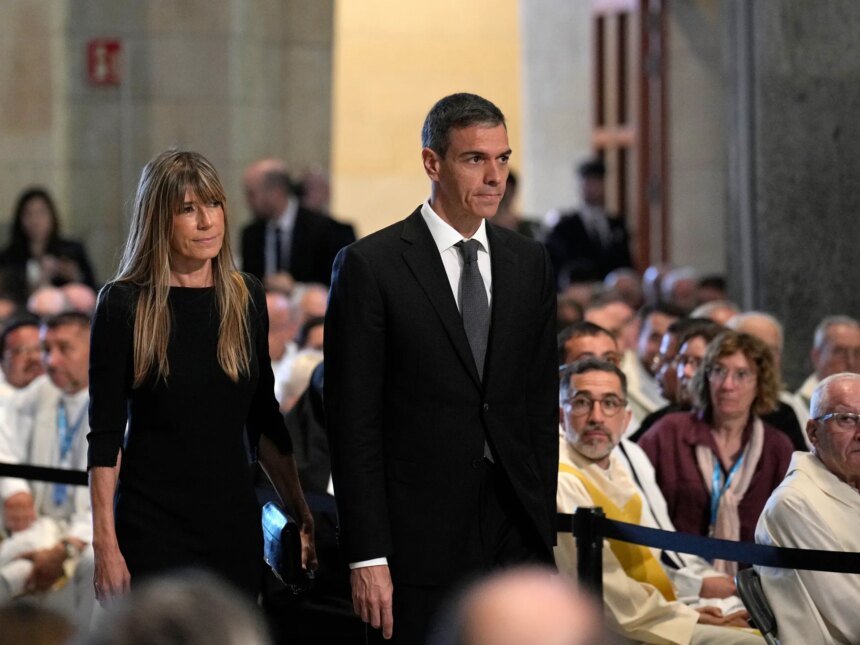
The case reached its peak this week with the issuance of a judicial decision preventing Begonia Gomez, the Prime Minister’s wife, from leaving Spanish territory, and obliging her to surrender her passport and appear before the court twice a month, as part of preliminary investigations related to suspicions of corruption and exploitation of influence.
The decision comes at a sensitive stage in the investigation that was launched more than two years ago, and aims to examine the nature of professional and academic connections in which she is suspected of benefiting from her position as the wife of the Prime Minister.
Suspicions of abuse of influence
The accusations against Gomez revolve around suspicions of exploiting influence in professional relationships linked to the Complutense University in Madrid, in addition to accusations about private companies benefiting from their proximity to the circles of power.
The charges presented in the initial file also include embezzlement, corruption in commercial transactions, and misuse of public funds, which she completely denies, while final judicial rulings have not yet been issued against her.
The investigations do not stop at the wife, as they extended to the Prime Minister’s brother and a number of his former aides, in the context of various files related to employment, contracts, and the management of public resources.
In a parallel context, a political and legal controversy was also opened regarding other political figures from within the socialist circle, including former Prime Minister Jose Luis Rodriguez Zapatero, against the backdrop of accusations related to lobbying activities on behalf of private parties, which he categorically denies.
In a remarkable development, the Spanish police entered the headquarters of the ruling Socialist Party last May, as part of a judicial investigation related to a plan suspected of aiming to influence the conduct of procedures related to issues affecting the government or the party.
Media reports said that the operation was conducted as an inspection of the party’s headquarters, while the Spanish Supreme Court explained that investigating judge Santiago Piedrath issued an order to obtain documents and electronic files from inside the headquarters.
This measure comes within the process of open judicial investigations, while the official channel RTVE described the operation as a “political earthquake” given its sensitivity and timing.

The struggle of the right and the left
A large part of these cases are based on complaints filed by the “Clean Hands” organization, a body that is widely classified within the Spanish political debate as a controversial judicial actor, whose name has previously been associated with filing lawsuits against public figures in cases of a political nature.
This has sparked widespread debate in Spain about whether what Whether these cases reflect a purely judicial effort to combat corruption, or are they being used as a tool in a political struggle between the right and the left.
As the case entered a more sensitive phase, additional controversy arose after the judge supervising the investigation decided to impose travel restrictions on Gomez, a move that government supporters considered draconian at this early stage of the proceedings, while supporters of the investigation saw as a precautionary measure linked to assessing the possibility of escaping justice.
An additional uproar arose after the General Council of the Judicial Authority decided to open a disciplinary process against the judge supervising the investigation, against the backdrop of statements that were considered offensive and unprofessional regarding the possibility of security personnel helping Gomez leave the country.
In the background of this internal scene, foreign policy factors overlap in shaping the image of the Spanish Prime Minister within the European debate.
Sanchez is considered one of the most prominent voices within the European socialist movement, and in recent months he has taken striking foreign policy positions, especially with regard to the war on the Gaza Strip, as he adopted a more critical discourse of Israel’s policies compared to a number of his European partners.
He called for stopping the escalation and strengthening the political path. This position placed him in an advanced position within the European left wing, which demands a review of the European Union’s traditional approaches to the conflict in the Middle East.
The position on Israel
The Spanish Prime Minister had previously announced, last April, that his country had asked the European Union to terminate the partnership agreement with Israel, which “violates international law,” and for the reasons, he said that “a government that violates international law cannot be a partner of the European Union,” referring to the government of Benjamin Netanyahu.
Some observers believe that the escalation of judicial pressure on the circle close to Sanchez comes in a complex internal context, in which the legal factor intersects with the intense political polarization in Spain, in addition to the presence of the international dimension in reading his position within Europe.
In this context, critics of the government argue that these investigations coincide with Sanchez’s foreign positions, including his public criticism of Israeli military operations in Gaza, which reflects an overlap between domestic and foreign policy, despite the lack of judicial evidence linking the two files.
On the other hand, Sanchez and his Socialist Party confirm that what is taking place is an independent judicial process, and that the investigations are based on complaints and entities submitted by opposition political parties, and that they do not yet amount to conclusive evidence of systematic violations being committed, and they stress that the Prime Minister himself is not accused in any of these files, and that the goal of exaggerating them is to weaken the government politically.
As investigations continue without setting a final trial date for most of the files, the scene remains open – according to observers – to new developments that may determine not only the future of the potential defendants, but also the balances of the Spanish political scene, in light of a government facing increasing pressure from the opposition, the street, and the judiciary at the same time.