Published on 6/23/2026
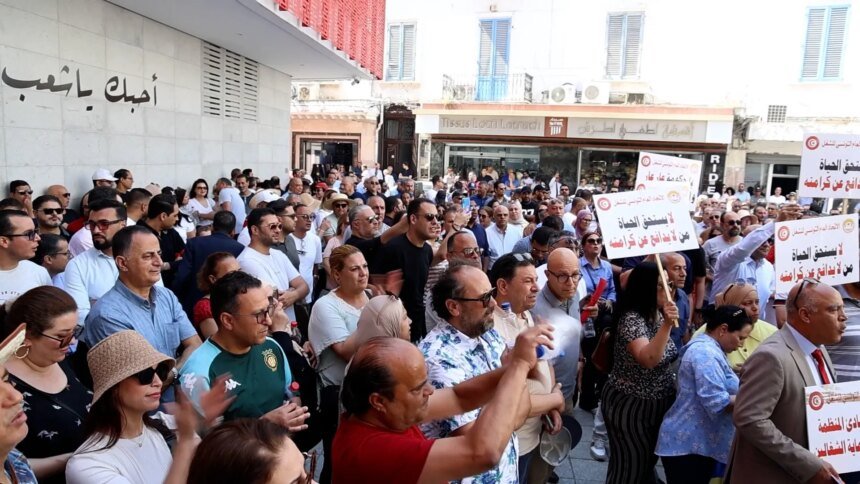
Employees of banks, financial institutions and insurance companies in Tunisia entered a sectoral strike lasting three days, in a move that reflects the escalation of the dispute between union structures and banking institutions regarding the wage file and the future of social dialogue within one of the most important economic sectors in the country.
The strike comes after the General League of Banks, Financial Institutions and Insurance Companies, affiliated with the Tunisian General Labor Union, announced the implementation of a protest movement on June 23, 24 and 25, in protest against what it describes as faltering negotiations and the failure to respond to workers’ demands.
Union: The strike is a defense of professional dignity
Al-Tayeb Al-Bahri, Assistant Secretary-General responsible for the private sector at the Tunisian General Labor Union, said in a statement to Al-Jazeera Net that the strike decision came after “the door to dialogue was closed,” adding that the Banking and Financial Council adhered to positions that it described as unilateral despite the union party’s willingness to continue negotiations.
Al-Bahri added that the rate of commitment to the strike at the national level reached 87%.

For his part, Salah Al-Majri, Assistant Secretary General of the General University of Banks, Insurance and Financial Institutions, explained that the employees’ demands remained unanswered by the Banking and Financial Council, indicating that the essence of the dispute revolves around the increase in wages for the year 2025.
He stressed that the issue goes beyond the direct financial aspect, considering that the crisis reflects a “rejection of dialogue” despite repeated correspondence, and stressing that the strike “came in defense of the dignity of employees and not just financial demands.”
The protesters raised slogans demanding an immediate response to the outstanding sectoral demands and a serious return to the negotiating table, stressing that the decision to escalate came as a result of what they described as a policy of procrastination and the absence of serious dialogue, and declaring their commitment to defending their rights through the available legal and union frameworks.
Banking Council: The increases have been paid and the law will be implemented
On the other hand, the Banking and Financial Council confirmed, in a statement issued hours before the start of the strike, that all banks and financial institutions fulfilled their obligations and disbursed wage increases for the year 2026 in accordance with the order regulating basic wage increases and transportation and attendance grants in sectors subject to joint agreements.
The Council considered that the call for a strike lacked objective justifications, warning of its repercussions on the interests of individuals and institutions, especially since it coincided with the periods of disbursing wages and gratuities and paying bills.

He stressed the need to ensure the continuity of basic banking services, including withdrawals and deposits, and supplying branches and ATMs with cash.
The Council waved financial measures against the strike participants, stressing the implementation of the provisions of the law and the arrangements in place, including deducting days off work from monthly wages, grants, and in-kind benefits related to the job.
Sector profits reopen the wage file
The dispute comes at a time when Tunisian Central Bank data for the year 2025 showed that the banking sector ended 2024 with strong financial results despite the slowdown in loan growth.
According to the annual report of the Central Bank, the net profits of Tunisian banks amounted to about 1.6 billion dinars during the past year, an increase of approximately 12% compared to 2023, while the net banking output rose to about 8 billion dinars, with a growth of more than 5%.
Bank deposits also exceeded the level of 114 billion dinars, recording growth of more than 10%.
Part of this improvement is due to the increase in banks’ resources and the expansion of their investments in treasury bonds, while the growth of loans directed to the economy remained limited.
These indicators raise questions about the extent to which the sector’s strong financial performance reflects the conditions of its workers, which is the issue that stands at the heart of the current conflict between unions and banking institutions.

Declining role of oversight and imbalance
Economist Jamal Aweidi believes, in a statement to Al Jazeera Net, that the bank employees’ strike falls within the normal practices in the relationship between the employee and the institution, but reaching the strike stage reflects, in his estimation, “a blockage in the negotiation horizon between the two parties.”
Oueidi believes that the crisis reveals an imbalance of power within the sector, citing the growing influence of private banking institutions and the decline in oversight and regulation tools capable of achieving balance between the various parties.
He attributed this situation to the diminishing weight of public banks in the Tunisian market compared to the expanding presence of private banks, which have begun to play a more influential role in the financial sector, according to his estimate.
Between the union’s adherence to its right to protest and the banking institutions’ refusal to consider the strike justified after disbursing the scheduled increases, the current conflict remains an important test for the system of social dialogue within a financial sector that occupies a pivotal position in the Tunisian economy, and plays an essential role in financing economic activity and stabilizing the financial cycle in the country.