Published on 6/23/2026
In an astronomical breakthrough that may open a new window on the life and death of massive stars, astronomers have announced the discovery of strong evidence indicating that the remains of two ancient star explosions in our galaxy originally belonged to a single binary system of sister stars.
The discovery came thanks to the analysis of 16 years of data from NASA’s Fermi Gamma Ray Telescope, which enabled researchers to study two mysterious regions in the Gemini constellation.
Read also
list of 2 itemsend of list
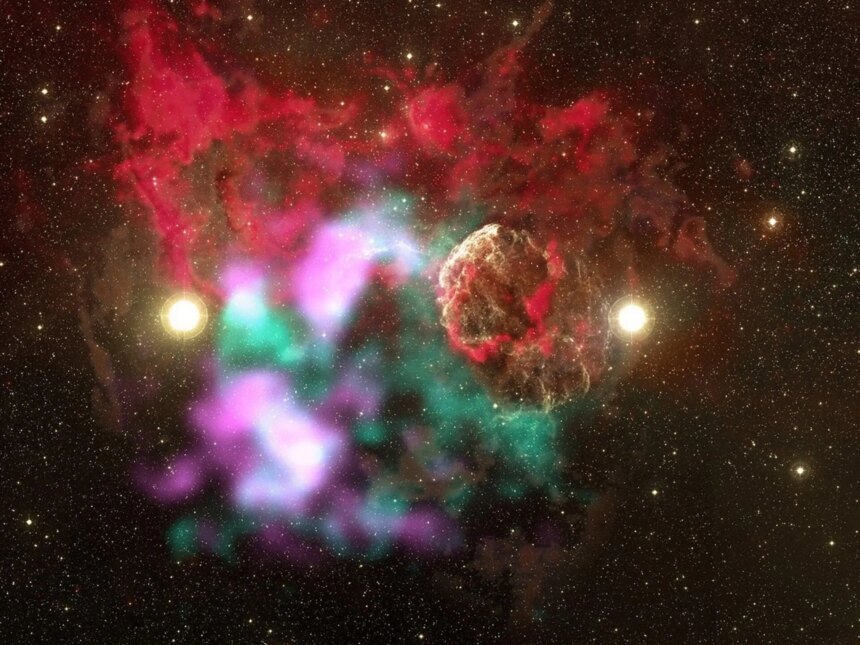
One of these two spots is the Jellyfish Nebula, which is one of the most famous supernova remnants in the sky, while the other is known as “G189” (G189.6+3.3), which is a faint remnant that has not received much study previously.

Scientists believe that the two stars were orbiting each other millions of years ago, until one of them exploded first as a supernova, pushing its companion away through space, and after thousands or tens of thousands of years, the second star ended up with the same fate.
How did gamma rays reveal this secret?
When a massive star explodes, massive shock waves are released that accelerate charged particles to speeds approaching the speed of light, producing what are known as cosmic rays. When these particles collide with the surrounding gas clouds, they create high-energy gamma rays that can be detected even thousands of years after the original star has disappeared.
“There are many surprising connections between the discovered stellar remnants, which makes us believe that they are related to each other, and they may represent the first known example of a binary system in which the two stars exploded as supernovae,” said Miltiadis Michaelides, a researcher at Stanford University and leader of the study.

The team relied on gamma ray and
Strong evidence and little chance of coincidence
The study showed that the remnants of the two supernovas partially overlap in the sky, and are connected by a bright gas filament that was subjected to a violent shock as a result of the explosion waves colliding with dense clouds of interstellar matter.
The researchers also conducted computer simulations that included a million massive binary star systems, and found that systems in which stars exchange matter during their lives can produce two successive explosions with characteristics very similar to what was observed.
Calculations indicate that the probability that this correspondence in location and distance occurred by chance is only less than 1%, which strongly supports the hypothesis of common origin.
“We can now link the glowing remains of two massive stars to a powerful binary that has evolved together over thousands of years,” said Elizabeth Hayes, a scientist involved in the Fermi Project.
A natural laboratory for understanding the universe’s most violent explosions
The discovery not only reveals the story of two sister stars, but also provides a rare opportunity to study how massive stars evolve and exchange matter before they explode.
Researchers estimate that the two original stars had a mass more than 20 times the mass of the Sun, and that the time interval between the two explosions may have ranged between several thousand and about 100,000 years.

The Jellyfish Nebula is also a candidate to be one of the giant cosmic accelerators of high-energy particles, capable of producing protons with energies reaching enormous levels, and the presence of the remnants of a second supernova in the same region may help understand how these giant natural accelerators arise.
Marianne Lemoyne-Gomard from the French National Center for Scientific Research said: “The overlapping of the stellar remnants, the presence of the gaseous filament connecting them, and the abundance of available data encouraged us to delve deeper into this complex region, and the results led us to a coherent and convincing picture.”
When dead stars tell their history
This study reveals that stars do not end their story with their explosion, but rather continue to tell new chapters through the remnants they leave behind in space. Thousands of years after the disappearance of the two original stars, traces of their death still carry valuable information about their origin, development, and fate.
With every discovery of this kind, man’s understanding of the universe to which he belongs deepens. The stars that were born, lived, and died millions of years ago are still sending us their messages through light, particles, and energy, a reminder that science is an ongoing journey to read the history of the universe written among the stars.