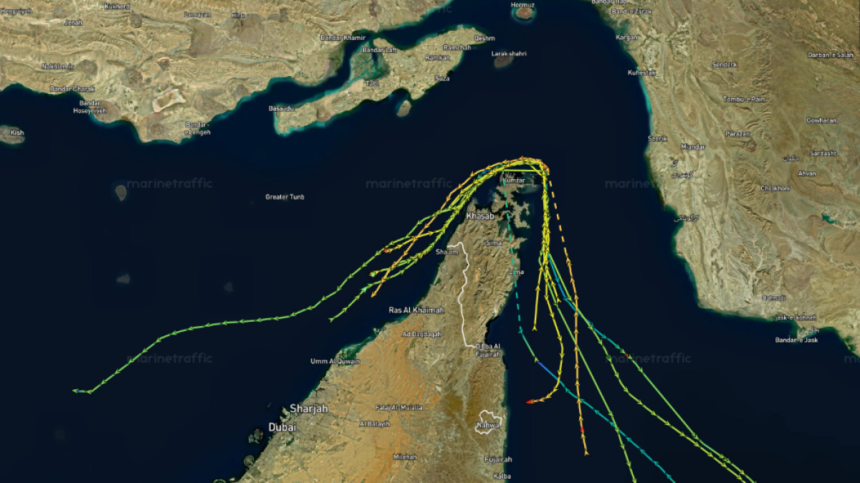
The number of ships crossing the Strait of Hormuz has risen to 30 oil tankers and ships since this morning, the highest confirmed movement since the beginning of the war, after the Iranian Revolutionary Guard announced the first closure of the strait on March 2.
The significant increase in the number of transiting ships, although they are still far below pre-war levels, coincides with the Sultanate of Oman’s announcement on Tuesday of allowing the use of a temporary sea lane for all ships wishing to cross the Strait of Hormuz in coordination with the International Maritime Organization, according to what was reported by the Oman News Agency.
Read also
list of 4 itemsend of list
The transit movement included 11 oil tankers, four liquefied gas tankers, six cargo ships, eight bulk cargo ships, and a passenger ship.
Two safe passages
Despite Iran’s announcement on Saturday of officially closing the Strait of Hormuz in response to the continued Israeli strikes in Lebanon, navigational data monitored by the Al Jazeera Network’s open source unit revealed that transit traffic through the Strait continued, and even increased significantly, compared to the week that preceded the announcement.
Marine Traffic platform data shows that the current crossing has taken two routes, the first is Iranian, passing south of the Iranian island of Qeshm, within Iranian territorial waters, and the other is Omani, passing alongside the Musandam Peninsula.
Six bulk cargo ships linked to Greece crossed the strait, and five ships linked to China crossed the strait: three liquefied gas tankers, an oil tanker, and a bulk ship.
Transit data showed that ships linked to Greece and China formed a prominent presence among the movement of ships that passed through the strait before the crossing stopped.

Safe Passage Details
The official Omani News Agency explained that the decision was based on the Sultanate’s firm commitment to the principles of international law and the law of the sea, ensuring freedom of navigation in the strait without imposing transit fees, and is consistent with the results of the efforts and endeavors reached recently by the United States and Iran.
The Sultanate of Oman directed ships wishing to cross the strategic waterway, through which about 20% of global oil and liquefied gas supplies pass, to coordinate with the International Maritime Organization.
On June 17, Washington and Tehran electronically signed a memorandum of understanding between Islamabad and Pakistani and Qatari mediation, which includes arrangements to discuss opportunities to reach an agreement to permanently end the war that has erupted between the two sides since last February in the coming days, by negotiating items including the security of navigation in the Strait of Hormuz and Iran’s nuclear program.