Published on 6/22/2026
|
Last update: 13:20 (Mecca time)
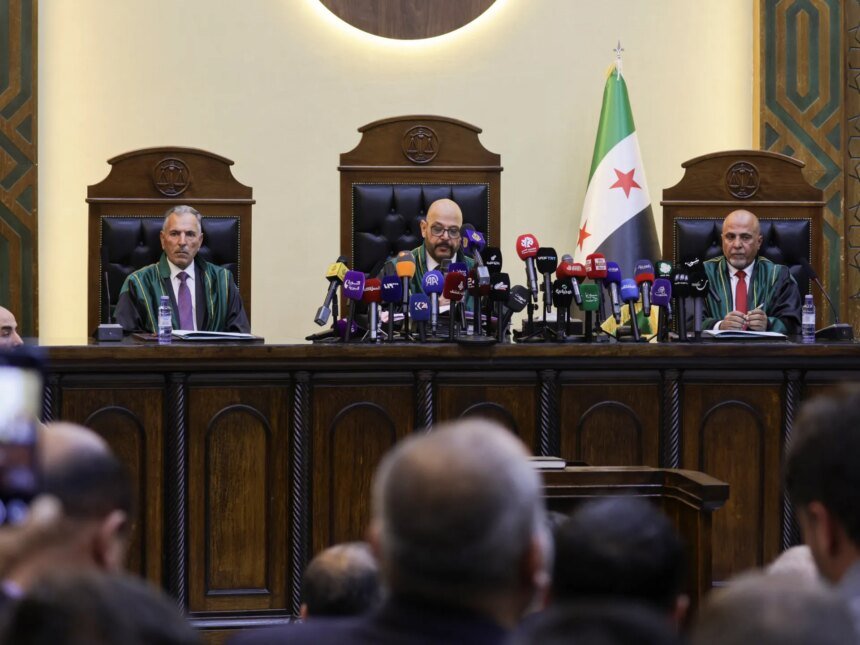
The National Authority for Transitional Justice in Syria announced the launch of a series of new trials for those accused of committing crimes against Syrians during the time of the ousted Assad regime, coinciding with the Syrian Ministry of Justice taking new steps to “accelerate the process of transitional justice,” about a week after popular protests demanded accelerating accountability for perpetrators of violations.
The Director of the Accountability and Accountability Department at the National Authority for Transitional Justice, Radif Mustafa, stated that the trials will begin – today, Monday – against the accused, “Abdel Nasser Barak,” and that a new session will be held for the trial of the accused, “Atef Naguib,” tomorrow, Tuesday.
For the first time, the trial session of the accused Wassim al-Assad will begin next Wednesday, followed by the first session of the trial of the former mufti of the ousted Assad regime, Ahmed Badr al-Din Hassoun.
Chambers in the provincial judicial offices
In a related context, a meeting was held at the Ministry of Justice – yesterday, Sunday – chaired by Minister Mazhar Al-Wais, in the presence of all public lawyers across Syria, to discuss the recent situation and popular demands to accelerate transitional justice procedures, according to what was reported by the “Syria Now” correspondent.
The meeting resulted in decisions, the most notable of which was the allocation of rooms in all governorates’ judicial offices to the Public Prosecution, in addition to investigation and referral departments, to look into “complaints submitted by citizens regarding violations committed by the cronies of the former regime,” according to what the Public Prosecutor in Damascus, Hossam Khattab, explained.
Khattab told “Syria Now” that these rooms will enable the citizen to file a complaint against any person who committed a violation against him or his family, to be directly referred to the investigation department designated for transitional justice, to collect and investigate evidence, and then refer it to the competent criminal court in the Damascus center.
The Public Prosecutor in Damascus considered that this step “is an acceleration of the course of justice and a real response to the demands of the street.”
“Accelerate litigation and achieve accountability”
In an exclusive interview with “Syria Now”, Minister of Justice Mazhar Al-Wais said that the meeting “was a natural interaction with the legitimate demands made by the Syrians and dealt with the calls of the societal and academic elites who put the ball in the court of the authority of law and referred the matter to the judiciary,” pointing out that “the goal of the meetings is to secure procedures that guarantee the smoothness and speed of the required procedures so that people reach the state of justice and accountability required in accordance with the rule of law.”
He added: “It is the duty of the judiciary to be responsible and deal with these calls,” noting that there are mechanisms, means and methods that deal with this stage that have been prepared and arranged in advance.
Security campaigns and about 6,000 “detained”
In a related context, the Syrian Ministry of Interior continues to announce, on an almost daily basis, the arrest of “those involved in committing violations” during the time of the deposed regime.
On June 21, the Ministry announced the arrest of Haitham Rahal, who held the rank of colonel in Saydnaya Military Prison, during the era of the ousted regime. On the same day, it announced “the overthrow of one of the most prominent military figures in the army of the former regime, Brigadier General Abdul Ghaffar Al-Hussein,” and the Syrian Interior Ministry explained through its official identifiers that the arrested man had a “long record of violations.”
On June 19, the Syrian Interior Ministry announced the arrest of former Major General in the ousted regime forces, Rafiq Ahmed Kulthum, as part of “continuous efforts to pursue those involved.”
In a press conference held a week ago, its spokesman, Nour al-Din al-Baba, announced that the Counter-Terrorism Department has 5,989 detainees, distributed among several military ranks of members of the ousted regime.