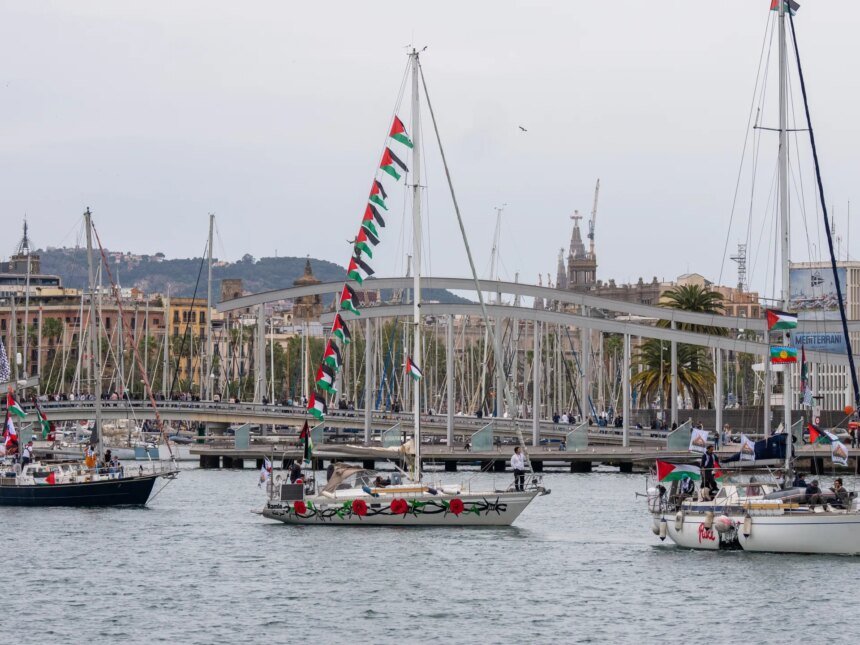
In a new escalation of the maritime confrontation, the Israeli naval forces pre-empted the arrival of the “Global Resilience Fleet” to the coast of the Gaza Strip by intercepting it hundreds of nautical miles away near the Greek island of Crete.
This operation, which targeted a fleet of 58 ships departing from Spain, was not just a field military move, but was supported by a package of financial sanctions and a war of narratives aimed at drying up the sources of funding for international activists.
While Israel justifies this early objection with security necessities and directly linking the flotilla to the Islamic Resistance Movement (Hamas), observers and humanitarian organizations believe that this move reflects a new Israeli strategy aimed at preventing any attempt to break the siege near Gaza, and blocking attempts to internationalize the humanitarian crisis in light of the current regional tensions.
In this report, we review the details of Israeli planning, from the financial blockade to the military interception in international waters, and the justifications given to market this operation internationally.

Military preemption
In 2026, Israel did not follow the “wait” tactic that it had applied in previous years, but rather adopted a long-range interception strategy. According to tracking data, the Global Resilience Fleet – which includes 58 ships – was present near the Greek island of Crete, hundreds of nautical miles from Israel, when the Israeli forces confronted it, which reflects the Israeli army’s desire to resolve the confrontation before it reaches Israel, away from the limelight.
Seven Israeli Navy warships participated in the operation, along with Israeli naval commandos, supported by a fleet of drones that assumed the task of reconnaissance and real-time monitoring of the movements of the fleet consisting of 58 ships.
The selection of the “Shayetet 13” commando unit to carry out the interception of the “Resilience Fleet” was not spontaneous. Rather, it was a continuation of the new role that this elite unit has been playing as a “strike arm” since October 7, 2023. It is considered one of the three most important special units in the Israeli army, and despite its long history of operations “behind enemy lines”, it witnessed a radical transformation after the Battle of “Al-Aqsa Flood”, as it was transformed for the first time into an additional arm for the regular infantry divisions.
The flotilla organizers revealed that they were subjected to an “intensive electronic jamming” operation that targeted the communication and navigation systems on board the boats. This technical control led to a complete loss of communication with 11 ships, isolating the fleet leaders from the rest of the ships and preventing them from coordinating any protest movement or documenting what is happening in real time.
The forces also relied on sending direct warnings through naval communication channels, as footage – published by the flotilla organizers – showed that an Israeli naval officer called on the activists to change their course.
He said, “If you wish to deliver humanitarian aid to Gaza, you can do so through official and recognized channels. Please change your course and return to the port of departure. However, if you are carrying humanitarian aid, you are invited to go to the port of Ashdod.”
He added that those boats directed “laser beams and semi-automatic assault weapons” at the boats, and issued orders to the activists to go to the bows of the ships and bend on their knees.
According to the Walla website, the Israeli government decided to “deter the participants” in the fleet, and therefore seized only about 20 ships, and issued warnings to the rest.
He added that the Commander of the Navy, Major General Eyal Harel, will conduct an assessment of the situation in the coming hours and present his recommendations, and the Military Intelligence Service “Aman” and the Ministry of Foreign Affairs will participate in the operation.

Drying the sources
In parallel with the military action, Israel activated the weapon of “financial sanctions” to strike the fleet from within before its arrival, and in a move aimed at striking the logistical capacity of the activists, Defense Minister Israel Katz announced the imposition of severe financial sanctions on the fleet’s crowdfunding campaign.
“Article 56 (b) of the Terrorism Law stipulates that the Minister of Defense may order the confiscation of the property of a declared terrorist organization, or property designated for the commission of a serious terrorist crime, if he is convinced that this is necessary to thwart the activities of a terrorist organization and harm its ability to advance its goals or to thwart a serious terrorist crime,” Katz said.
The occupation Ministry of Defense also justified these sanctions by claiming that the flotilla was “organized by the Hamas movement in cooperation with international bodies,” and that the humanitarian cover for the trip was merely a “screen” to hide other goals. This narrative, according to Katz, aims to deter international donors from individuals and institutions by placing them under legal responsibility and financial prosecution on charges of “contributing to the financing of a terrorist organization.”
Although the immediate practical impact of these sanctions is not clear, the newspaper “Israel Hayom” indicated that the goal is to disrupt the vital “financing sources” needed by the fleet, which consists of about 100 ships and about a thousand participants. With these sanctions, Israel seeks to make dealing with the fleet a legal and banking burden in European ports, which hinders processing and sailing operations.
In order to justify the blockade and objection, the Israeli media portrayed the flotilla as a mere “propaganda campaign,” noting that the organizers refuse to deliver aid through “official and recognized channels” such as the port of Ashdod.
The Israeli novel
The campaign organizers confirm that the “Spring 2026 Mission” is humanitarian and aims to deliver relief aid, open a civilian sea corridor to Gaza, in addition to supporting relief and reconstruction efforts. The official page of the mission indicates that the aid includes food, baby formula, medical supplies, hygiene materials, and educational tools.
On the other hand, the Israeli media and political machine focused on formulating justifications aimed at withdrawing the “humanitarian” character from the fleet, and linking it to complex political agendas. Analysts believe that Israel is using this rejection as legal evidence before the international community to justify the interception of ships far from the coast, under the pretext that the goal of the fleet is “political provocation” and not humanitarian relief.
Israel also gave a political justification that these moves aim to sabotage regional and international efforts aimed at finding “realistic” solutions for the Gaza Strip, including arrangements that are in line with the vision of the “Trump peace plan” that focuses on development in exchange for disarmament.
To reinforce this narrative, the State Department published materials claiming that prohibited items (such as drugs) were found on board the ships, describing the trip as a mere demonstration that does not provide real aid compared to what enters through inspected land crossings.
This is the second initiative of the “Global Resilience Fleet”, after the September 2025 experiment, which ended with an Israeli attack on ships in October of the same year while they were sailing in international waters, and the arrest of hundreds of international activists on board before their deportation began.
These initiatives come at a time when the Gaza Strip is witnessing an unprecedented humanitarian and health crisis since Israel began its war of genocide against the Gaza Strip, which led to the widespread destruction of infrastructure, including hospitals and health care facilities.
This suffering is exacerbated by the strict Israeli restrictions on the entry of fuel and medical supplies, in addition to a severe shortage of medicines and equipment, in addition to the siege of the Gaza Strip since 2007. About 1.5 million Palestinians out of about 2.4 million in the Strip have become homeless after the genocide war destroyed their homes.