Published on 6/17/2026
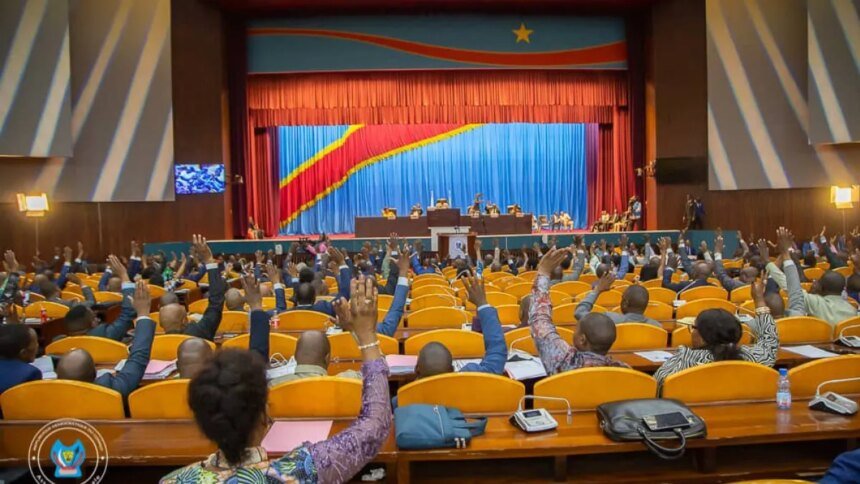
The Senate of the Democratic Republic of the Congo, the day before yesterday, Monday, unanimously approved a proposed law specifying the mechanisms for organizing the referendum, as 89 members out of 109 attendees voted in favor of it. Hours after the Council voted, the House of Representatives and the Senate reached a unified version of the text through an equally joint committee that settled the differences, in preparation for referring it to President Felix Tshisekedi for approval, according to Congolese Radio Okapi.
According to the same radio, the agreement included the exclusion of municipal advisors from the Constituent Assembly, which is the body established during the course of the referendum and charged with studying any constitutional reform project. The two chambers also agreed to abandon the principle of co-presidency of this body, provided that it is headed by the President of the National Assembly, assisted by the President of the Senate.
The National Assembly approved the law on the ninth of this month, in a vote that took place without opposition representatives who boycotted Parliament weeks ago in protest against the initiative.
The law allows for a referendum on a new constitution under which Tshisekedi’s previous presidential terms will not be counted. On the other hand, the current constitution explicitly prohibits any review of the number or duration of presidential terms. However, the text goes beyond this prohibition by allowing the amendment of these provisions if a “constitutional problem” occurs that paralyzes state institutions, provided that it is put to a referendum.

Two opposing narratives
The ruling majority presents the law as a legal framework for organizing referendums stipulated in the constitution, according to Radio Okapi. The German “Deutsche Welle” channel quoted MP Paul Gaspard Ngondankwe, the author of the proposal, as saying that “the sovereign people who decided in 2006 the limits contained in the current constitution can decide again today.”
On the other hand, the opposition, led by the “Article 64 Coalition,” believes that the law opens the door to a constitutional review that may lead to a third term for Tshisekedi, according to Radio Okapi. Deutsche Welle quoted opposition member Moise Katumbi, who came in second in the 2023 elections and lives in exile, as saying that the clause is a “trick” aimed at enabling Tshisekedi to carry out a “constitutional coup,” vowing that the opposition “will resist.” He added, “The constitution is not a shirt that can be changed according to whims.”
Opposition figures, including Katumbi, Martin Fayulu, Matata Bonyo, and Jean-Marc Kaponde, along with civil society organizations, launched the “Article 64 Coalition to Defend the Constitutional Order” late last May. On the third of this month, a massive strike was organized under the slogan “Dead City Day,” as the opposition demanded Tshisekedi’s resignation.
Tshisekedi, 62 years old, has been in office since 2019. He is limited to two terms under the constitution adopted about twenty years ago, and his second and last term ends in 2028. He had said at the beginning of last May: “I did not ask for a third term, but I am telling you: If the people want me to have a third term, I will accept.”
This move comes as the Central African country faces multiple crises, including an Ebola outbreak and a decades-long conflict in the east of the country with the M23 rebels supported by Rwanda, according to United Nations experts, which is among more than 100 armed groups. Tshisekedi said last month that the country would not be able to hold elections unless the conflict was resolved and stability returned.
Source: The island + Foreign press + African press