Published on 6/16/2026
|
Last update: 6/17/2026 05:16 (Mecca time)
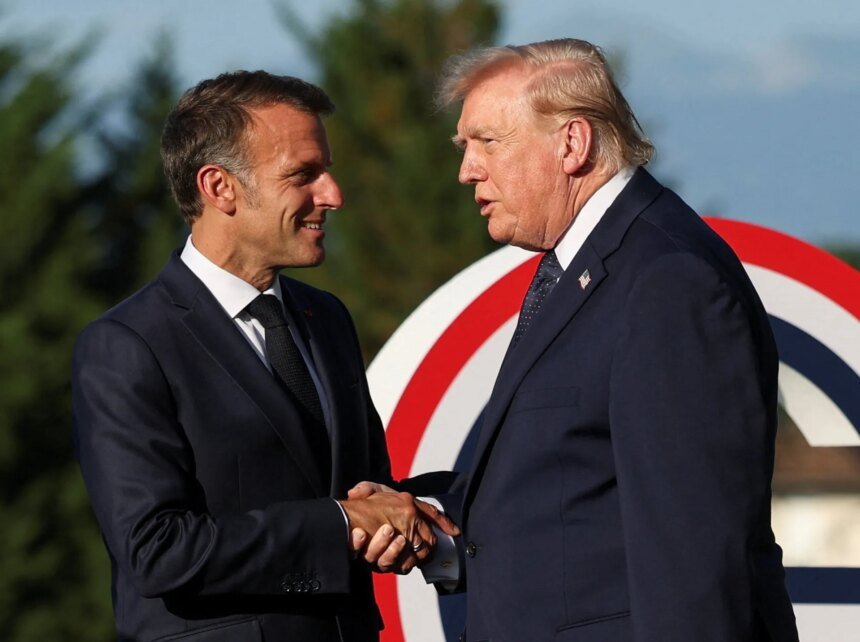
The G7 summit kicked off today, Tuesday, in the French city of Evian, with the war in Ukraine and the agreement with Iran at the top of its agenda, at a time when the leaders are preparing to hold talks with Ukrainian President Volodymyr Zelensky, amid indications launched by US President Donald Trump regarding the possibility of reaching a settlement to the conflict that has been going on for more than four years.
Zelensky is scheduled to participate in a special morning session within the summit’s work, devoted entirely to discussing developments in the Ukrainian file, in light of accelerating international efforts to contain the war and push the political path towards a final settlement.
This step comes at a time when European leaders – hosted by French President Emmanuel Macron – are seeking to convince Trump of the necessity of pressuring Moscow to accept a peace that takes into account Kiev’s conditions, and to ensure that the latter is not forced to make concessions to the Russian side.
Yesterday, Monday, Zelensky called on the group’s leaders to take a “decisive and concrete” response to the recent wave of Russian strikes, which led to the death of at least 11 people and damage in a fire in a prominent cathedral in Kiev.
The Ukrainian president also revealed that he proposed holding a meeting with his Russian counterpart, Vladimir Putin, on the sidelines of the summit, but Moscow expressed its unwillingness to do so.
For his part, Trump referred to two phone calls he had with Zelensky and Putin, saying that “they are both open, and perhaps we can do something,” without providing further details about the nature of the possible move.

Fair agreement
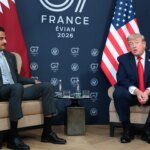
Meanwhile, US President Donald Trump praised the role of the State of Qatar and its mediation in resolving the crisis in the region, describing the agreement with Iran as “fair and good.”
Trump added, in a speech before the G7 summit in France, that what is important to him is that Iran does not possess a nuclear weapon in any way.
The US President also stressed the need for Israeli Prime Minister Benjamin Netanyahu to act more responsibly towards Lebanon.
For his part, the Emir of Qatar, Sheikh Tamim bin Hamad bin Khalifa Al Thani, said, “The agreement between Tehran and Washington is very important and there is still work to be done,” stressing that his country’s primary goal during the recent period was to reach an agreement.
He added, “If we continue these efforts, we will achieve something wonderful for the region and Iran, and we are ready to provide assistance whenever our friends request it.”
“Brutal strikes” and diplomatic paths
Regarding Western support for Kiev, British Prime Minister Keir Starmer announced that his country would supply Ukraine with enriched uranium to operate its nuclear facilities, announcing at the same time a new sanctions package against Russia.
Starmer described the Russian strikes as “brutal,” stressing Britain’s commitment to “choking the resources that finance Putin’s war” and supporting Ukraine during the coming winters.
Meanwhile, analysts believe that the balance of power on the battlefield is finally tilting in Ukraine’s favor, which – in their estimation – calls for continued Western support.
In another context, the Ukrainian session is scheduled to be followed by a special session on Iran, in the presence of Egyptian President Abdel Fattah Al-Sisi, the Emir of Qatar Sheikh Tamim bin Hamad Al Thani, and Emirati President Mohammed bin Zayed Al Nahyan.
Washington’s allies will seek to clarify Trump’s position on the agreement with Iran to end the war in the Middle East, an agreement that the US President said would lead to the complete reopening of the Strait of Hormuz by Friday.
Trump expressed reservations about the British-French proposal to launch a military mission to ensure freedom of navigation in the strait, considering that the United States “does not need much assistance” in this regard.
The summit will continue for 3 days with the participation of a number of world leaders, as part of French efforts to expand the scope of the G7 to include other international powers, with the participation of leaders such as Brazilian President Luiz Inacio Lula da Silva and Indian Prime Minister Narendra Modi.
It is noteworthy that the Group of Seven Nations (G-7) is not an international organization, but rather an informal forum that emerged in 1975, and includes the world’s leading industrialized countries, namely the United States, the United Kingdom, France, Germany, Italy, Canada, and Japan.