Published On 10/6/2026
|
Last update: 17:53 (Mecca time)
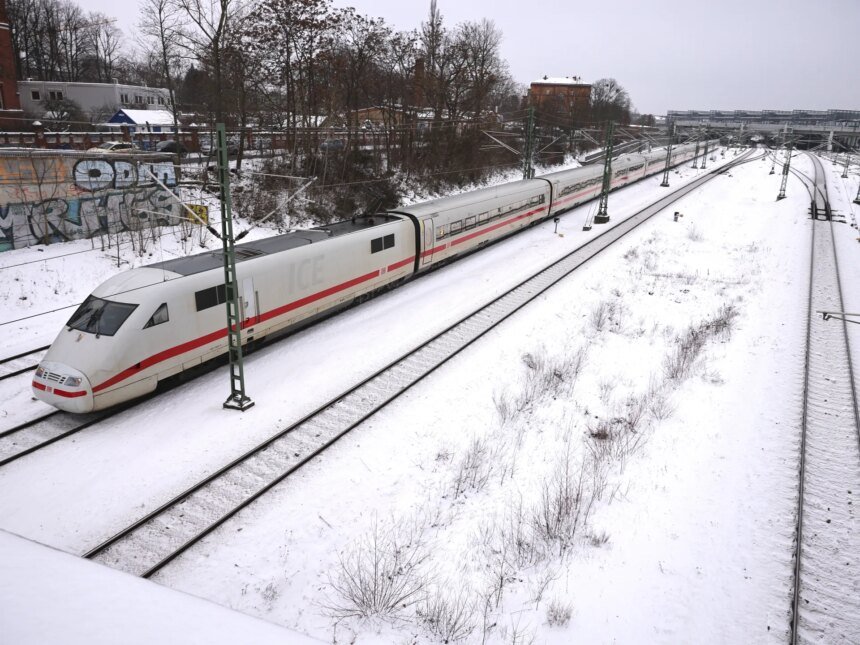
Nearly 200 years after the first commercial train ran in Germany, Berlin seeks to confront the problem of trains being late in arriving on time, which has become one of the priorities of the German government at the present time, through a plan that cost 100 billion euros ($115.6 billion).
The Financial Times reported that only about 60% of German trains traveling long distances arrive on time at their destinations, a clear decline from 84% about two decades ago.
Read also
list of 4 itemsend of list
The newspaper pointed out that the performance of the German state-owned train company, Deutsche Bahn, is weak, and less so than train companies in Britain whose passengers complain about poor services.
German railways have become the subject of constant complaint by citizens, so much so that Transport Minister Patrick Schneider warned in March that they “threaten to undermine democracy” if citizens lose confidence in the government’s ability to provide basic services.
The French newspaper Le Monde described the situation of Deutsche Bahn as deteriorating to the point where it became a source of “national embarrassment” for the Germans.

“Political and economic symbol”
The German train company Deutsche Bahn has been suffering from weak investments for many years, which has clearly been reflected in the decline in the level of its services, and is putting pressure on the German government led by Friedrich Merz.
Meretz is facing increasing economic pressures, as the growth of the German economy has slowed in the last four years, and the unemployment rate has risen to a limited extent, but continues.
In this context, the co-founder and CEO of the train operating company “Flex”, Andrei Shvamlein, told the newspaper that train problems have become a “political and social symbol” of a state of general deterioration, adding, “Many people judge how well a country is performing based on the performance of the railway system.”
As part of its efforts to develop infrastructure, Berlin abandoned the traditional commitment to achieving balance in the state budget, that is, equalizing expenditures with revenues, and Parliament allowed the government to borrow an amount of 500 million euros to repair state facilities, especially trains.
Deutsche Bahn problems
The German train company Deutsche Bahn was established in 1994 as a result of the merger of the two train companies in eastern and western Germany following the unification of the country.
A few months after assuming power in 2025, the Meretz government dismissed Deutsche Bahn’s CEO, Richard Lutz, who became a symbol of the company’s problems.
His successor, Evelyn Bala, has pledged to cut red tape and simplify the bloated company, and said in a newspaper interview last May that she aspires to make the company the best railway in Europe.

There are currently hundreds of private train companies in Germany, most of them specializing in freight trains and local trains, with Deutsche Bahn’s market share in these two sectors falling to less than 40% and 59% respectively.
As for long-distance travel, Deutsche Bahn still controls 94% of the market, while competing companies such as Flex and Eurostar make up the remaining percentage.
Huge investment program
The Financial Times explained that “the largest railway investment program since post-war reconstruction” is now being implemented in Germany.
“Rail users will face a very difficult period for five months, but after that, things will be much better,” Philip Nagel, CEO of DB InfraGo, the infrastructure arm of Deutsche Bahn, which is carrying out development and repair work on its facilities and lines, was quoted as saying.
Nagel explained that the current spending commitments of 107 billion euros ($123 billion) for the period between 2025 and 2029 are still less than the 130 billion euros ($150 billion) required, to compensate for years of underinvestment in railways.
Nagle noted that every year, more rail infrastructure assets reach the end of their useful lives.
By the end of 2026, Deutsche Bahn is expected to have rebuilt 900 kilometers of railway lines, starting in 2024, nearly a quarter of its target for 2036. This is equivalent to half the length of the new lines built after 1945, which are approximately 1,900 kilometers long.