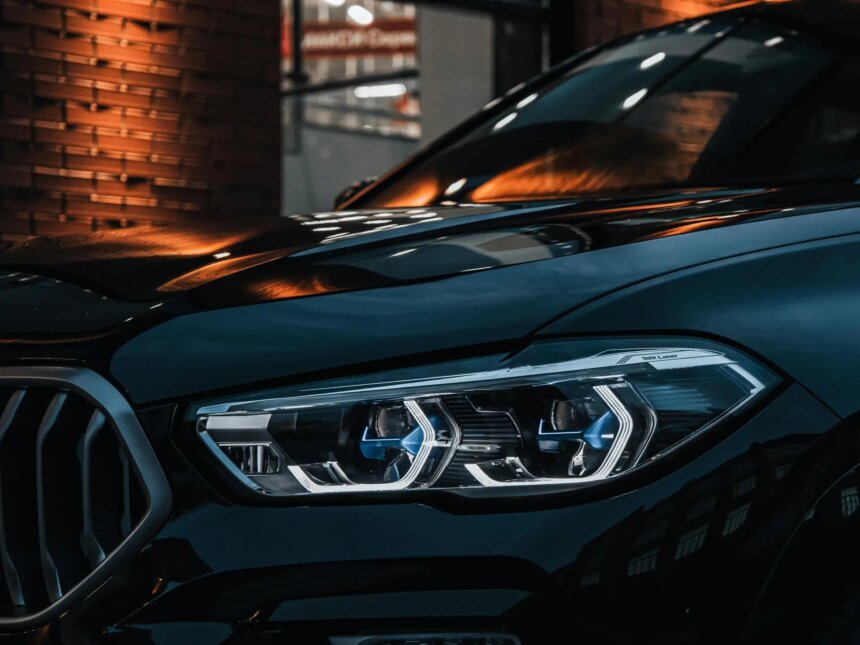
Car lighting has witnessed tremendous development since the emergence of vehicles in the late 19th century and the beginning of the 20th century. The journey began with primitive lamps that relied on flame and gas, before the industry witnessed qualitative leaps with the emergence of electric lamps that continued to develop over the years, leading to smart lamps that rely on advanced techniques and technology that provide higher levels of safety, efficiency, and clarity of vision while driving.
The development of car lights was not only an aesthetic element, but rather a response to the growing need to enhance safety during night driving, and in various weather conditions.
With the acceleration of innovation in the automotive industry, lamps have become an essential element that combines performance, smart technologies and modern design, reflecting a long journey of engineering and technological development that has changed the concept of lighting on the roads.
Over the past decades, international car companies have competed to develop lighting systems that are more efficient and able to adapt to different driving conditions. Whereas lamps used to be limited to basic lighting only, today they are equipped with smart systems that have contributed to improving the driving experience and enhancing safety levels, so that lighting has become a pivotal part of the car’s identity and modern technology.

The journey of the development of automobile lamps
Over the course of more than a century, lamps and lanterns have witnessed an amazing journey of development that constituted a qualitative shift in the world of cars. The following is a summary of the history of their development:
First: oil and gas lamps
In their early days, cars relied on kerosene lamps (open flames), such as those used to light homes, but they did not provide a good addition and did not allow a clear view of the road.
Lanterns were developed in the late 19th century that operated with acetylene gas, which was produced from a chemical reaction and resisted wind and rain better, but it also had weak and limited illumination.
Second: traditional light bulbs
Since 1910, with the development of electrical systems and the advent of the dynamo, or device for converting mechanical motion into electricity, and the battery, electric lamps began to spread.
The American company Cadillac introduced the first integrated car electrical system in 1912, after which car lighting systems developed to include high and low beams, the addition of side signals, and lighting when the brakes are pressed.

Third: halogen lamps
Halogen lamps first appeared in practice in the late 1950s, but their use in cars began to spread in the early 1960s, and they were initially used only for some luxury car models.
This type of lamp is characterized by its stronger illumination and clearer vision than old lamps, and its lifespan is longer. It works like a regular lamp, with a tungsten filament inside it, but with halogen gas, which reduces corrosion of the filament and increases the lifespan of the lamps. It also gives a bright, yellowish light.
This technology remained in use until a new technology emerged in the early 1990s.
Fourth: Xenon lamps
With the development of technology, new technology for car lamps has begun to emerge; In 1991, the German company BMW introduced High Intensity Discharge (HID) technology, now known as xenon lamps.
These lights are characterized by a brighter white light that tends to be blue, and they also cover a wider area, giving the car driver a clearer and better view of the road at night and in difficult weather conditions as well.

Fifth: LED lamps
As lighting technologies continued to develop, “light-emitting diode” lamps, abbreviated “LED,” appeared. They began on a limited basis in the 1980s and then spread strongly in the 1990s and the beginning of the third millennium.
This technology is characterized by low power consumption, longer lifespan, and ultra-bright lighting.
These lamps were first used in car taillights, before they were later used in headlights, signals, and interior lighting as well.
Sixth: Adaptive lighting
Adaptive Front-lighting System is a system in which the headlights move automatically with the movement of the car’s steering wheel, with the aim of improving the illumination of the road inside turns and illuminating them before entering them.
This system helps the driver have a clearer view of the road and increases the level of safety, especially during night driving.
Seventh: Smart lamps
Matrix LED is a lighting system based on LED technology, but it does not work from a single light source, but rather consists of a group of small light points, each of which the car can control independently and according to road conditions.
This technology is an advanced system linked to cameras and sensors, which automatically turns off or dims certain parts of the lighting to block the brightness from cars coming in the opposite direction, yet the lighting remains strong and continuous on the rest of the road.
This technology is characterized by smart lighting that adapts to different driving conditions, and provides excellent visibility while driving in the dark and on highways through a very long illumination range and high efficiency, in addition to increasing the level of safety by reducing the inconvenience of other drivers with bright light.

Eighth: Laser lights
Laser lights are one of the latest automotive lighting technologies, and they appeared commercially for the first time in 2014 in some luxury cars.
This technology relies on blue laser beams directed at a phosphorescent material inside the lamp, producing very bright and strongly focused white light.
These lamps have a longer illumination range than LED lamps, lower energy consumption, and a clearer and wider vision.
Where is the future of car lights?
The future of car lights is moving towards more intelligence and technical development, with a focus on enhancing safety and improving the driving experience. With the rapid progress in lighting technologies, companies have begun developing systems capable of adapting to road conditions, weather, and other vehicle movements automatically, by controlling the intensity and direction of lighting with high precision.
It is also expected that LED and laser technologies will play a greater role in the coming years, in addition to integrating lighting with self-driving systems and artificial intelligence.
Advanced lighting systems and technological advances
The great development in automotive lighting systems reflects the extent of technological progress that the automotive industry has witnessed over more than a century.
With continued innovation and development, it is expected that these systems will witness more smart technologies in the future that provide higher efficiency and clearer vision in keeping with the developments of modern cars and safety requirements while driving on the road.