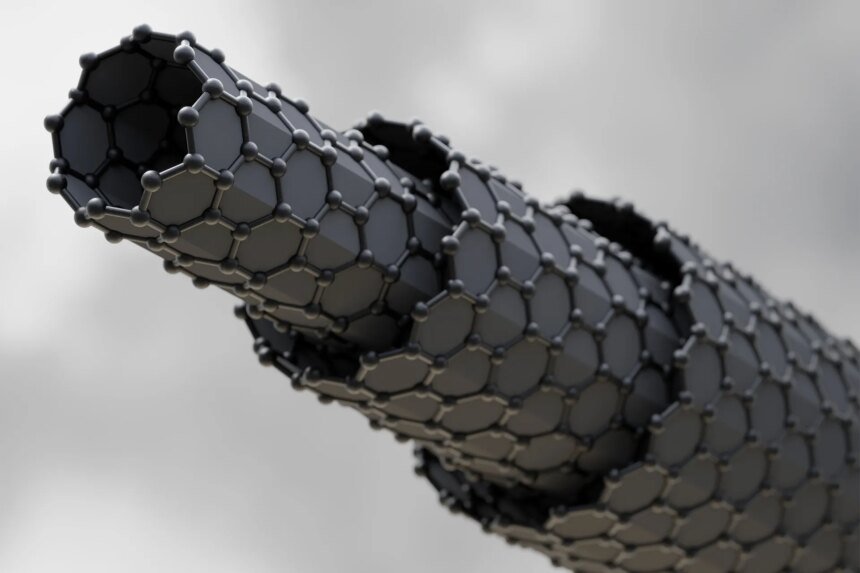
Physicists usually classify states of matter based on the way the electrons move within them, a movement that is affected by multiple factors, including the atomic structure and arrangement of atoms in the material.
When a thin material is placed in a magnetic field, electrons tend to move in small circular paths, while the electric current is deflected sideways towards the edges of the material as a result of its internal magnetic properties, a phenomenon known as the “Hall effect.”
This effect usually shows relatively predictable behavior, especially when taking into account whether the material actually belongs to a 2D or 3D system.
In materials with magnetic properties, the movement of electrons becomes more complex, leading to the emergence of different forms of this effect, whose historical roots go back to the physicist Edwin Hall in 1879.
During an experiment conducted on a distinctive type of layered graphene placed inside a magnetic field, a team of physicists led by physics professor Li Wang from the School of Physics at Nanjing University in China observed a previously unknown class of material behaviors that only appear in graphene layers with a specific thickness that does not exceed a few nanometers.
According to the researchers, who published their results in the journal Nature, matter is entering a new state of quantum matter that they described as “trans-dimensional,” that is, neither fully two-dimensional nor three-dimensional, but rather located in an intermediate state. This unusual case revealed a completely new pattern of electron movement.

Breaking down physical barriers
This discovery was completely surprising, as it had not been previously observed in any other known material, nor was it indicated by any previous physical theory, nor had it been observed in any other material before, and it took the team about a full year to understand the initial experimental data. The original goal of the study was to examine the behavior of electrons within multilayer rhombohedral graphene, a form of thin graphite characterized by a special layered stacking, in the hopes of achieving highly efficient electrical currents within this unique structure.
Wang explains that rhombohedral graphene is a pioneering physical system that has received great attention from researchers in recent years, especially after many new physical phenomena were observed in its pentagonal and hexagonal layers.
He added in his interview with Al Jazeera Net that his team decided, 3 years ago, to explore this system within a range of different thicknesses that other research groups had not previously studied, so we focused on samples consisting of 9 layers and even thicker.
The researcher points out that this decision proved correct, because this thickness range falls within the multi-dimensional range, a state in which graphene is no longer a two-dimensional system, and it has not yet reached full three-dimensional behavior, which is crucial to this discovery.
In this unique physical range, the researchers observed that when this material was exposed to a magnetic field, the electrons began to exhibit unusual behavior that allowed the electrons to move in a coordinated manner within the layers as well as between them, leading to more complex patterns in magnetic and electrical behavior compared to what was previously known.
What specifically puzzled the researchers was that the material showed a type of Hall effect when exposed to two perpendicular magnetic fields. This means that the electrons were able to carry out horizontal and vertical circular motions at the same time, even though the thickness of the material was theoretically supposed to be insufficient to support such a complex double motion.

A new transdimensional domain
Initially, the researchers suggested that the error might be due to an experimental flaw, but repeated experiments using multiple samples confirmed the validity of the results. Measurements in materials with a thickness of only 2 to 5 nanometers showed that electrons exhibit an unprecedented movement pattern, clearly different from known behaviors in previously studied two- or three-dimensional systems.
Since this thickness does not make the material fully two-dimensional or three-dimensional, the researchers chose to describe this unusual state as “trans-dimensional,” but Wang explains that this term does not mean combining or mixing the properties of the two dimensions, but rather refers to a completely new system that does not fall within the traditional frameworks known in dimensional physics.
He points out that the trans-dimensional effect differs from traditional cases (two- and three-dimensional) in that it is not limited to vertical magnetism only, but is linked to orbital magnetism inside and outside the plane of matter at the same time.
He added, “We have proven this experimentally by the emergence of a strong and clear magnetic response when the material is exposed to magnetic fields parallel to its surface (in-plane) and perpendicular to it (out-of-plane).
Potential practical applications
The present discovery reinforces the idea that undiscovered classes of physical behaviors may emerge at the limits of conventional dimensions. Scientists hope that it will help in a deeper understanding of the physics of quantum materials, which may pave the way for new applications in studying complex quantum phenomena, and may also contribute to the development of new electronic technologies that depend on precise control of the movement of electrons.
“What we see today is only the first beginning of the exploration of the trans-dimensional system,” Wang says. “When we begin to study dimensions that have been ignored for a long time, it may have a major impact not only on our basic understanding of physics, but it may also generate new technologies that are so far only a fantasy, but may become a reality, as objects behave according to completely different rules in the trans-dimensional world.”
In the next phase, Wang and his team are looking forward to searching for phenomena similar to what they call “trans-dimensional physics” in other materials, in addition to using advanced measurement tools such as diamond-based magnetic field sensors, with the aim of deepening understanding of this new state of matter, which may open broad horizons in materials science and quantum physics.
The researcher concludes by saying, “We are currently working intensively to expand our research related to trans-dimensional effects on many basic physical phenomena. We are also re-examining a number of well-established physical rules to verify whether they are still valid within the trans-dimensional system, in graphene as well as in other materials.”