Ragon – From Dushanbe, the trip to Ragon begins as many trips to Tajikistan begin: a quiet city behind you, and mountains that come closer and closer to the car window. You leave the capital with its wide streets and organized parks, then the urbanization thins out, and the road turns into a long strip that rises and bends between rocky hills and small villages, before the Wakhsh River appears below like an angry blue thread cutting through the valley.
On both sides of the road, the scene does not look touristy in the usual sense. There are no luxury hotels, no big signs, and no restaurants competing to receive passers-by. Just silent mountains, heavy trucks, and workers going to a project that almost every Tajik knows about: the Ragon Dam.
As the car approaches the site, you feel that you are not just going to an electrical facility, but to a big national idea. In a country that knows the meaning of winter cold, power outages, and difficult geography, the dam becomes more than a wall that holds back water. It becomes a promise of light.

Between the narrowness of the mountains and the breadth of the dream
From Dushanbe to Ragon, the trip takes about two hours or more. The road itself is part of the story. Tajikistan, which appears on the map to be a relatively small country, on the way to the dam reveals its harsh, yet beautiful, mountainous reality. Every turn opens a new scene: sharp rocks covered in green, deep valleys, scattered houses, and a river that never stops flowing.
On the way, trucks loaded with stones and heavy materials pass by, as if they were coming from or going to the heart of the mountain. The visitor does not need a long explanation to understand that the project here is not being built on easy land. Everything seems difficult: accessing, digging, transporting, and controlling a river rushing from the heights of Central Asia.
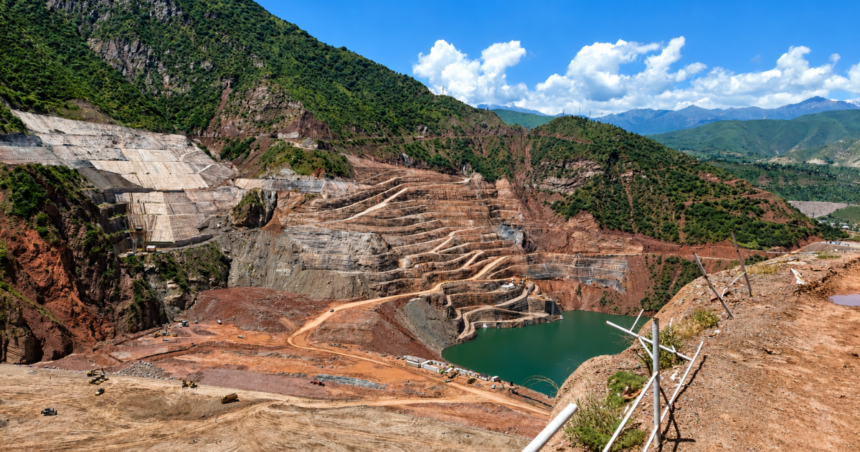
As you approach the site, Ragon’s features begin to appear, not as a complete picture at once, but as fragments of a huge landscape: dirt roads, giant equipment, opened mountains, tunnel entrances, and a dam being formed in the middle of a larger nature than everything.

Workshop at the bottom of the mountain
The first thing that strikes a visitor in Ragon is not only the height of the dam, but also the vastness of the workshop. The place does not look like an ordinary power station, but rather a working city suspended between the mountain and the river. The sounds of machinery echo among the rocks, dust rises slowly, and workers move at different points as if they were part of an enormous, restless machine.
The mountain looks like it has been opened from the inside. There is not a single interface to the project, but rather levels, entrances, and paths. You see a road going down, another going up towards the work area, and a third leading to a dark tunnel opening that looks like a door to the underground.
At that moment, the visitor realizes that the word dam is not enough to describe what is happening. Ragon is not just a wall, but a whole network of tunnels, diversions, canals and facilities under and around the mountain. Water does not encounter concrete alone, but rather passes through complex engineering prepared to tame the Wakhsh River and transform its power into electricity.

Tunnels…the hidden heart of the project
At the tunnel entrances, the sense of place is different. The harsh light outside recedes, the air grows colder, and the sound of machinery takes on a deep metallic echo. Inside, the visitor does not see the river, but feels it. All these passages were constructed because, in a project like Ragon, water does not move at will; it must be directed, diverted, compressed, and then released toward the turbines.
The project includes hydraulic tunnels with a length ranging between 1,100 and 1,500 meters, and an underground generating station that includes six units.
In some places, the tunnels look like giant arteries under the mountain, through which water passes or is preparing to pass, and through them also passes the whole idea of the project: How can a natural impulse that is thousands of years old be transformed into organized energy that enters homes, factories, and schools?
Here the great paradox is revealed. Above you is a silent mountain, beneath you is complex architecture, and in front of you is a country waiting for light to emerge from this inner darkness, and perhaps that is why the tunnels in Ragon appear more poetic than one would expect from an engineering facility. It is the places that people do not usually see, but they are the ones that decide whether the dream will work or not.

Turbines waiting for water
In the area designated for the generating station, the imagination becomes clearer. The idea is not just for the dam to trap the water, but to release it with a calculated force towards huge turbines, rotating under enormous pressure, and then converting the movement of the water into electricity.
A non-specialized visitor may not understand all the technical details, but he will pick up the size of the bet from the size of the place. Everything is prepared to deal with energy that cannot be seen with the naked eye until it is transformed into sound, vibration, and rotation. The water coming from the mountains will descend through a huge system, rush toward the turbines, and then emerge from the other side, leaving behind electricity that Tajikistan wants to build its future on.
There, amid the concrete, iron, and walkways, talking about megawatts no longer seems like just a number. The number becomes imaginable: each generating unit means cities and villages, factories and homes, less harsh winters, and perhaps an economy less dependent on the outside.

Dreaming about numbers
Near the work site, the Italian engineer Andres, from the team of the Italian company Webuild, which is carrying out the main works on the Ragone Dam, speaks in an enthusiastic language. He points to the mountain and then to the riverbed, and tells those present that the project, when completed, will include a dam 335 meters high, which will be the highest in the world, and that the generating station is designed with six huge units capable of producing about 3,600 megawatts of electricity.
The engineer adds that it is not just a concrete block, but rather a complete system: a rubble dam with a clay core, hydraulic tunnels, an underground generating station, and huge turbines that gradually operate as the project stages are completed.
Andres sums up the idea with a simple sentence: “The mountain here is not only an obstacle, but rather part of the strength of the project. We are not building above nature, but rather trying to understand it and use its energy safely.”
This phrase seems appropriate for the whole Ragon. The project is not trying to eliminate the mountain, but rather to engage in a difficult dialogue with it. It digs underneath it, builds on top of it, directs its water, and then waits to give it electricity.

A project larger than electricity
For Tajikistan, Ragon does not stop at the limits of energy production. It is a sovereign, developmental and symbolic project at the same time. The country, which has long suffered from electricity shortages in the winter, sees the dam as an opportunity to reduce the seasonal deficit, improve supplies, and perhaps export the surplus to neighboring countries in the future.
This is why Ragon appears in the national imagination as the “Project of the Century.” The mountainous country, which does not have huge oil wealth, has something else: rivers descending from the peaks, and water that can be transformed into energy. From here, the dam becomes Tajikistan’s bet on its geography, and an attempt to turn difficulty into strength.
But the bet is not without questions. A project of this size requires huge financing, careful management, safety guarantees, and a sensitive balance with downstream countries that monitor water flows, according to the Italian engineer.
The water that collects behind the dam is not the water of Tajikistan alone from a geographical and political standpoint, but rather part of a sensitive regional water system. Therefore, Ragon needs transparent and balanced management, so that it becomes a source of energy and development and not a cause of new tension in Central Asia.
“The mountain here is not only an obstacle, but rather part of the strength of the project. We are not building above nature, but rather trying to understand it and use its energy safely.”
When the light looks different
On the way back to Dushanbe, the mountains begin to gradually move away, but the image of the dam sticks. Dark tunnels, waiting turbines, heavy trucks, and the river running stubbornly between the rocks; They all turn into scenes that summarize Tajikistan’s relationship with water.
When you arrive in the capital in the evening, and the lights shine on Rudaki Street, you look at it in a different way. Electricity is no longer just an ordinary service. It becomes an extension of that distant river, that open mountain, and those tunnels in which men work that most of the population does not see.
Ragon Dam, in the end, is not just a tale of engineering. It is the journey of an entire country from darkness to light, from difficult geography to great ambition. If a visitor goes there to see a huge project, he returns from it having seen something deeper: a country trying to build its future with its own hands, in the heart of a mountain, and on the roar of a river.