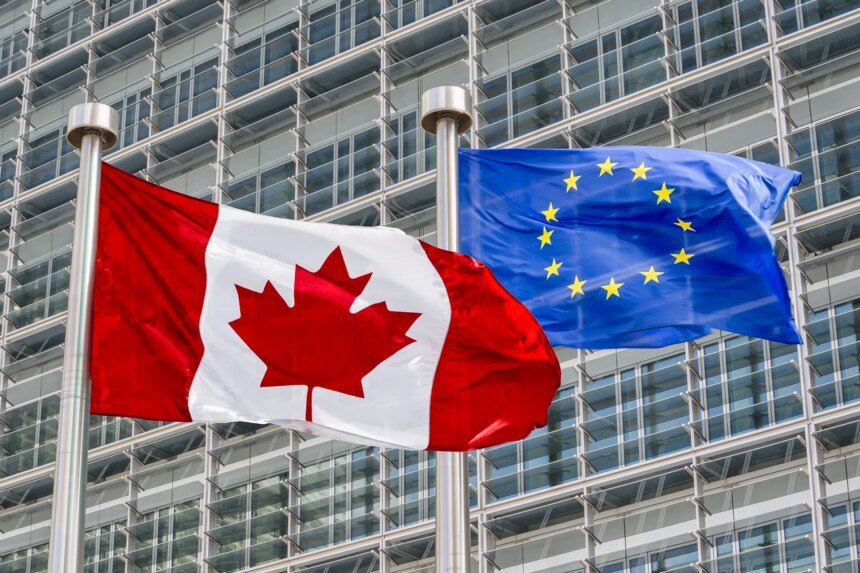
Recent European statements regarding Canada’s possible accession to the European Union did not carry a direct political significance, as much as they reflected a deeper shift in the continent’s economic priorities. The issue is not related to expanding the Union’s membership as much as it is related to determining what Europe needs from its external partners after years of crises that revealed the fragility of its traditional economic model.
Since the energy crisis that followed the Russian war on Ukraine, through the tensions in the Middle East and the fears raised by the American-Israeli war on Iran regarding oil supplies and navigation in the Strait of Hormuz, in addition to the disruptions in global supply chains and the escalation of industrial competition with China and the United States, the European Union no longer views trade relations from the perspective of customs duties and market size only, but rather from the perspective of economic security, diversification of sources of supply, and ensuring access to vital raw materials.
In this context, Canada has emerged as a partner that increasingly has what Europe needs, with its abundance of resources, institutional stability, industrial progress, and political and regulatory rapprochement with Western countries and economies.
French Foreign Minister Jean-Noel Barrot said at the “Europe 2026” conference – which was held in the German capital, Berlin, last March – that other countries may join the European Union at some point in the future, and he mentioned Canada, as part of a broader talk about the rise of Europe as a third power after the United States and China.
In turn, Finnish President Alexander Stubb referred to the idea during his conversation with Canadian Prime Minister Mark Carney, who later said at the NATO summit that joining “is not the path we are taking.” But the symbolism of this discussion hides a clearer economic reality, which is that Europe has come to view Canada as a strategic partner more than a subject for a symbolic political discussion.
Europe is rearranging its priorities after crises
The European economic model has been based for decades on three main pillars:
- Low cost imported energy.
- And open global trade.
- Cross-border production chains operate with high efficiency.

However, recent years have shaken these pillars strongly, as the gas crisis prompted European governments to spend hundreds of billions of euros to secure urgent alternatives to Russian supplies, while the green transition race and the expansion of electric cars, batteries, smart grids, and defense industries revealed that the continent lacks sufficient quantities of many strategic minerals.
Thus, European thinking shifted from the logic of “cheaper and faster” to the logic of “safer and more sustainable,” and the issue was no longer simply importing a commodity, but rather ensuring continued access to it in times of geopolitical tensions.
Canada has what Europe is looking for
Canada’s importance lies in the fact that it is one of the few countries that combines abundant resources and a reliable investment environment, a rare combination in the global economy. According to the Canadian Department of Natural Resources, the country produced 125,364 tons of nickel in 2024, a key metal in batteries and the stainless steel industry.
Canada also produced 14.3 thousand tons of uranium in the same year, and maintained the position of the largest global producer of potash with a share of 32.8% of global production. These numbers reveal that Europe is not only looking for raw materials, but also for suppliers that can be relied upon in the long term.
Nickel is an essential element in electric car batteries and energy storage systems, uranium is a pillar of European nuclear energy security, and potash is a pivotal material in the fertilizer industry, and thus in food security and food price stability.
Uranium…the clearest evidence of European dependence
If there is one number that sums up Canada’s economic value to Europe, it is uranium. According to the European Atomic Energy Agency Euratom, Canada supplied European utility companies with about 4,741 tons of natural uranium in 2024, equivalent to 33.9% of the European Union’s total imports of this material in the same year, becoming the continent’s largest supplier.
This comes at a time when several European countries, including France, Czechia, Romania and Poland, are moving to expand nuclear energy programs or extend the life of current reactors as part of plans to reduce emissions and enhance energy security. Thus, Canada does not appear to be a potential supplier for Europe, but rather a strategic partner.

Potash and grains…a value that goes beyond mining
Canada’s importance is not limited to minerals and energy. The disturbances in fertilizer markets after the sanctions on Russia and Belarus have shown that food security begins with agricultural raw materials. Here, Canada stands out as the largest global producer of potash, which is an important element in raising the productivity of agricultural crops.
European studies indicated that Canada was one of the most prominent countries capable of compensating for the global shortage of potash during periods of turmoil. It is also a major exporter of grains and agricultural oils, as its wheat exports reached 29.2 million tons, while canola exports reached 9.3 million tons as of July 2025, according to Statistics Canada data.
Although Europe does not depend on Canada daily as a major food resource, it represents a highly reliable backup resource in times of turmoil in global markets.
Trade between the two sides went beyond symbolism
The relationship between the two sides is not limited to political ambitions or future perceptions, but rather is based on an existing economic partnership that continues to expand. Since the start of the temporary implementation of the Comprehensive Economic Trade Agreement between Canada and the European Union in 2017, trade exchange between the two parties has recorded remarkable growth.
European Commission data indicate that trade in goods between the two sides amounted to 75.6 billion euros (about 88.32 billion dollars) in 2024, while trade in services reached 48.9 billion euros (about 57.13 billion dollars). Trade in goods has also increased by more than 75% since the implementation of the agreement, and trade in services has increased by about 97%.
The Commission added in an official assessment that the agreement raised the annual gross domestic product of the European Union by about 3.2 billion euros (about 3.74 billion dollars), and raised the Canadian GDP by about 1.3 billion euros (about 1.52 billion dollars) annually, and it also increased the exports of small and medium European companies to Canada by 20.3%. These numbers confirm that the relationship has gone beyond the stage of political niceties to tangible economic gains.

Canada needs Europe too
In contrast, Ottawa sees in Europe a strategic opportunity to reduce over-reliance on the American market. According to official Canadian data, 76% of Canadian goods exports went to the United States in 2024, before the percentage decreased to 71.7% in 2025 with attempts at trade diversification. This means that the Canadian economy remains highly sensitive to any trade, regulatory, or political tensions with Washington. As for Europe, it gives Canada access to a market that includes more than 449 million consumers and an economic output of approximately $25.1 trillion, according to official Canadian data.
Canadian expert Mark Camilleri said, in an analysis published by Foreign Policy magazine, that Canada does not need European Union membership, but rather to maximize the benefit of the current trade agreement and expand it towards a deeper partnership, warning that full accession may impose a broad reorganization that may confuse the Canadian economy linked to North America.
From a trade agreement to an economic security platform
Most likely, the next stage in the relationship between the two sides will not be political membership, but rather an institutional deepening of the economic relationship, according to observers. This includes expanding cooperation in critical minerals, digital trade, industrial investment, clean energy, defense supply chains and harmonizing regulations.
In March 2026, the two sides launched negotiations for a new digital trade agreement, in a move that reflects the relationship’s transition from the logic of traditional trade to the logic of a broader strategic economic partnership. European data indicate that more than 40% of services trade between the two sides is already conducted through digital means.
Europe does not deal with Canada as a political expansion project, but rather as a reliable partner that enhances its ability to confront market shocks and economic geography fluctuations, while rapprochement with the continent gives Ottawa a broader outlet to reduce dependence on a single market. The debate over membership may subside, but the economic drivers of rapprochement appear more entrenched, especially at a time when considerations of security and flexibility take precedence over the logic of cost alone.