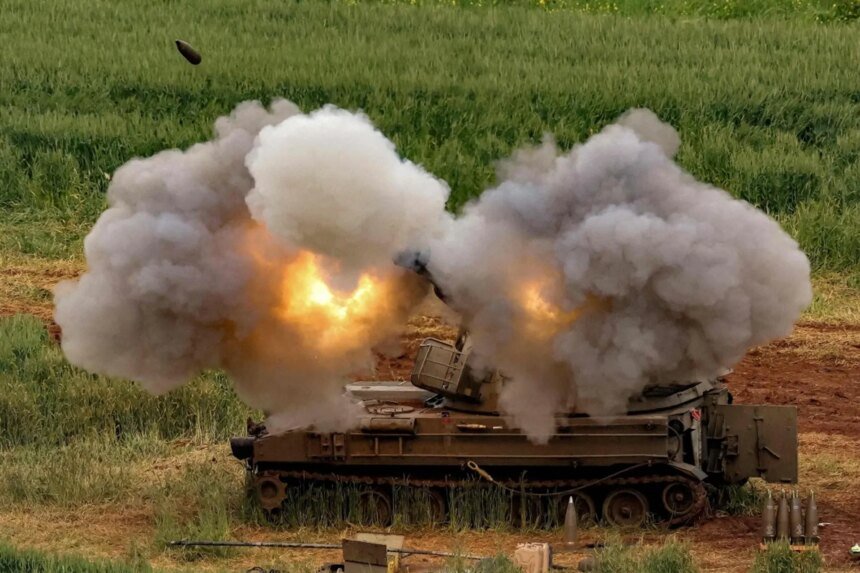
Since Israel expanded its military operations in southern Lebanon, the security and military establishment has been seeking to impose new field conditions that limit Hezbollah’s influence and secure the northern border region.
This comes in light of what some Israeli voices have come to describe as a “soldier hunting field,” as a result of repeated targeting operations targeting advanced forces and vehicles along the border.
However, successive developments on the ground indicate that this goal still faces major challenges, in light of the continuing Israeli human and military losses and the recurrence of attacks targeting advanced forces and their vehicles, which raises increasing questions within Israel regarding the feasibility of continuing ground operations and their escalating cost.
A painful blow
The killing of 4 Israeli soldiers – elite soldiers – including the commander of the 52nd Battalion in the 401st Armored Brigade, Lieutenant Colonel Dor Jedaliah Ben Simhoun (32 years old), during the targeting of their tank in the vicinity of the town of Kafr Tibnit in southern Lebanon, constituted the latest episode of attrition facing the Israeli forces in southern Lebanon.
Israeli Army Radio reported that the tank belonging to the 52nd Battalion was operating within a combat force led by the Givati Brigade in the area of the village of Mantif in southern Lebanon.
The recent loss bears special significance given the rank of the slain officer within one of the most prominent armored brigades in the Israeli army, the 401st Brigade. He joins a long list of leaders of this brigade who have been killed or wounded since the outbreak of confrontations in Gaza and Lebanon.
Israeli media also reported that 17 soldiers were injured, including members of the elite forces and field officers, in one of the harshest strikes the Israeli army received on the Lebanese front in recent weeks.
Thus, the number of Israeli army deaths in Lebanon rises to 23 soldiers since the ceasefire was announced last April.
In the wake of the killing of the four soldiers, the Israeli government was quick to issue threats to expand the military response, while ministers on the extreme right called for the complete destruction of Lebanon.
However, observers considered that these statements partly reflect the extent of frustration resulting from the continuing losses and the inability of military operations to provide a stable security reality on the northern border.

Continuous drain
The nature of the recent operation in southern Lebanon reflects Hezbollah’s continued ability to target Israeli forces even in areas witnessing intense military activity and continuous air strikes.
The cost of the Israeli presence is not limited to human losses only, but also extends to material losses affecting tanks and military vehicles.
During the past months, Merkava tanks and various engineering and military vehicles were targeted by guided missiles, drones, and ground ambushes, which forced the Israeli army to adopt additional protection measures and raise the level of caution during ground movements.
Reactions inside Israel reveal growing concern about the Lebanese front turning into a long-term arena of attrition.
Earlier, the father of one of the soldiers participating in operations in southern Lebanon described the region as a “hunting field for soldiers with Hezbollah marches,” and political and media criticism of the government escalated regarding the continuation of operations without achieving decisive results on the ground.
According to the Israeli Broadcasting Authority, the soldier’s father – who was not named – sent a letter to Army Chief of Staff Eyal Zamir, in which he stressed that the soldiers were now facing a constant threat that made them depend on luck to survive.
Hezbollah’s field capability
On the other hand, field data show that Hezbollah still maintains a wide margin of freedom of movement and military action in the regions of southern Lebanon.
In recent days, the party announced that it had confronted several Israeli advance attempts in the vicinity of Kafr Tibnit, Arnoun, and Ali al-Taher Hill, confirming the infliction of human and material losses among the ranks of the attacking forces.
The operations carried out also indicate its continued ability to monitor, collect information, plan ambushes, and target moving forces at sensitive times.
Despite the intensity of the Israeli air strikes that targeted dozens of sites in southern Lebanon, the repeated targeting operations against ground forces suggest that air superiority has not yet succeeded in ending Hezbollah’s ability to fight or prevent it from redeploying and operating within the confrontation areas.
The continuation of clashes after months of military operations reflects the difficulty of achieving a quick field resolution in a complex combat environment that relies on flexibility and decentralized deployment.
With every new targeting operation, questions are renewed – within Israeli society – about Israel’s ability to achieve its declared goals, at a time when Hezbollah continues to demonstrate its ability to initiate, maneuver, and impose an equation of attrition that makes the cost of remaining in the field higher than expected.