Published On 4/23/2026
|
Last updated: 4/24/2026 00:43 (Mecca time)
Al Jazeera correspondent Omar Hawash quoted Iranian Foreign Ministry spokesman Ismail Baghaei as saying that his country has not yet decided on its decision to participate in the upcoming round of negotiations in Islamabad.
Baghaei said that the Iranian position is still linked to clear conditions, most notably the lifting of the siege on the countryAnd remove the threats directed against it, pointing at the same time to what he described as “excessive American demands.”
He accused the United States of continuing to violate the ceasefire by continuing the naval blockade, and considered this a blatant violation that may amount to war crimes and a new aggression against Iran. He also cited the attack on an Iranian commercial ship in the Gulf of Oman a few days ago, which he said does not reflect the behavior of a country engaged in a diplomatic path.
The Iranian spokesman also revealed that one of the scenarios proposed during the previous negotiations in Islamabad included the option of reducing the level of enriched uranium by 60%, but he stressed that this issue had not been resolved due to the failure to resume negotiations.
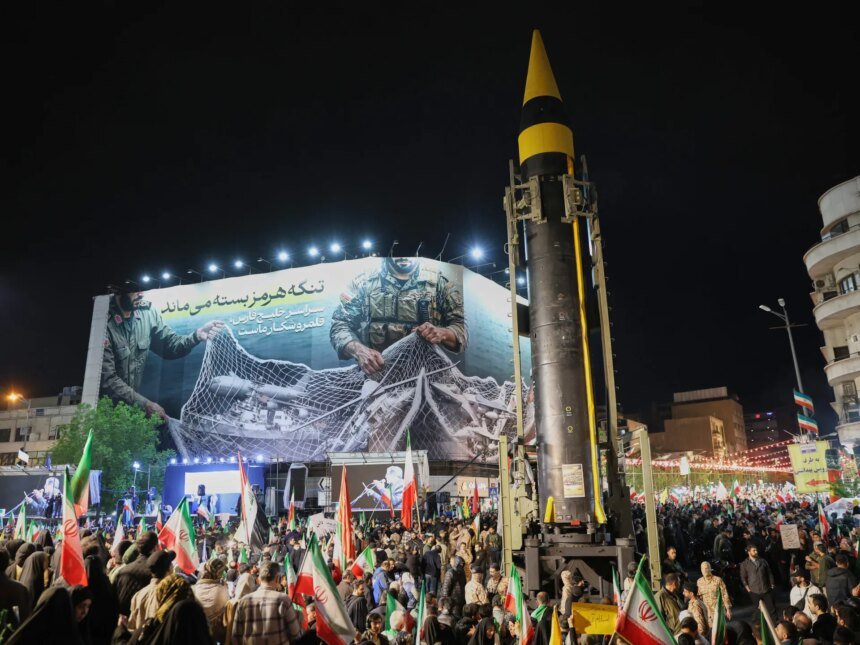
Regarding the Strait of Hormuz, Al Jazeera’s correspondent pointed out the continued state of tension in the region, with Tehran emphasizing what he described as “strengthening its sovereignty” over the strategic corridor, by talking about transit fees imposed on passing ships.
Fars Agency quoted the Central Bank of Iran as saying that Tehran has actually begun collecting transit fees in cash and in hard currency, with the value of the fees determined according to the size and type of goods, their degree of danger, and their impact on the safety of navigation.
According to the Central Bank, these fees come within the framework of what Iran considers to be in exchange for securing maritime navigation in the vital strait.
Unity message
In a simultaneous internal political context, a series of tweets and statements issued by senior Iranian officials, including President Masoud Pezeshkian, his deputy Mohammad Reza Arif, Parliament Speaker Mohammad Bagher Qalibaf, Foreign Minister Abbas Araqchi, in addition to the head of the judiciary, Gholam Hossein Mohseni Ejei, unanimously agreed on a unified position, as a direct response to the statements of US President Donald Trump, who spoke of the existence of a division within Iran between moderates and extremists.
Taken together, these statements confirmed that there are no moderates or extremists in Iran, and that the Iranian people are united as a single revolutionary force under one leadership, while emphasizing the unity of the institutions of the state, the people, and the various nationalities.
Qalibaf said in his tweets that Iranians are united revolutionaries and that the country will make the aggressor regret the unity of the people and the government, while Pezeshkian and Qalibaf together stressed denying any internal division.
As for the Iranian Vice President, he considered that Iran is not a land of disagreements, and that political diversity represents the essence of democracy, while Foreign Minister Abbas Araqchi stressed that the field and diplomatic front are completely consistent, and that Iranians are more united than ever before.
For his part, Iranian Foreign Ministry spokesman Ismail Baghaei said that the enemy’s tweets target the country’s unity, and that talk of division is baseless, stressing at the same time that any agreement with Washington must guarantee national interests, remove the threat, and prevent the recurrence of aggression.
He added that Iran does not see the possibility of accepting the continuation of ceasefire commitments in light of the American party’s lack of commitment, noting that the blockade on the ports reflects Washington’s bad intentions.
He also stressed that the issue of transporting highly enriched uranium is not an option currently, while the option of reducing enrichment remains theoretically valid, stressing that there is a contradiction between the American rhetoric calling for diplomacy and the continued attacks on Iranian ships.
In a related context, the Iranian Foreign Ministry spokesman confirmed that the decision to participate in a new round of negotiations with Washington has not been taken yet, explaining that Iran, despite its readiness to negotiate, also remains ready for all other scenarios.
He pointed out that the continued American pressure prevents building the confidence necessary for any negotiating path, pointing out that the current negotiations depend on indirect channels through intermediaries.

Ghalibaf’s resignation was denied
For his part, Hussein Pak, a member of the delegation accompanying the negotiating team in Islamabad, denied the validity of what was circulated in the Israeli media regarding the resignation of Iranian Parliament Speaker Mohammad Baqir Qalibaf from his position under pressure from the Revolutionary Guards, stressing that he is at the helm of his work and enjoys the confidence of the leadership and the Revolutionary Guards.
Pak said that Ghalibaf is part of the Iranian political and military establishment, and enjoys close relations with various state institutions, including the National Security Council.
In response to a question about the possibility of the Speaker of Parliament leading any future negotiating delegation, the Iranian official said that it depends on the level of American representation, adding that if the American side commits, we may witness the presence of Qalibaf at the head of the Iranian delegation.