US President Donald Trump said on Wednesday that the authorities in Iran had agreed not to execute eight female demonstrators, and he considered this a sign of respect for his person. This was denied by Tehran, which accused him of spreading lies.
“This is very good news,” Trump wrote in a social media post, a day after he announced a unilateral ceasefire in the war that the United States and Israel began on February 28.
Read also
list of 2 itemsend of list
Trump added that 4 of the women will be released immediately, while the other four will be sentenced to one month in prison, and expressed his gratitude by saying: “I greatly appreciate that Iran and its leaders respected my request as President of the United States and canceled the scheduled execution.”
In the context of promoting the same story, White House spokeswoman Carolyn Levatt stated during an interview with Fox News that “only President Trump was able to save the lives of these eight beautiful Iranian women.”
The origin of the publication and the background of the source
The White House account on the “X” platform had reposted a screenshot of Trump’s statement on the “Truth Social” platform, in which he said: “To the Iranian leaders who will soon enter into negotiations with my representatives, I would greatly appreciate the release of these women, and I am sure they will respect that. I hope you do not harm them, and it will be a great start for our negotiations.”
It is noteworthy that Trump initially shared a tweet published by the account of “Eyal Yacobi,” an influencer known for his strong support for Israel and his promotion of Israeli propaganda and lies related to the war on Gaza to cast doubt on the victims.
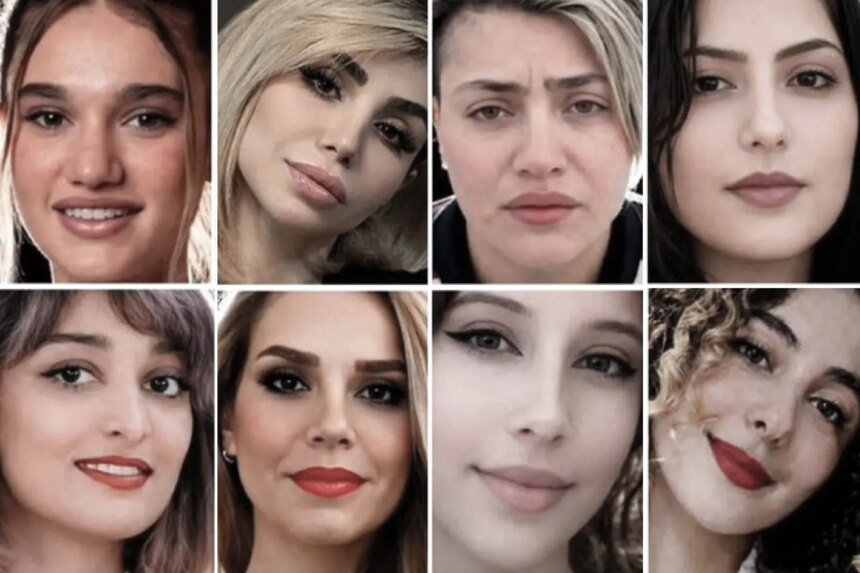
On April 21, Yaqubi published pictures of the faces of eight women, and wrote: “The Islamic Republic is preparing to execute eight women by hanging, without a single word from the international community or the so-called human rights organizations.”
Questioning the images
Social media platforms witnessed a widespread state of skepticism, as users accused Trump of re-publishing photos of alleged women that were generated using artificial intelligence techniques.
Influential activist Owen Shroyer wondered why they had a stable headshot from the same photo session, adding: “Did they take these professional photos together? Or was it just another coincidence?”
News platforms summoned clips generated by artificial intelligence as part of what they called an Israeli influence operation, as Chris Minahan’s account wrote: “There is an Israeli influence operation called generative artificial intelligence for good that creates victims from Iran to incite regime change. They held a conference in New York last week, and this is a short clip of a false propaganda video that they published.”
In another interaction, Robert Barnes, a lawyer in civil, criminal, and constitutional cases, mocked Trump’s adoption of Yacobi’s allegations, and described the latter as an activist who puts Israel first and constantly lies.
Barnes added in a sarcastic manner: “Trump embraced it enthusiastically, but it is good news for Iran anyway, as they can agree not to execute the eight women who they did not intend to execute in the first place, as it is difficult to execute people who are in fact just images generated through artificial intelligence technologies.”
Extensive ridicule and the “Grock” test
In another interaction, an account called “Muhammad” criticized the White House’s adoption of this narrative, writing: “No one spreads blatant lies in favor of Israel more than Eyal Yacobi, and now the White House is spreading its made-up nonsense. What a stupid world.”
The Junior account wrote: “Trump begs Iranian leaders not to execute 8 women born with artificial intelligence, this is the funniest thing I have ever seen.”
To verify the images, activists tested the “Grok” robot, which showed that the claim was exaggerated. Pointing out that the pictures of women belong to female detainees in the protests of last January, and that human rights organizations such as Amnesty International and Human Rights Watch confirmed that one activist, Beta Hemmati, received a death sentence, but there are no confirmed execution dates for the entire group.
Iranian response
On the Iranian side, Tehran, according to Reuters, described the entire issue as a fabrication and an attempt by Trump to save face, in light of his frustration at Iran’s refusal to reopen the Strait of Hormuz, which is a vital corridor for a fifth of the world’s oil and gas, despite the ceasefire he announced on April 8 and extended on Tuesday.
The Iranian Mizan Agency said on Wednesday: “Trump’s empty-handedness on the battlefield pushed him towards fabricating achievements from false news,” adding that Trump called on Tehran to cancel death sentences based on a false story, and despite exposing its falsity, he returned to announce the cancellation of the sentences and thanked Iran.
The agency confirmed that some women have already been released, and some of them face charges that could lead to imprisonment rather than death.
Identification of the women and the response of the Iranian embassy
Other activists published the names of eight Iranian women based on reports from American websites such as Fox News and the New York Times, but they denied what was reported about Trump’s efforts to stop their execution.
In the same context, the account of the Iranian embassy in Sierra Leone responded to Trump’s statements with a fact-checking blog post, confirming that four of the women mentioned by Trump have been at large for weeks, while the others are in custody awaiting trial on charges that lead to imprisonment, not death.
The embassy recalled Trump’s previous “lie” about carrying out 800 executions in Iran, and concluded its post by saying: “The bottom line: Trump is a losing warmonger, a liar, and completely divorced from reality.”
It should be noted that the protests in Iran began on December 28, against the backdrop of rising prices and poor living conditions, following the decline in the exchange rate of the local currency (the riyal) to low levels, and the rise in the inflation rate to 43%, according to official figures.
Last January, Iranian television announced, based on a security source, the arrest of 3,000 people on charges of belonging to “terrorist groups” or participating in riots.
Tehran says that these groups turned the protests toward violence, leading to deaths among police and security forces.
In terms of human losses, the latest statistics issued by the Human Rights Organization in Iran, based in Norway, indicate that at least 3,428 demonstrators were killed.
The organization explained that the actual number may be much higher, but it was not possible to confirm these numbers through independent sources.
Source: Iranian press + Reuters + social media sites