Published on 6/27/2026
The Russian-Ukrainian war witnessed a simultaneous field and political escalation. While Moscow and Kiev exchanged violent drone strikes that resulted in deaths and injuries, a diplomatic debate raged between the Russian and American foreign ministers over the reality of reaching understandings to end the war at the Alaska summit.
Mutual attacks
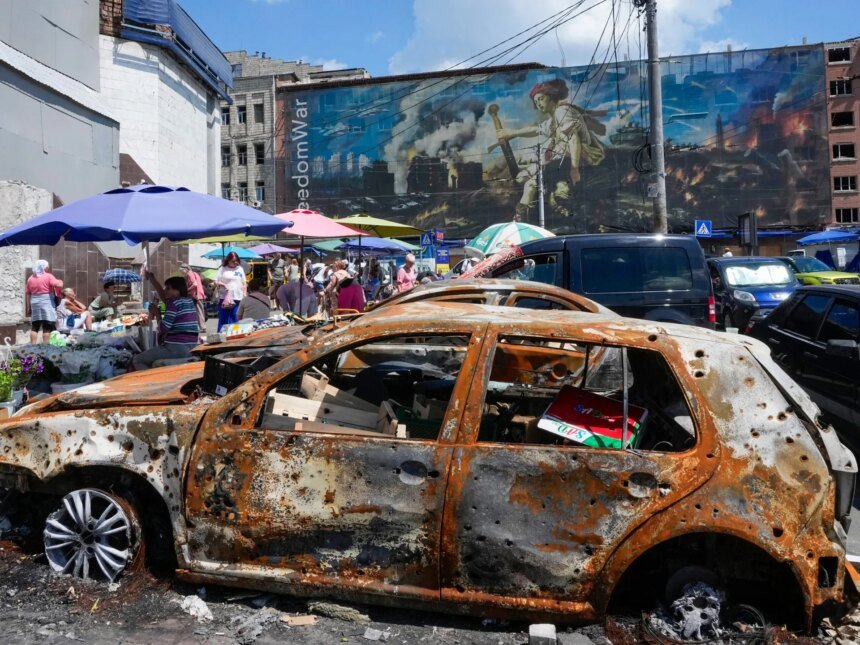
Local officials reported that a Russian air strike with drones resulted in the killing of two passengers on a minibus in the Dnepropetrovsk region in southeastern Ukraine, in addition to the killing of another person in the Sumy border region.
The governor of the Dnepropetrovsk region, Oleksandr Hansa, said on Friday that two people were killed and 12 people were injured, including two children, in the raid that took place in the city of Nikopol.
This city, located on the opposite bank of the Dnipro River from the Zaporozhye nuclear power plant, is frequently subjected to Russian attacks, according to Reuters.
In the Sumy region, which is subject to almost continuous Russian attacks on the border, its governor, Oleh Hryhorov, said that a drone air strike resulted in the death of a man in a village located on the outskirts of the main center of the region, which also bears the name Sumy.
Mikhail Fedorov, governor of the Zaporozhye region in southeastern Ukraine, said that two people were injured in Russian attacks that continued throughout the day and damaged the facades of residential buildings.
On the Russian front, Moscow Mayor Sergei Sobyanin announced on Friday that Russian defenses shot down at least 28 drones heading towards the Russian capital within about one hour, indicating that specialists from the emergency services were working at the sites where the debris fell.
These attacks come after 5 people were killed, Thursday, in Ukrainian attacks on Russia and the Crimean Peninsula.
Russian political escalation
Politically, Russian Foreign Minister Sergei Lavrov escalated his dispute with his American counterpart Marco Rubio, as Lavrov asked for clarification about Washington’s role in trying to end the war.
In written responses to questions from the media, Lavrov escalated his dispute with his American counterpart Marco Rubio over whether Presidents Vladimir Putin and Donald Trump had reached an understanding on the broad outlines of a peace agreement during their meeting in Alaska last year.
Russia says that this understanding between the American and Russian presidents, which outlined the outlines of a peace agreement, has already been achieved, but Rubio denied reaching any agreement in statements to reporters on Thursday.
Rubio said: “There was a proposal in Alaska, but we did not reach an agreement. If there had been an agreement, the war would have ended.” In response, Lavrov provided the most detailed account to date of what happened at the summit last August.
He said that Putin reviewed a series of American proposals that Steve Witkopf, Trump’s envoy, brought to Moscow a few days ago and presented them point by point.
“So, when my colleague Rubio says there were only proposals in Alaska and no agreement, it raises the question of what we actually mean by ‘agreement,'” he added.
The critical comments made by Lavrov and other Russian officials this week reflect a shift in Moscow’s assessment of Washington’s efforts to end the Russia-Ukraine war, which has stalled since the United States and Israel launched a war on Iran in February.