Published on 6/26/2026
|
Last update: 19:53 (Mecca time)
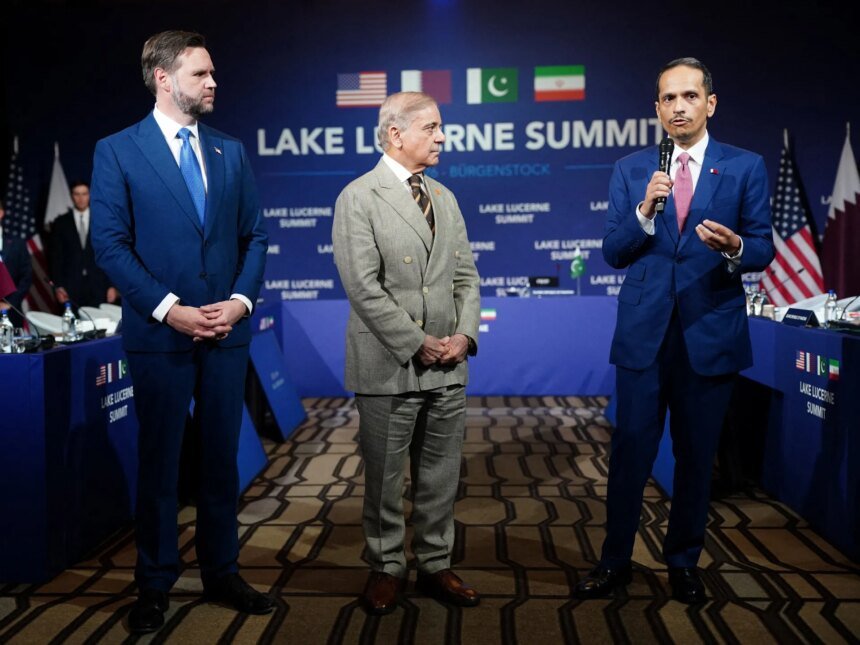
The Qatari-Pakistani mediation succeeded in leading a complex process that resulted in a US-Iranian agreement that saved the region from the precipice of war that almost ravaged the Middle East and global stability.
A report by the Associated Press, today, Friday, revealed the scenes of that mediation, which took place amid mutual American-Iranian threats that almost destabilized the diplomatic track.
On June 11, a plane carrying Qatari mediators was stuck on the airport runway in Tehran, due to the United States and Iran exchanging intermittent escalatory strikes.
The mediators were engaged in intense talks throughout the night, trying to stop what appeared to be a dangerous slide that would return the region to all-out war, according to what the agency quoted an informed diplomat.
This tense scene on the airport tarmac summarized the stormy diplomatic path led by Pakistan and Qatar, which resulted last week in reaching an agreement to end the war.
This was one of several stations in which threats made through statements on social media platforms or actual military actions almost ignited the flames of war again.
This report, which reveals the scenes of the mediation of the agreement, is based on interviews conducted by the Associated Press with 3 Pakistani officials, regional officials, and the aforementioned diplomat.

Behind the scenes of Qatari mediation
On the same day as the airport runway incident, US President Donald Trump threatened massive military action, saying Washington would strike Iran “very hard tonight” and impose “total control” over Iran’s oil and gas sectors.
While US forces were preparing to launch new military action against Iran, efforts by regional mediators moved quickly with the aim of convincing Trump to give diplomacy another chance.
According to the diplomatic source, the Emir of Qatar, Sheikh Tamim bin Hamad Al Thani, spoke directly with Trump and urged him to back off the attack on Iran because an agreement was imminent.
Qatari efforts were successful, as Trump canceled the planned strikes. Days later, Washington and Tehran signed an agreement to end the conflict that broke out following the American-Israeli attack on Tehran last February.
The agreement stipulates the reopening of the Strait of Hormuz, which Iran had closed at the beginning of the conflict, which obstructed shipping traffic and caused energy prices to rise, in addition to lifting the US blockade to allow Iran to export its oil.
The US-Iranian agreement set a deadline of 60 days to negotiate a broader agreement on Iran’s nuclear program, in exchange for providing facilitations and economic incentives to Tehran.
Qatar has extensive experience in the field of mediation, as it played a major role alongside Egypt in negotiating a ceasefire in Gaza. Then Qatari officials began working side by side with Pakistan on the Iran file.
Qatar and the Sultanate of Oman had contributed to previous negotiations between the United States and Iran, but those efforts suffered a setback at the beginning of the war when Iran launched attacks on the Gulf states.
Accordingly, Qatar refused to mediate under the fire of those attacks, but by mid-May, with the cessation of Iran’s strikes on the Gulf states, the United States and Iran contacted Doha asking for their help to break the stalemate, according to the diplomat.

Pakistani mediation efforts
In parallel with the Qatari moves, Pakistan emerged as a major channel of communication. Although it did not usually conduct high-level diplomacy in such complex files, it led mediation efforts because it shares a land border with Iran and enjoys good relations with Tehran and Washington.
Officials said that Pakistani Army Commander Field Marshal Asim Munir played a major role in the success of diplomatic efforts, due to his direct contacts with Trump.
In this context, Charles Lyons Jones, a former Australian diplomat who worked in Pakistan, said: “With the prolongation of the US-Iranian war and the desire of both parties to reach an agreement, the unique network of relationships that Munir has in Washington and Tehran has become of great value.”
The Pakistani negotiating team used a secure system to transmit messages between Iranian and American officials, to prevent any influence on the talks. One Pakistani official said that employees had been warned that leaking any information could result in a life sentence.
Pakistani mediation efforts enabled a truce to be reached last April. Days later, representatives of the United States and Iran met in Islamabad for the first talks.
US President Donald Trump later commented on the ceasefire, saying, “I wasn’t really in favor of it, but we did it as a service to Pakistan. They are wonderful people.”
The Associated Press, citing regional officials, reported that Iran wanted to postpone discussing the fate of its highly enriched uranium, but the mediators convinced it to include a commitment to reduce its stockpile in the draft text of the agreement.
This step came in response to American promises to exempt from sanctions imposed on oil sales and gradually lift the freeze on billions of dollars in Iranian assets.