Published on 6/26/2026
|
Last update: 23:13 (Mecca time)
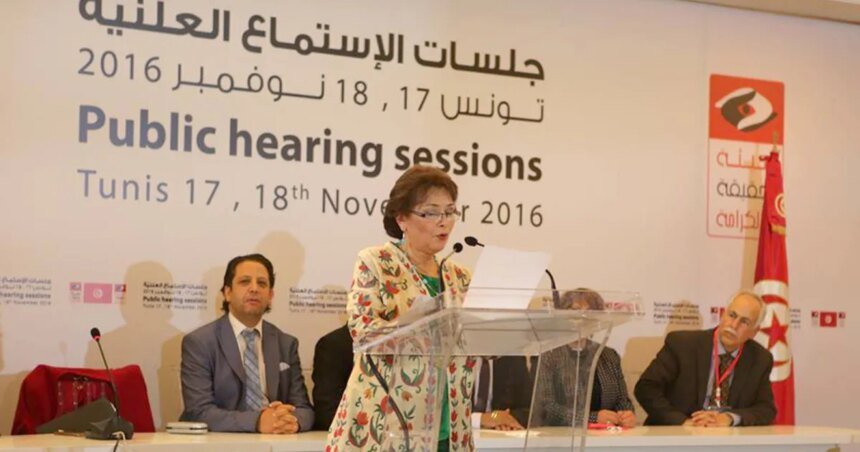
The recent ruling issued against the outgoing head of the Truth and Dignity Commission, Siham Ben Sedrine, has reignited the controversy over the legality of the trials targeting opponents of Tunisian President Kais Saied, which many criticize at home and abroad and are defended only by his supporters.
The criminal department responsible for examining financial corruption cases at the Court of First Instance in the Tunisian capital sentenced Ben Sedrine to 25 years in prison in cases related to what the court described as “abuses and violations” that accompanied the work of the Truth and Dignity Commission, in addition to the Franco-Tunisian Bank file.
The trial included a number of defendants, including former Minister of State Property and Real Estate Affairs Mabrouk Karsheed, former member of the Truth and Dignity Commission Khaled al-Kraishi, and businessman Salim Shaiboub.
Commenting on these rulings, Siham Ben Sedrine told Al Jazeera Net that these decisions condemn those who issued them, and that the judges “do not have any legal legitimacy to try the Truth and Dignity Commission.”
While opponents of President Kais Saied consider this ruling an episode of persecution of political opponents and the killing of the democratic and human rights path in the country, his supporters see it as part of the path to achieving justice and applying the law to everyone.

Liquidation of democracy
Journalist and political analyst Mohamed Al-Youssoufi said that what happened was shocking, even if some disagreed with Siham Ben Sedrine politically or ideologically because it carried historical and struggle symbolism, and was one of the headlines of the democratic transition in Tunisia.
Because she was the head of the body that supervised the transitional justice process, what is happening to her “is considered a trial of all the symbols of the democratic transition,” according to what Al-Youssoufi said on the “Beyond the News” program.
Through these rulings, which Al-Youssoufi said lacked the minimum elements of justice, the state is trying to say that all those who participated in the democratic transition process are guilty and deserve to be held accountable because they did things that are inconsistent with the aspirations of Tunisians, while it is trying to escape from its economic and political failure after mentioning Tunisia in the international press has become associated only with trials.
One of the ironies of the Tunisian political scene, in Al-Youssoufi’s opinion, is that Khaled Al-Karishi (one of those included in the recent rulings), who was a supporter of Kais Saied, is being tried today with Siham Ben Sedrine after he rejected the president’s monopolization of power and his encroachment on rights and freedoms.
Therefore, it is not possible to talk about the fairness of the trial in the absence of the Supreme Judicial Council and the Constitutional Court, which were stipulated in the Constitution of Kais Saied, which he wrote with his own hand. Therefore, the conditions for a fair trial do not exist, in the opinion of the Tunisian journalist and analyst, who describes these trials as “a settling of scores and a democratic experiment.”
Siham Ben Sedrine is not accused of corruption, says Al-Youssoufi, who expects more trials in the future, “because the authority invests in hatred and demonizes everyone who disagrees with it, whether politicians, human rights activists, or journalists, including Najib Chebbi, the leader of the democrats in Tunisia, who was tried during the reigns of Habib Bourguiba and Zine El Abidine Ben Ali.”
The law applies to everyone
But writer and analyst Suhaib Al-Muzariqi completely disagrees with the previous opinion, and believes that the state “adopts the logic of accountability and the recovery of looted funds globally, not just locally.”
Even issuing these rulings late at night “is not a heresy, because Tunisians have become accustomed to it since 2011 until today,” says Al-Mazriqi, who believes that justice “should not exclude anyone.”
These provisions were not based on laws enacted by Kais Saied after July 2021, but rather on laws stipulated in the post-revolution Tunisian constitutions, according to Al-Mazriqi, who said that the body headed by Ben Sedrine “was not the subject of an agreement at all.”
This body, as the Tunisian journalist spoke to, was the subject of controversy because some believe that it was established to approve compensation for some political parties, and that it applies double standards and looks at one faction over the other factions and tries to compensate it materially and morally, which has made it lose its credibility before the people.
The Truth and Dignity Commission, which was established after the Tunisian revolution, is one of the most prominent institutions in the transitional justice process, as it investigated the violations that Tunisia witnessed over the decades, before ending its work amid an ongoing political and legal debate about its legacy and results.
As for the international human rights organizations that criticize the situation in Tunisia, they are also not reliable, “because they are tools in the hands of major powers that want to interfere in the affairs of others, as evidenced by the fact that they do not talk about what is happening in Palestine or on the African coast,” according to Al-Mazriqi.
Indeed, the presence of some of those who supported Kais Saied’s previous measures in prisons and the issuance of sentences against them confirms – in the speaker’s opinion – that the state “does not favor anyone and holds everyone accountable in the same way.”
Tunisia is experiencing a political and human rights reality that has brought it a lot of internal and external criticism, as many political and human rights figures in the country have been tried on charges that opponents see as illogical and unacceptable.