Published on 6/27/2026
|
Last update: 09:24 (Mecca time)
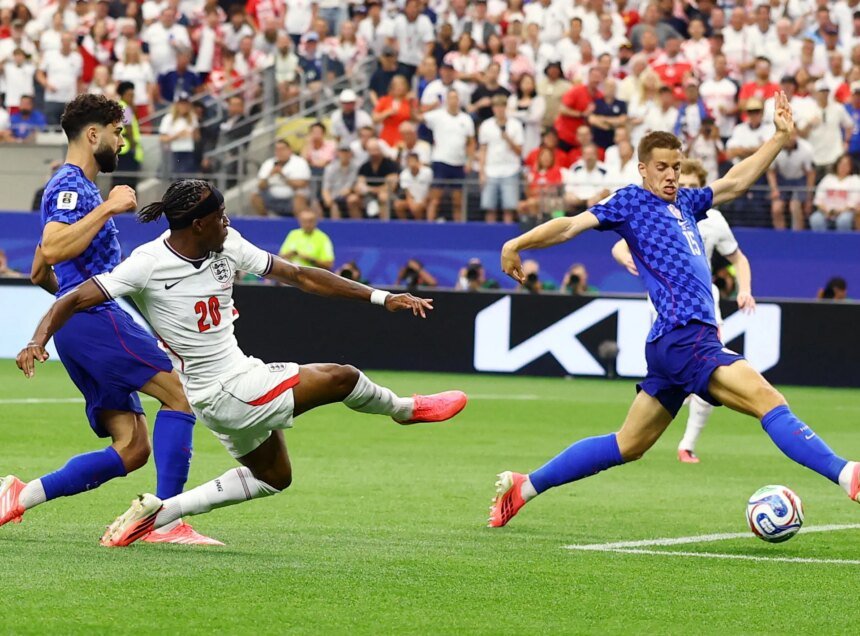
During a match between England and Croatia that ended in favor of the English with four goals to two, an unusual scene emerged. The match referee was French, England’s coach was German, and of the 22 players who participated in the match, only two of them had never played in the Spanish League. Despite these backgrounds that had nothing to do with the Spanish language, the cry “Vamos” rose from the field.
This was shouted by English player Noni Madueke after he dribbled past defender Josko Gvardiol and shot a cross that hit Mario Pasalic’s foot. Madueke headed towards the English fans, asking them to raise the level of encouragement. This behavior seemed surprising to observers, given that Madueke grew up in London and spent the years of his career between English clubs and the Dutch club “PSV Eindhoven”.
Read also
list of 2 itemsend of list
The impact of cultural diversity in dressing rooms
Experts attribute this behavior to the intermingling of cultures in the locker rooms. Players partner with teammates and coaches from diverse linguistic backgrounds. Jude Bellingham, the England national team midfielder and Real Madrid star since 2023, is a living example of this. In an interview with ITV, Billingham explained that he uses “Vamos” in Spain to communicate with his teammates, but sometimes he uses it involuntarily while participating with the England national team, which raises the surprise of his teammates.
A linguistic analysis of the emergence of the phenomenon
Dr. Texas Martin, a lecturer in linguistics at the University of Cambridge, explained in a report published by The Athletic that the rise of this word is due to the dominance of the Spanish League and stars such as Lionel Messi. Martin points out that modern football has acquired something like a “Spanish accent” as a result of the influence of players and coaches from Spain and Latin America.

Martin added that the era of rivalry between “Tiki Taka” Pep Guardiola and “Galacticos” Jose Mourinho, and the brilliance of Messi and Ronaldo, contributed to introducing Spanish vocabulary into the international football dictionary. Just as Italian became the language of classical music and French the language of cooking, Spanish became the language of football, influenced by Latin American radio commentary styles and terms like “golazo” or “goal.”
Nadal.. “zero point”
For his part, writer for The Athletic, Charlie Eccleshire, confirms that tennis legend Rafael Nadal is primarily responsible for the spread of this trend. Between 2005 and 2022, Nadal’s name – who topped the world rankings for a total of 4 years – was associated with the “Vamos” shout, which he released after every decisive point.

This tradition moved from the tennis courts to football, as other athletes began to adopt the word. Eccleshire pointed out that Nadal was “point zero” in this phenomenon, explaining that his influence extended beyond the boundaries of tennis to the point that the word “vamos” began to compete with the traditional English phrase “Come on.”
Why does “Vamos” succeed sonically?
Dr. Martin explains that “vamos” have vocal characteristics that make them ideal for cheerleading; It is a “sonor” (high resonant) word that is easy to pronounce, and its vowels can be lengthened to match the cheers of the crowd, similar to the word “Marchons” in the French national anthem.
Technically, the word has a “rhythmic character” that gives a boost of energy when pronounced. As for its meaning, it has evolved from its literal meaning (let’s go) to become an expression of collective energy and “participation”, as it is not directed to a specific person, but rather creates a link between the player and the audience.
Martin concludes his analysis by emphasizing that “Vamos” has become part of the international football dictionary, not only because of its meaning, but also thanks to a combination of historical, phonetic and cultural factors that made fans aware of its context and use it accurately without the need to master the Spanish language.