Published On 6/24/2026
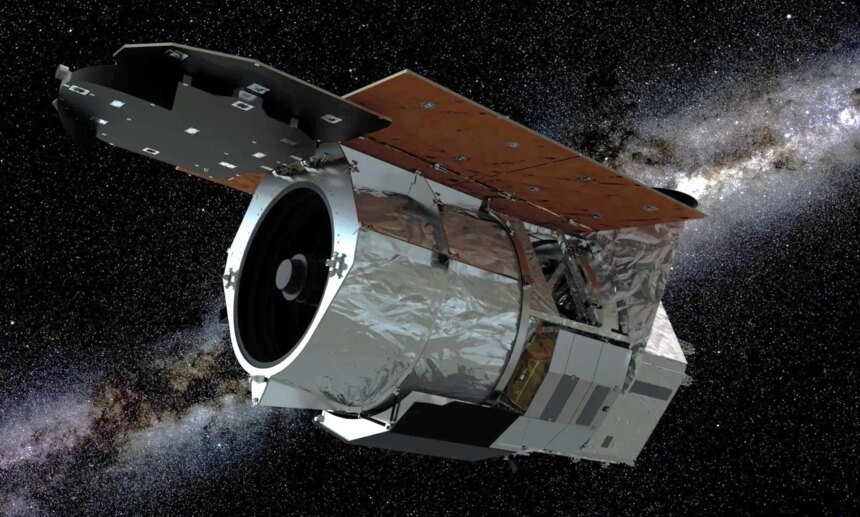
The Nancy Grace Roman Telescope, the newest of NASA’s major space observatories, has arrived at the Kennedy Space Center in Florida, USA, marking the start of the final stage of preparations before its expected launch at the end of next August aboard a SpaceX Falcon Heavy rocket.
The telescope bears the name of American astronomer Nancy Grace Roman, who is known as the “Mother of Hubble” for her pivotal role in establishing the space telescope program at NASA during the 1960s and 1970s.

The observatory was transported from NASA’s Goddard Space Flight Center in Maryland to the port of Baltimore, before the agency shipped it via the Pegasus sea barge along the Atlantic coast to Florida.
Read also
list of 2 itemsend of list
The observatory weighs about 8,200 kilograms, making it one of the largest and most important astronomical projects that NASA is preparing to launch during the current decade.
Final tests before flight into space
After arriving at the Kennedy Center’s Space Hazardous Payload Processing Facility, engineers began a series of cleaning operations to remove contaminants that may have become trapped in the protective container during the cruise.
The telescope will be transferred to a highly sterile clean room where it will undergo final tests that include examining the six solar panels, thermal insulation systems, and components responsible for managing temperatures in space.

The vehicle will also be supplied with approximately 1,100 liters of hydrazine fuel, a highly toxic liquid chemical fuel used in space propulsion systems to guide the observatory to its final orbit and perform precise corrective maneuvers throughout its operation.
NASA is currently targeting a launch date no earlier than August 30, 2026, a date that comes about eight months ahead of the original mission schedule, reflecting the rapid progress achieved by the development and testing teams.
A journey to the point of cosmic balance
After the launch, the observatory will head to the second Lagrange point between Earth and the sun, located about 1.6 million kilometers from Earth in the opposite direction to the sun.
This region is characterized by a gravitational balance between the Earth and the Sun, which allows spacecraft to operate very efficiently while reducing fuel consumption.

The primary mission is expected to last at least five years, with the possibility of extending it for a full decade or more if scientific instruments and fuel reserves remain in good condition.
Roman will join the elite of famous space observatories such as Hubble, James Webb, and Chandra, but he will be distinguished by his ability to survey large areas of the sky at an unprecedented speed, which gives him a unique advantage in studying the cosmic structure on a massive scale.
A mission to understand the greatest mysteries of the universe
The telescope carries a main mirror with a diameter of 2.4 meters, which is almost identical to the Hubble mirror, but it is equipped with a huge camera with a resolution of 300 million pixels, in addition to an advanced device to block bright starlight that allows some exoplanets to be photographed directly.
The mission aims to study the nature of dark energy, which is the mysterious phenomenon that scientists believe is responsible for the continuous acceleration in the expansion of the universe.

The telescope is also expected to monitor billions of galaxies, discover hundreds of thousands of exoplanets, monitor hundreds of black holes, and provide huge amounts of daily data that will help scientists understand the evolution of the universe over billions of years.
NASA confirms that the observatory will also contribute to mapping the distribution of planets in our galaxy, and improving our understanding of planetary systems similar to the solar system.
A new era of cosmic exploration
The arrival of the Roman telescope in Florida represents more than just a logistical step leading up to the launch; It is an announcement of the approaching new chapter in man’s journey to understand the universe. After decades of achievements achieved by observatories such as Hubble and James Webb, humanity is preparing to obtain a new eye capable of looking into wider areas and deeper depths of space.
Perhaps the value of this mission is that it reminds us that the greatest discoveries always begin with a question. Every new galaxy observed by the telescope, and every distant planet it discovers, may hold part of the answer to the questions that have accompanied man ever since he raised his eyes to the sky, wondering about the origin of the universe, his fate, and his place in it.