The world of cars is going through a phase of radical transformation, the largest in its history, as manufacturers and technology alike race to chart the features of a new phase of mobility.
In the midst of this intense race, a question arises in the minds of those interested and working in this sector around the world: How do we lead the future?
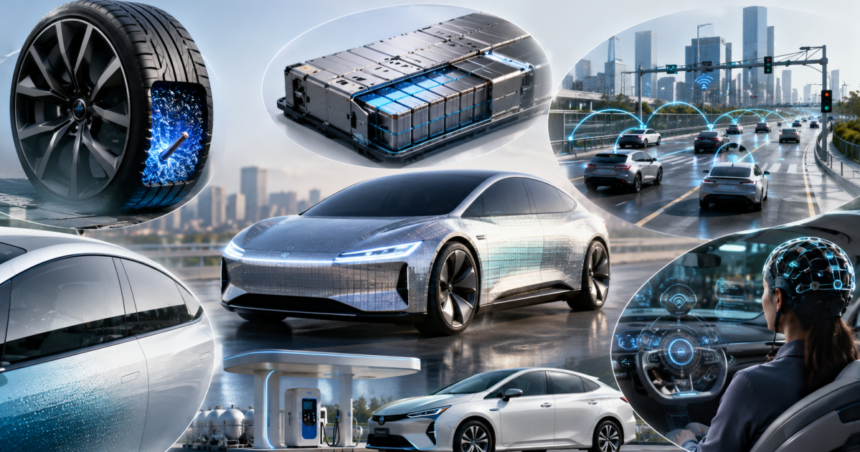
In an effort to answer this question, investments and research are directed towards developing unprecedented, revolutionary technologies that may make the cars of the future completely different from what we know today. From tires capable of self-repairing themselves when punctured, to solid-state batteries that provide longer range and faster charging, to systems that allow cars to communicate with each other and with the surrounding infrastructure to avoid accidents and improve driving on the roads and thus streamline traffic, the features of a new era of smart mobility appear clearly to be taking shape.
The innovations do not stop there, but extend to the details of design and comfort, through smart coatings that change the color of the car electronically when desired, and electrochromic glass that automatically adapts to the intensity of light to provide the best level of vision and privacy.
Researchers are also working on developing control systems that rely on nerve signals from the brain, which may allow the driver to execute some commands just by thinking about them, while advanced hydrogen technologies continue to strengthen their position as one of the most promising solutions for the future of sustainable transportation.
These revolutionary technologies are no longer just ideas in laboratories or visions of bold projects on the desks of engineers and designers. Rather, they have become real projects under development, and some of them may be on the roads in the next few years, opening the door to a new era of smart mobility that we have already been seeing for years, but only in science fiction movies, and it will one day become a tangible reality.
Self-repairing tires
Imagine that your car tire was punctured while driving; Then you will have to stop on the side of the road to replace the spare tire, and then continue your journey after some suffering, even if it is minor.
advertisement
But in the near future, we will say goodbye to changing tires on the road, as such situations will no longer be an inconvenience for drivers. Thanks to self-healing tire technology, the tire is able to automatically treat small punctures and cracks within moments, reducing sudden breakdowns and enhancing safety and comfort levels while driving.
This technology works by using special materials that line the tires from the inside, often a viscous substance or elastic polymers, that move to automatically plug holes as soon as they occur, preventing air leakage and maintaining tire pressure without the need for immediate intervention from the driver.
This technology is not a purely futuristic idea, as it is already present in a number of commercial car models. Michelin SelfSeal technology, for example, has become standard in several models produced in 2020 and newer, including the Ford Explorer, Cadillac CT5, Chevrolet Bolt, and Chrysler Pacifica.
The Acura ZDX comes with self-sealing tires capable of handling punctures up to 5 mm in diameter without stopping, and with a life span of up to ten years.
However, it is still far from being a comprehensive standard for all cars, and there are practical challenges it faces, most notably the high cost and the lack of standardization of maintenance and repair methods among manufacturers, which puts it in a transitional stage between the present and the future.

Solid state batteries
We are just steps away from a major, game-changing leap in the world of electric cars, thanks to solid-state batteries, which are expected to take cars to a new level of longer range, faster charging, and higher levels of safety compared to current technologies.
Most electric cars currently rely on lithium-ion batteries, which use a liquid substance that transports ions into the battery, while a new, bolder technology looms on the horizon: solid-state batteries, which replace this liquid with a solid electrolyte, giving them higher levels of safety, greater energy density, and more efficient performance.
The pace of development of solid-state batteries is accelerating within the corridors of major automobile companies around the world, as they gradually move from the stages of theoretical research to practical tests.
Toyota Motor Corporation is at the forefront of this race after years of working on prototypes in preparation for their commercial launch, while Stellantis has begun actual tests on a Dodge Charger Daytona equipped with solid-state batteries in cooperation with Factorial Energy, in a step that reflects the proximity of this technology to moving to real-life use.
In addition to automobile companies, companies specializing in the battery industry such as CATL have emerged as one of the most prominent players in this field, working to develop advanced solutions for semi-solid and solid-state batteries as part of a global race to accelerate access to a new generation of electric vehicle batteries.
advertisement
Despite this progress, solid-state batteries are still far from widespread commercial production, as they face major challenges related to high cost and the difficulty of manufacturing on a large scale.
However, what makes it the focus of industry attention is the important advantages it provides, most notably a higher energy density than traditional lithium-ion batteries, which gives cars a longer driving range, in addition to the ability to charge within a few minutes, a longer lifespan, and higher safety levels, which places them at the forefront of technologies that are candidates to reshape the future of electric cars.
Communication between cars and infrastructure
In an important step towards building smarter and safer roads, the role of communication technology between cars and infrastructure in the places where vehicles travel is highlighted. The world is witnessing a growing interest in this technology as it is one of the basic pillars of the future of smart transportation.
This technology relies on providing cars and surrounding infrastructure components, such as traffic lights and cameras, with wireless systems that allow real-time data exchange. For example, when a car approaches a crowded area or intersection, it sends information about traffic, road conditions, and potential dangers.
This continuous interaction between the car and the surrounding environment contributes significantly to reducing accidents and significantly improving the flow of traffic.
One of the most prominent real-world applications of this technology is the Car-to-X systems offered by companies such as BMW and Mercedes-Benz, which allow real-time data exchange between cars and infrastructure to warn drivers of accidents and congestion.
Audi has also introduced Traffic Light Information in a number of cities, which allows communication with traffic lights to improve driving flow and reduce stops.
With this rapid development and successive technological progress, future cities are moving towards smart infrastructure capable of managing traffic automatically, so that driving becomes safer and more efficient.
E Ink is a paint that changes the car’s color electronically
It is no longer science fiction. Through the revolutionary E Ink technology, you will be able to change the color of your car within a few seconds, with just the push of a button.
Contrary to what some people think, this technology does not rely on a traditional color-changing paint, but rather on an advanced smart coating containing millions of tiny microscopic capsules. When an electrical charge is passed, these capsules rearrange their molecules to show different colors.
This innovative technology is still in the development and testing stage and is not widely available in commercial cars. What is currently being offered are experimental models to prove the technology’s potential and explore its future uses.
The most prominent practical application presented by the German company BMW is its experimental model, BMW iX Flow, which debuted in 2022 and is based on electronic ink technology.
This model is able to change the color of the exterior between white and black using a smart layer containing electrically charged particles, which rearranges them to change the reflection of light and thus change the apparent color of the car.
In a later version of the same project, BMW developed the idea to include the ability to display multiple patterns and graphics on different parts of the car, but the technology is still within the scope of experimental models and has not entered the commercial production stage.
Self-darkening glass
In the past, window shades were the solution to reduce sunlight and provide privacy inside the car. Then came tinted glass, which became a popular choice for many years.
The search for comfort and privacy did not stop there, as technological development opened the door to a new generation of smart windows thanks to the “electrochromic” self-darkening technology, which turns the windows from completely transparent to opaque and vice versa with the push of a button, giving passengers greater comfort and higher privacy without the need for curtains or traditional shading.
advertisement
In simple terms, this innovative technology works through multi-layer smart glass, which contains within it an electrochromic layer that can change its optical properties when a light electric current is passed, allowing the glass to be transformed from its transparent state to opaque and vice versa within moments.
Although this technology is already used in some modern buildings and aircraft, to date it is still limited in its spread in the world of cars. However, it has begun to appear in some luxury models and experimental models from companies such as Mercedes-Benz, Volkswagen, BMW, Ferrari and McLaren, in a step that reflects an accelerating trend towards a smarter future in car design.

Car control via nerve signals
Car control systems via neural signals are among the latest experimental technologies in the world of cars, as their idea is based on connecting the driver’s brain directly to the car’s systems through a smart interface capable of reading neural signals and converting them into driving commands in moments.
Scientists are developing “Brain-Computer Interface (BCI)” technology, in a step that brings the idea of controlling vehicles through the mind closer to becoming a tangible reality.
Nissan is currently working on developing a helmet or sensor to wear on the driver’s head as part of the Brain-to-Vehicle (B2V) project, which captures neural signals from the brain, and then analyzes these signals using artificial intelligence systems at high speed, so that the car can respond faster than the driver’s own movement, which contributes to reducing reaction time while driving, thus enhancing safety and making driving smoother.
Mercedes-Benz is also developing its future model, VISION AVTR, which embodies a revolutionary vision based on enhancing sensory interaction between the driver and the vehicle.
Instead of relying on the traditional steering wheel, which is not originally included in the design, the car relies on unconventional control methods such as gestures and motor interaction, envisioning a future in which humans can be linked to the vehicle in a more modern and integrated manner.
Advanced hydrogen energy
Despite the growing global interest in electric cars, hydrogen-powered cars are still receiving growing attention as one of the promising alternatives for future mobility, especially because of the near-zero emissions and speed of refueling compared to other technologies.
This existing technology does not depend on burning hydrogen as a traditional fuel, but rather through an intelligent chemical reaction that produces an electric current that feeds the engine to run the car.

Among the most famous cars that currently operate with this technology are the Toyota Mirai and Hyundai Nexo, and work is currently underway to develop a new generation of hydrogen cars that is more efficient and less expensive, with the aim of enhancing the spread of this technology and making it a broad practical option in the future of sustainable transportation.