Published on 6/26/2026
The arms race in North and South Korea has taken a dangerous upward turn, as traditional missile firepower has interfered with modern warfare technology, amid frantic efforts by both sides to modernize their military systems.
Kim missiles
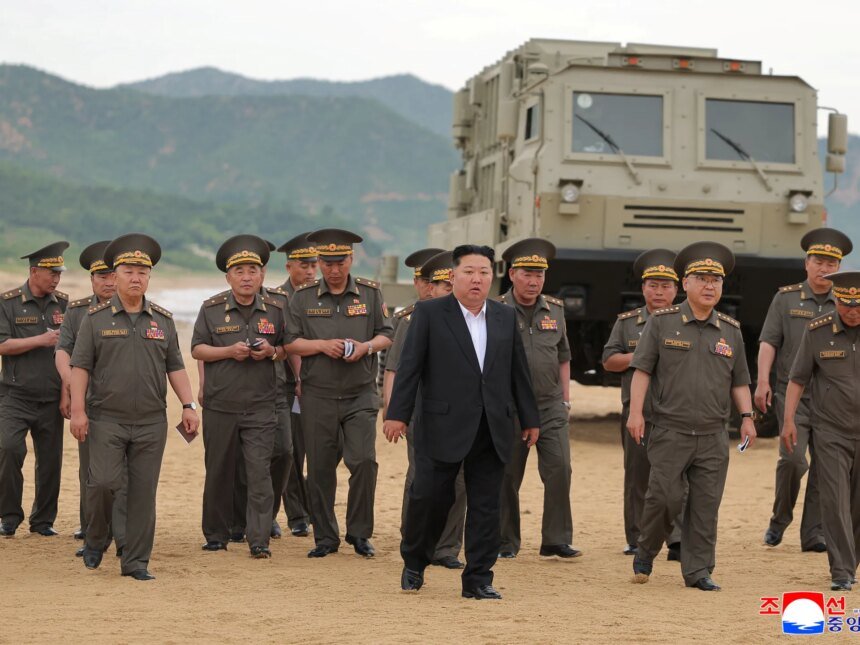
In this context, North Korean leader Kim Jong Un, today, Friday, supervised field tests of advanced artillery and missile systems, including missile launchers.
These tests evaluated an advanced 240-millimeter multiple rocket launcher with a declared range of 90 kilometers, a “special mission” warhead designated for a tactical ballistic missile, and 155-millimeter self-propelled howitzer shells capable of reaching a distance of 65 kilometers.
Kim supervised tests of “major weapons” conducted by defense research institutes under the country’s five-year military development plan, the main Korean Central News Agency reported.
Kim expressed his satisfaction with the results, and said, “The tests showed progress in enhancing firepower along the southern border through increased automation, longer range, and higher accuracy.”
Regarding the goals, Kim reiterated that his country’s self-defense policy does not only aim to strengthen defensive capabilities, but also aims to enhance the “deadly offensive posture” to deter enemies, as he put it.
On the ground, Kim called for the rapid deployment of advanced long-range strike systems, stressing at the same time that developing the country’s artillery and missile forces remains a priority under the five-year defense plan.

Sol marches
On the other hand, South Korea did not stand idly by, as the Ministry of Defense said on Friday that it would work quickly to expand its capabilities in the field of drones and how to confront them to confront North Korea, including training half a million “combat drones” and deploying tens of thousands of unmanned systems on units deployed on the front lines.
The army also plans to produce 110,000 drones by 2029 for deployment in all units of the army, navy, air force and marines, with the aim of making drones a traditional element for every soldier.
“Drones should no longer remain equipment used by a limited number of units,” Defense Minister An Kyu-baek said at a press conference, but should become a “general combat tool.”
An indicated that Seoul will rely on 100% locally manufactured components instead of resorting to Chinese components in manufacturing these systems, and attributed this to security concerns.
“Low-cost drones deployed in large numbers are radically changing the nature of warfare,” Ahn said, warning that North Korea is also working to develop unmanned systems, which increases the threats to military and civilian facilities in the South.
The two Koreas are intensifying their efforts to build drone capabilities while drawing lessons from conflicts in Ukraine and the Middle East, where unmanned systems have been a game-changer on the battlefield.
Technically, North and South Korea are still at war, because the three-year war that took place between them between 1950 and 1953, in which more than 2.5 million people were killed, ended with an armistice, not a peace treaty. Even this truce is unstable, and there is only a demilitarized zone buffer between the communist north and the capitalist south.