Gaza- In the Gaza Strip, where war does not leave a home without knocking on its doors with loss and destruction, widows experience double suffering, from the loss of a husband, the cruelty of displacement, and the lack of sources of livelihood, but they rise up from the midst of pain, piles of rubble, and memories, and challenge reality and the misery of life, so that the will to live prevails in them.
Rasha, Najwa, Ikhlas, and Abeer each have the story of a widow whose husband was kidnapped by the Israeli genocidal war, but they took off the garment of sadness and despair, possessed a will to defy death, and succeeded in transforming tragedy into strength, loss into motivation, and the tent of displacement into a space for innovation and action.
On International Widows’ Day, which was approved by the United Nations and falls annually on June 23, to confront the poverty and injustice affecting millions of widows and their families around the world, Gaza appears as a stark witness to the scale of the tragedy, as the war left more than 26 thousand widows, according to the latest statistics issued by the Ministry of Social Development.

There are no options in the face of loss
Thousands of these widows are mothers who live a harsh life with their children in tents and shelter centers. However, many of them did not surrender to despair or remain hostage to the scarce relief aid. Rather, they chose the challenge and engaged in small productive activities to support their families, proving that the will is capable of defying loss and death.
Like others, Rasha Abu Shawish lost her husband as a martyr, and amid harsh living conditions resulting from war and siege, she found herself required to bear the responsibility of father and mother together and to support 5 children, one of whom was martyred by the fire of the Israeli occupation forces, like hundreds of others who lost their lives on the doorstep of American aid distribution centers.
Rasha (42 years old) did not surrender to the bitterness of loss and the tragedy of displacement and movement with her children, until she settled in a tent in “Al-Baraka Orphan Camp” west of the city of Khan Yunis, south of the Gaza Strip. Then she carved out part of the space in her small tent, and opened a small stall in it where she sold candy and biscuits to the children of the camp, in an attempt to earn a living.
She told Al Jazeera Net: “Life is difficult and we do not have any source of livelihood after the martyrdom of my husband, and after him my eldest son. The relief aid that reaches us is very scarce compared to the size of our needs in Gaza.”
Throughout the day, Rasha sits on the floor next to her stall, receiving the children with a cheerful face and a smile that hides a responsibility that she describes as great. Even though she lost her husband and son, “but I did not lose my will,” she adds in a serious tone about her daily work in order to meet the needs of her children, so that they do not feel inferior and needy after the absence of their father.

“Threads of hope”
When Najwa Al-Shamali’s husband was martyred, she felt as if the ground had collapsed beneath her feet, but she grabbed the embroidery threads to weave new hopes for her five children. She told Al-Jazeera Net: “Despite the bitterness of loss and the harshness of life in Gaza, I wanted to prove my ability and that of many of the widows of the martyrs in this project to rise again.”
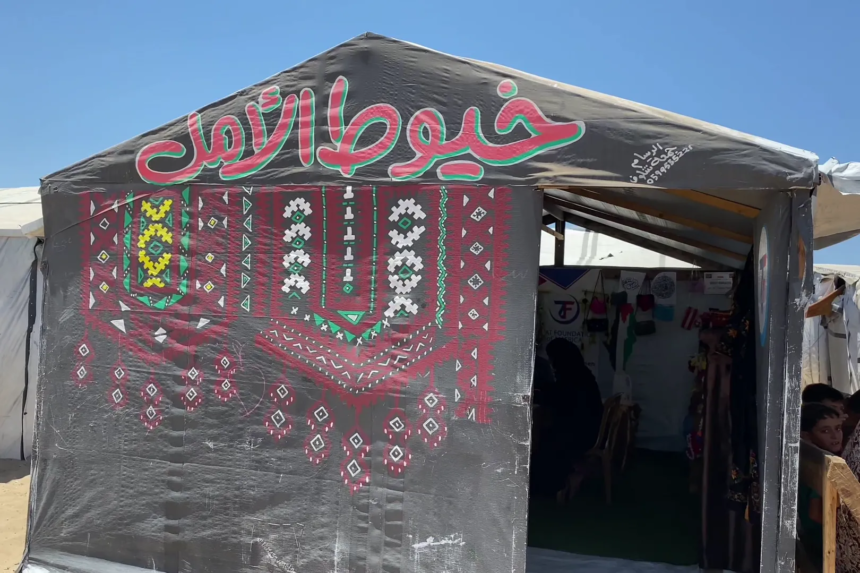
Al-Shamali (44 years old) and 50 other widows opened an embroidery and handicrafts project called “Threads of Hope,” in an effort to weave a new life for themselves and their children after the loss of their husband and breadwinner.
She mastered the “art of crochet” (knitting and spinning), and found in the hook and woolen threads a window of hope and a path to a profession that provides her and her children with daily food and basic life needs.
Al-Shamali did not give in to the state of loss that befell her after her husband’s martyrdom. She was certain that there was still a long way to go before her to raise and care for her children. She and other widows were guided by the idea of embroidery and weaving handicrafts, such as traditional artistic pieces, clothes, bags and bedspreads.

Hard work to get on with life
In a corner of “Al-Baraka Orphan Camp,” Ikhlas Na’an, in her thirties, accompanies the sun’s rays at sunrise, and spends her day from early morning until just before sunset in front of a clay oven, as a small project she opened in order to care for her only child, who experienced the agony of loss and orphanhood early following her father’s martyrdom.
Na’na suddenly found herself alone in facing life’s challenges, but she refused to rest in her great sadness over the loss of her husband as a martyr in the occupation fire.
“My husband was everything in my life. I depended on him for all the daily details, and suddenly I found myself alone with my daughter. Like other widows of martyrs, we face great and complex challenges, but we refuse to remain hostages to sadness, despair, and surrender to the difficult reality, and the majority of us rise again to continue life for the sake of our children,” Naanaa tells Al Jazeera Net.
Although she only earns a few shekels (less than $3 a day) from sitting for long hours in front of the flames emanating from the oven fires, she feels very happy that she is supporting her child from the work of her hands, and she adds: “I want her to grow up and see that her mother is strong and was able to face the harshness of life for her sake.”
An attempt to rouse enthusiasm
In the camp itself, the meanings of steadfastness and rising again are embodied by widows who were stranded after losing their husbands and homes, and found themselves without a breadwinner or shelter, but a look at their children gave them the strength to continue life.
The director of Al-Baraka camp, Abeer Al-Sawalha, herself the widow of a martyr, says: “Widows arrive at the camp broken, without a home or a breadwinner, but I believe that within each of them there is a latent strength, and with small projects we rebuild our lives again.”
“Al-Baraka Camp 4”, which is one of a group of camps specialized in sheltering widows and their orphans, accommodates 200 widows of martyrs and their children. Al-Sawalha indicated in her interview with Al-Jazeera Net that many of them are qualified and hold university degrees, which helped open a kindergarten and a primary school, relying entirely on a teaching staff of widows.
The war prolonged and the siege intensified, and the widows found themselves facing a miserable reality, where relief aid was insufficient and did not meet all the family’s needs. This was an incentive for them to establish small projects that demonstrated the will of Palestinian women and their ability to rise up, according to Al-Sawalha.
Each widow employed whatever skill or talent she possessed, and the result was productive projects. Al-Sawalha continues, “Despite the simplicity of these projects, they helped the widows of the martyrs to integrate into society and support their children.” She stresses that the feasibility of these projects is not limited to the financial return, but rather gives them a feeling of self-satisfaction despite the harsh circumstances.

Psychological and financial support
Before the outbreak of the genocide war on October 7, 2023, the number of widows in the Gaza Strip reached 20,649, in addition to 26,500 widows of martyrs who lost their husbands during the war. According to the spokeswoman for the Ministry of Social Development in Gaza, Dr. Aziza Al-Kahlot, all the widows registered on the ministry’s database are heads of families, and their numbers are likely to rise as murders continue.
Al-Kahlot told Al-Jazeera Net that widows are in dire need of all types of aid and programs, including urgent interventions, small projects, monthly cash support, and a monthly food basket, in addition to their need for psychosocial and legal support programs, and the establishment of educational centers and integrated educational support programs.
Widows in Gaza face great challenges in light of the harsh conditions and scarcity of relief aid. According to Al-Kahlout, the Ministry of Social Development is making great efforts to provide some financial and in-kind programs in order to serve this segment most affected by the war and siege.
According to data from the Palestinian Central Bureau of Statistics until last April, there are 58,000 orphans in the Gaza Strip who have lost one or both parents.