Published On 9/6/2026
The “Civil Contract” party, led by Armenian Prime Minister Nikol Pashinyan, won the parliamentary elections with 49.81% of the votes, according to the final results announced by the Central Elections Commission after counting all polling stations.
These are the first general elections since the military defeat by Azerbaijan in 2023 and the displacement of about 100,000 Armenians from the Karabakh region. It is also a test of the peace path led by Pashinyan, and the country’s increasing turn toward the West at the expense of its historical ally, Russia.
Pashinyan described the result as a “historic victory that will guarantee Armenia’s immortality and development,” but the number itself carries its own dilemma, as less than half of voters gave him their votes, a clear decline from the 54% he achieved in the 2021 elections, according to Reuters.
Victory is enough for governance, not peace
The first irony in these elections lies in the gap between votes and seats. According to Anadolu Agency, the 49.81% translated into 61 seats out of 105, meaning a majority that allows Pashinyan to form the next government alone.
However, this majority, as summarized by Armenian analyst Armen Badalyan, means that the party “obtained a sufficient number of seats to form the next government,” but “did not achieve the necessary majority to pass constitutional amendments” that Azerbaijan demands as a condition for a final peace treaty.

Stronger opposition than expected
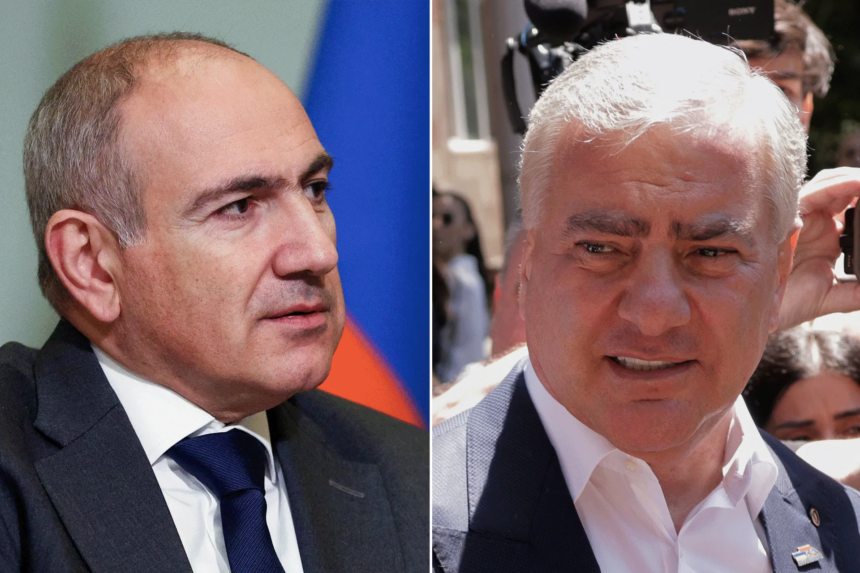
The paradoxes do not stop at the limits of seats, as the Western turn led by Pashinyan did not bring internal consensus. The “Strong Armenia” coalition led by the Russian-Armenian billionaire Samvel Karapetyan came second with 23.29%, followed by the “Armenia” coalition led by former President Robert Kocharyan with 9.94%, then the “Prosperous Armenia” party with 4%, according to the Central Election Commission.
Reuters indicates that the three opposition groups, all of which call for reforming the relationship with Moscow, together received about 37%, a result that exceeded expectations.
Karapetyan did not acknowledge the result, describing the elections as “shameful” and denouncing “violations and repression,” saying that dozens of his campaign staff had been suspended.
He had denied seeking to return the country to Russian hegemony, warning of what he called “Pashinyan’s reckless rush toward the West.”
Karapetyan has been under house arrest since last year on charges of planning a coup, which he denies and considers politically motivated.

Accusations between Moscow and the West
At the level of the influence struggle itself, another paradox emerges in Moscow’s response. The Russian Foreign Ministry criticized the elections through spokeswoman Maria Zakharova, who said in a statement that the vote took place “amid unprecedented pressure on the opposition and interference from the West, especially the European Union.”
However, Moscow itself is widely accused of seeking to influence the vote against Pashinyan, who is pro-European Union. According to Agence France-Presse, analysts have monitored misinformation on the Internet, hacking activity, and narratives supportive of the Kremlin that portray cooperation with the West as a danger, while before the vote Russia banned the import of Armenian agricultural products in a move that was read as an instrument of economic pressure.
The Russian position was not surprising after President Vladimir Putin’s warning in May when he said, “We all see what is happening with Ukraine now… How did it all start? With Ukraine’s attempt to join the European Union.”
Pashinyan had frozen his country’s participation in the Collective Security Treaty Organization led by Russia, deepened his relations with Brussels and Washington, and put Armenia on the path to possible European membership.

On the other hand, the Western welcome came quickly, as European Commission President Ursula von der Leyen congratulated Pashinyan on the X platform, saying that the Union “highly appreciates its partnership with democratic Armenia, which is getting closer and closer to Europe,” while French President Emmanuel Macron believed that the result would enhance “the momentum towards closer relations with Europe.”
Regionally, the Turkish Foreign Ministry expressed its satisfaction with the completion of the elections “in a peaceful and calm atmosphere,” expressing its hope that “Armenia will take bolder steps towards peace and normalization in the region,” and Ankara affirmed its continued contribution to regional stability on the basis of common interests.