After about 4 months of waiting in the waters of the Gulf and the Gulf of Oman, commercial ships and oil and gas tankers began crossing the Strait of Hormuz again, in an early indication of the movement of navigation within one of the most important sea lanes in the world, following the entry into force of the US-Iranian agreement.
But the shipping scene in the strait has not yet returned to normal; The number of passing ships is still below pre-war levels, Iranian-imposed routes are still in use, while navigation systems continue to be disrupted near the strait and the Gulf of Oman.
Read also
list of 2 itemsend of list
Navigational data monitored by the Al Jazeera Network’s open source unit showed 15 ships crossing the Strait of Hormuz since the agreement entered into force early in the morning of June 18.
The movement included 7 oil tankers, a liquefied gas tanker, 5 cargo ships, a vehicle tanker, and a passenger ship, in the highest daily movement of oil tankers monitored by the unit since the start of the US naval blockade about 66 days ago.
The movement of ships surrounding the Strait indicates the possibility of an increase in the number of crossings by the end of the day, as maritime tracking data showed additional ships moving towards transit routes from both sides of the Gulf and the Gulf of Oman.

Ships crossing for the first time
Among the ships that crossed the strait, the unit monitored the passage of six ships for the first time since the outbreak of the war on February 28, after remaining in the Gulf waters for more than 111 days since the outbreak of the American-Israeli war on Iran.
This group includes the liquefied gas tanker “MRAIKH”, the oil tankers “TONG LIN WAN” and “YE CHI”, in addition to the passenger ship named “HORMUZ”, the bulk cargo ship “JOSCO SHUNZHOU”, and the vehicle tanker “GRANDE TORINO”.
The nationalities of these ships reflect the diversity of the parties that began testing the crossing after the agreement, as the “Grande Torino” flies the Italian flag, and the “Maraikh” flies the French flag. It departed from the Qatari port of Ras Laffan and is heading to the port of Karachi in Pakistan.
While the three ships linked to Chinese companies fly the Hong Kong flag, and the passenger ship “Hormuz” flies the Omani flag.
Although the Iranian Revolutionary Guard did not impose declared restrictions on Chinese ships, navigational data – previously monitored by the Open Sources Unit – documented a number of ships linked to China declining to cross after arriving in the vicinity of the Strait of Hormuz, as passage remained subject to a transit permit in accordance with the navigation arrangements imposed during the war.
As part of the June 18 movement, the oil tankers “Tong Lin Wan” and “Yi Qi” crossed, along with the bulk cargo ship “Jusco Shanzhou”, for the first time since the outbreak of war. These ships are linked to companies based in China, and remained stranded throughout the war.
Of the 15 ships that crossed Hormuz today, navigation data reveal the crossing of 4 oil tankers, a bulk cargo ship, and a container ship, all operated by Chinese-based companies, which means that a significant portion of the first transit traffic after the agreement was linked to Chinese ships.
The data also shows the direction of two additional ships transporting bulk goods towards crossing routes of the Strait, namely “SHENG TAI” and “XIN QI MENG”, and their navigational data shows references to Chinese ownership or affiliation.

Turin crosses
The Italian tanker Grande Torino has crossed the Strait of Hormuz after remaining stuck in a ship waiting area off the coast of the Emirates. It is currently heading to the port of Singapore, and is managed by an Italian-based company.
Italian Foreign Minister Antonio Tayani announced, through his account on the
The crossing of the “Grande Torino” represents a remarkable case, because it was not among the Iranian or Chinese ships around which a large part of the crossing restrictions were imposed, but rather a stranded European ship that tested the new route after the agreement.
Omani Coast Path
On a different route, a passenger ship named “Hormuz” and flying the Omani flag crossed the strait for the first time since the war, but along the Omani coast.
An analysis of the ship’s path shows that it had crossed the strait several times before the war, and then remained stuck in the waters of the Gulf of Oman, which makes its current crossing an indication of a partial return to local and regional movement through the passage.
The cargo ship “MSV SAFINA AL ZAHRA” followed the same route, as it left Khalifa bin Salman Port in Bahrain and headed to cross the strait towards the Gulf of Oman, without announcing its final destination in the available tracking data.
These routes show that the ships do not return to the traditional pattern all at once, but rather move within specific and calculated corridors, some of which are along the Omani coast, and some of which are along the route specified by the Iranian authorities south of Qeshm Island.
The highest tanker movement since the start of the blockade
On June 18, 7 oil tankers and a liquefied gas tanker crossed the Strait of Hormuz in both directions, the highest daily number of oil tankers monitored by the Open Sources Unit since the start of the US blockade on April 13.
This monitoring depends on counting the passing ships that kept the automatic identification signal open during the passage, which means that the number relates to the movement monitored publicly through the tracking platforms, and it does not rule out the presence of other unseen movements if some ships turn off the broadcasting devices.

Although today’s movement is much lower than the pre-war level, which amounted to 138 ships per day according to data from the British Maritime Trade Operations Authority (UKMTO), it represents a clear change after weeks of decline and waiting on both sides of the strait.
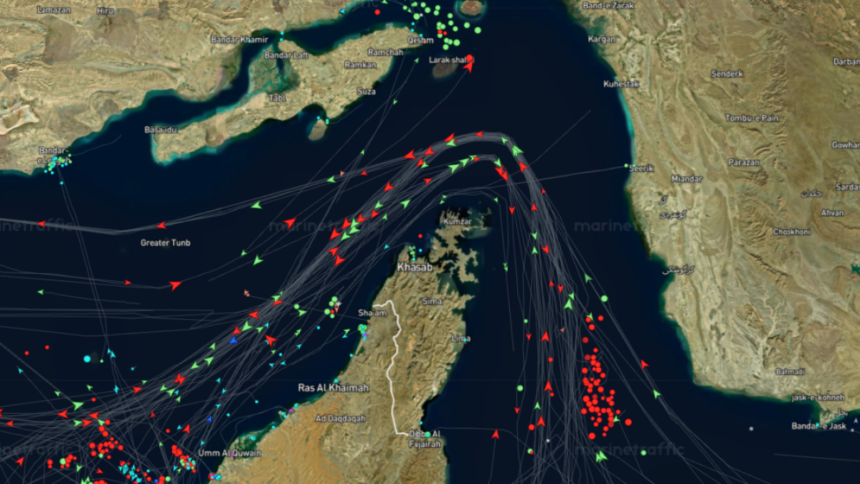
Route data shows that ships continue to use the corridor designated by the Iranian authorities south of Qeshm Island, instead of fully returning to the traditional traffic system in the strait.
The crossing of 15 ships does not mean that the Strait of Hormuz has returned to its usual state, as the current passage seems closer to a gradual and limited opening, subject to security and navigational calculations, pending clarification of the arrangements that will regulate the movement of ships after the agreement.
US President Donald Trump had said that the complete opening of the Strait would begin on Friday, June 19, in conjunction with disinfection and security operations.
These statements link the resumption of navigation to the issue of clearing mines and securing sea lanes. According to estimates published by Forbes magazine, Iran has an arsenal ranging between 2,000 and 6,000 sea mines, which can be deployed via small boats, submarines, or modified commercial ships.
Although these estimates do not necessarily mean that there are currently planted mines, they do explain some of the navigational caution and the continued restricted movement along specific routes.

Navigational confusion continues
Despite the ceasefire, and the signing of a memorandum of understanding between the two sides of the conflict, confusion continues in the Strait of Hormuz, as the unit detected interference in navigation signals near the Strait of Hormuz, the Gulf of Oman, and off the coast of the Emirates.
Marine Traffic footage showed an overlay of the locations of a large number of ships, over land, at close points, with long and overlapping paths extending in opposing directions, a pattern that is not consistent with normal navigation movement.

Hundreds of tankers are waiting
While hundreds of tankers stand stranded on both sides of the Strait of Hormuz, waiting for the terms of the US-Iranian agreement to be revealed, the future operational and administrative framework of the Strait of Hormuz remains shrouded in mystery. While Trump demands that the strait be made a permanent free waterway, Iran announced that maritime traffic “will be regulated by Iran in coordination with the Sultanate of Oman” by collecting fees, ostensibly for reasons related to safety, the environment, or insurance requirements.
Al Jazeera correspondent Adnan Burini explained that the official discourse in Iran is based on the issue that the waters of the Strait of Hormuz are not international, but rather are regional waters subject to the sovereignty of Iran and the Sultanate of Oman.
Tehran confirms that coordination regarding transit arrangements through this strategic strait is limited to the two countries, but the memorandum of understanding recently signed by Washington and Tehran indicated the possibility of consulting with countries in the region if the need arises.
In this context, Iranian Parliament Speaker Muhammad Baqir Qalibaf said – during a television interview – that his country will receive service fees from ships crossing the Strait of Hormuz. Borini pointed out that these fees are related to navigation, insurance and environmental damage.
On the other hand, the United States and European countries affirm that freedom of navigation must be restored without restrictions or fees imposed on international transit.