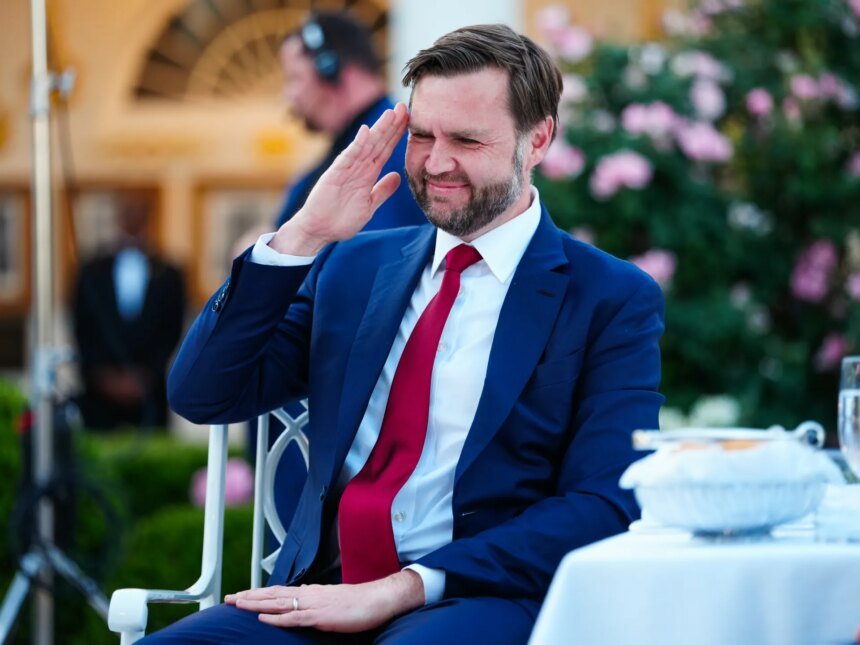
US Vice President Donald Trump’s J.D. Vance was supposed to spend this week promoting his new book, the kind of event a potential presidential candidate, such as the vice president, would typically use to talk to a wide audience about his life and values before launching his election campaign.
Instead, the launch of Vance’s second book, “Connecting: Finding My Way Back to Faith,” was overshadowed by something else: the tentative agreement to end the war with Iran.
The Republican Vice President adopted the role of the main defender of the agreement that Trump signed with Iran, as he gave a series of interviews in which he praised the memorandum of understanding as a “success,” and published a video clip promoting it.
This represents a remarkable shift for a politician known for his skepticism about foreign military interventions, and who seemed reluctant to talk about war with Iran when Trump and the Israeli Prime Minister launched it at the end of last February.
Vance is preparing to tie himself more closely to the outcome of the conflict tomorrow, Friday, and is expected to travel to Switzerland to launch a new phase of negotiations with Iran. He was originally expected to attend the official signing ceremony of the agreement, but Trump officially signed it yesterday, Wednesday (at dawn today, Mecca time) instead.

Gamble
Vance’s transformation into a strong promoter of the agreement appears to be a total gamble. If he decides to run for president in 2028, voters will reward him for being a symbol of an end to an unpopular conflict. This also sets Vance up to be the supposed scapegoat if the agreement with Iran fails.
Trump joked about the possibility yesterday, saying, “If it works, I’ll take the credit, and if it doesn’t, I’ll blame J.D. Vance.”
While the text of the agreement sparked angry reactions that preceded and followed it, the White House described in a statement the Vice President Vance as “the president’s right-hand man, and an indispensable member of the distinguished national security team.”
White House spokeswoman Olivia Wells said, “That is why the Vice President has been assigned to lead these negotiations alongside Special Envoy Steve Witkoff and Jared Kushner. What President Trump and his team have achieved on the battlefield and at the negotiating table is remarkable by all standards, and will enhance American security for years to come.”
Lawmakers were outraged
But angry reactions, including from conservatives, began to grow this week after the United States electronically signed a memorandum of understanding with Iran.
Luke Schroeder, the vice president’s spokesman, said in a statement, “It is unfortunate that some Republicans are trying to undermine the president’s efforts to achieve peace in the Middle East and ensure that Iran does not possess a nuclear weapon.”
Officials provided conflicting answers regarding when the text of the agreement would be published, but leaked copies of the draft agreement were quickly met with anger and skepticism by Democratic and Republican US lawmakers, as well as Israel and its defenders.
Their criticisms included concerns that the agreement – which aims to open the door to negotiations for two months – appeared to give Iran immediate gains with few guarantees in return, and that Trump’s stated reason for waging the conflict – to prevent Iran from obtaining a nuclear weapon – remains unclear.
On Tuesday, Vance reiterated the need for Iran to fulfill its obligations, and said in an interview on Fox News, “If they don’t do the right thing, they won’t get any of the benefits of this agreement.”
Under pressure from angry reactions and mounting questions, the Trump administration presented to reporters yesterday the text stating that the United States and Iran will negotiate regarding the Iranian nuclear program, but there are other commitments that still need clarification.

American surrender
After the text of the agreement was published, criticism from the right mounted, and conservative broadcaster Erik Erikson, a hawk who defended the war, said, “This is an American surrender.”
Republican Senator from Texas, Ted Cruz – a potential presidential candidate in 2028 – also criticized the agreement, telling reporters, “I think the president – unfortunately – is receiving bad advice.”
Trump’s “Operation Epic Rage” had previously angered wings of his movement, and the conflict, which extended into its fourth month, led to the division of Trump’s broad “Make America Great Again” coalition, and angered both supporters of a tougher stance toward Iran, and supporters of Trump’s “America First” foreign policy, which is based on the slogan “No New Wars.”

Vance’s responsibility
Critics including Republicans have already begun pointing the finger at Vance, asking: Is the deal similar to the 2015 nuclear deal struck by Democratic President Barack Obama? Does this new agreement achieve Trump’s stated goals of waging war?
Republican Senator Lindsey Graham of South Carolina – a Trump ally known for his hard-line positions on Iran – was skeptical of the agreement, and described Vance on social media as the “architect of the agreement.”
After the agreement was announced, Graham issued a lukewarm statement in support, saying, “It is not yet clear whether the United States is able to reach an acceptable and verifiable agreement with Iran on its nuclear program and other issues, but I see little harm in trying.”
Ben Dominick, opinion editor at The Daily Wire, said everything he was hearing about the agreement “sounds bad,” and he appeared to blame Vance by referring to his first book, “Hillbilly Elegy,” which includes his memoirs.
The Trump administration has not yet provided formal briefings to Congress on the details of the memo, but Vance has quietly begun communicating with some Republican senators in the Capitol.
Republican Senator Bernie Moreno from Ohio – a close ally of Vance – believes that the vice president will be able to calm even his critics within his party who question the agreement, because “J is just a carrier of the president’s message, and the president will prove them all wrong.”
Republican Senator Kevin Cramer from North Dakota believes that the agreement “enhances Vance’s experience in national security and geopolitics,” who served as a senator from Ohio for two years before becoming vice president, but Cramer acknowledged the dangers if the agreement fails.
“I think the advantage is that if you’re not the first person you can take the credit and avoid the pitfalls and the criticism, but maybe not that easily,” Kramer said.

Iran is not Iraq
In interviews with Vance this week, he sought to speak directly to skeptics in his party, hinting at the difficult explanations he might be asked to offer as a candidate about the war.
On the “Megyn Kelly” program, Vance told critics that “they believe Iranian propaganda about the agreement,” but he acknowledged some frustrations on the far right and tried to reassure those opposed to the intervention.
Vance believes that “the Iranian conflict is not like the war in Iraq,” where he served as a Marine, adding, “We would never have reached the quagmire that worried many people, because Donald Trump is not George W. Bush.”
Democrats stress that even with Vance at the forefront of the issue of the Iranian nuclear agreement, the fate of any US administration official who aspires to the presidency – especially Secretary of State Marco Rubio, who is known for his hard-line stances and who remained largely silent during the final stages of the agreement – will depend on its results.
Democratic Senator Brian Schatz from Hawaii said, “I believe that the rise or fall of any member of this administration will depend on the war with Iran and the management of the economy, and I do not think there are exceptions.”