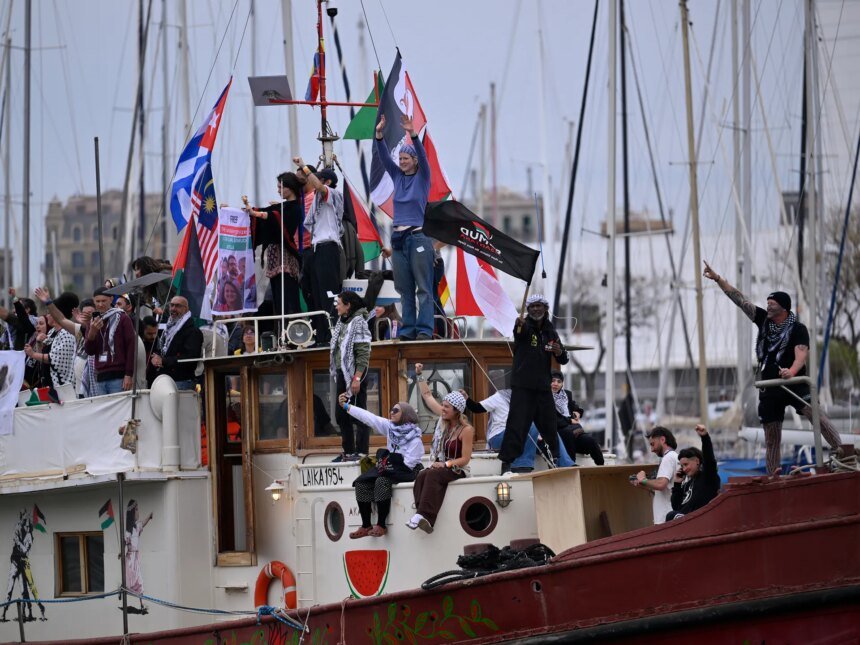
Once again – and in international waters – Israeli Navy boats attack the “Global Resilience Fleet” on its way to the Gaza Strip, on a humanitarian mission that includes hundreds of volunteer participants sailing on board dozens of small ships, in an effort to break the Israeli siege imposed on the Gaza Strip.
Minutes before midnight, those in charge of the Al-Samoud Fleet issued a distress signal and reported that most of their boats in the Mediterranean had been subjected to interference, followed by talk of military boats approaching their ships.
The Israeli Navy announced that it had begun intercepting fleet ships near the Greek island of Crete, according to what was reported by Israeli media. It confirmed that it had taken control of 21 ships out of 58, explaining that the current stage is preliminary and includes controlling part of the fleet, with the possibility of resuming operations against the remaining ships when needed if they do not return.
The Israeli Navy justified its attack on the flotilla by saying that “the attempt to break the legal naval blockade of Gaza is a violation of international law,” according to what naval officers told the Maariv newspaper.
The newspaper quoted a military source as saying, “The Israeli army is now implementing the naval blockade on Gaza based on the directives of the political leadership.”
Israeli Army Radio also confirmed that it was decided to control the fleet even though it is far from the Israeli coast due to its large size, and the Israeli “Wala” website reported from Israeli sources that some of the fleet’s ships will most likely be withdrawn to the port of Ashdod.
Where and when did the fleet launch?
The “Spring 2026 Mission” was launched with about 39 boats, sailing from the Spanish city of Barcelona on April 12, with organizers planning the participation of more than 100 ships and boats, departing from various ports in Spain, Italy and Tunisia.
Last Saturday, April 25, the ships arrived at the port of Syracuse in Sicily, and the next day 56 ships left the Italian port of Augusta, in preparation for heading towards Gaza.
Navigational data from the Marine Traffic website showed the movement of ships associated with the Global Resilience Fleet in the eastern sector of the Mediterranean Sea.

What is the importance of this initiative?
The current voyage is symbolically significant because it follows a previous attempt by the flotilla in 2025, which was intercepted by Israeli naval forces in international waters, arresting hundreds of participants before later deporting them.
The Associated Press reported that the attempt last fall saw dozens of boats approaching Gaza, before they were intercepted or forced to return.
Those in charge of the “Resilience Fleet” describe their campaign as “the largest coordinated civilian naval mobilization” towards the Gaza Strip, as part of an announced trip to break the naval blockade imposed on the Strip.
Organizers say that the “Spring 2026 Mission” aims to deliver relief aid, open a civilian sea corridor to Gaza, in addition to supporting relief and reconstruction efforts. The mission’s official page indicates that the aid includes food, baby formula, medical supplies, hygiene materials, and educational tools.
What is the nature of the participating parties?
Greenpeace announced that its ship “Arctic Sunrise” is accompanying the fleet to provide maritime and technical support, in cooperation with the “Open Arms” organization, noting that the fleet includes more than 50 ships moving towards the East across the Mediterranean.
A number of smaller boats appear among the observed ships, which reflects the mixed nature of the fleet between support ships and civilian boats participating in the movement.
Monitoring data also indicates that 9 ships – out of 30 that could be tracked – fly the Spanish flag, a presence that gives the trip added value, given the advanced Spanish position – on the European level – towards the war on Gaza.

What are the Israeli justifications and claims for the objection?
The Israeli Navy justified its interception of the High Resilience Flotilla in its current mission by saying that “the attempt to break the legal naval blockade of Gaza is a violation of international law,” according to what naval officers told the Maariv newspaper.
The newspaper quoted a military source as saying, “The Israeli army is now implementing the naval blockade on Gaza based on the directives of the political leadership.”
Over the past years, Israel has been using a variety of pretexts to justify its attacks on ships in international waters, considering that these humanitarian campaigns are trying to violate a “legal security blockade” aimed at preventing weapons from reaching the Palestinian factions.
The efforts of those in charge of this type of fleet are also classified as “provocative actions” aimed at destabilizing the region, and not purely humanitarian missions.
What previous campaigns did the Israeli Navy intercept?
October 2025 witnessed a violent Israeli attack on the “Resilience Flotilla” in its previous mission, as organizers reported that at least 21 ships – out of 44 – were attacked and intercepted in international waters, which led to the arrest of dozens of activists.
While the incident of the “Freedom Flotilla” interception and storming of the Mavi Marmara ship in May 2010 is considered the most violent and influential confrontation in world public opinion, as the fleet at that time consisted of 6 ships carrying 663 activists from 37 countries.
The Israeli forces carried out the interception 64 nautical miles from the coast, and the Israeli naval “commando” forces carried out a landing operation from helicopters and speedboats, during which they used live bullets, which led to the killing of 10 Turkish activists and the injury of dozens.
But this shock caused by Israeli violence was followed by waves of campaigns in support of Gaza, which were each time subject to Israeli objections, including:
- The Libyan ship “Hope” in July 2010.
- Malaysia’s Spirit of Rachel Corrie ship in May 2011.
- Our Canadian “Liberation” and Irish “Freedom” ships in November 2011.
- The ships “Amal” and “Zaytouna” launched from the port of Barcelona, Spain, in September 2016.
The Israeli Navy also continued to intercept ships that broke the siege during the war of extermination it launched against the Gaza Strip, including the Madeleine ship – the 36th ship in the Freedom Flotilla coalition – after it sailed in early June 2025 from the Italian port of Catania towards the Gaza Strip.
The Israeli army also intercepted the “Handala” ship on July 13, 2025, when it set off from Italy on a voyage with the slogan “For the Children of Gaza.” The ship had previously participated in broad solidarity initiatives around the world between 2023 and 2024.
It is noteworthy that the first naval operation to break the Israeli blockade on the Gaza Strip succeeded in August 2008, when the “Freedom” and “Free Gaza” ships were able to reach the shores of Gaza, while the last ship to succeed in arriving was the Qatari “Dignity” ship, which arrived at the Gaza port in December 2008 as well.