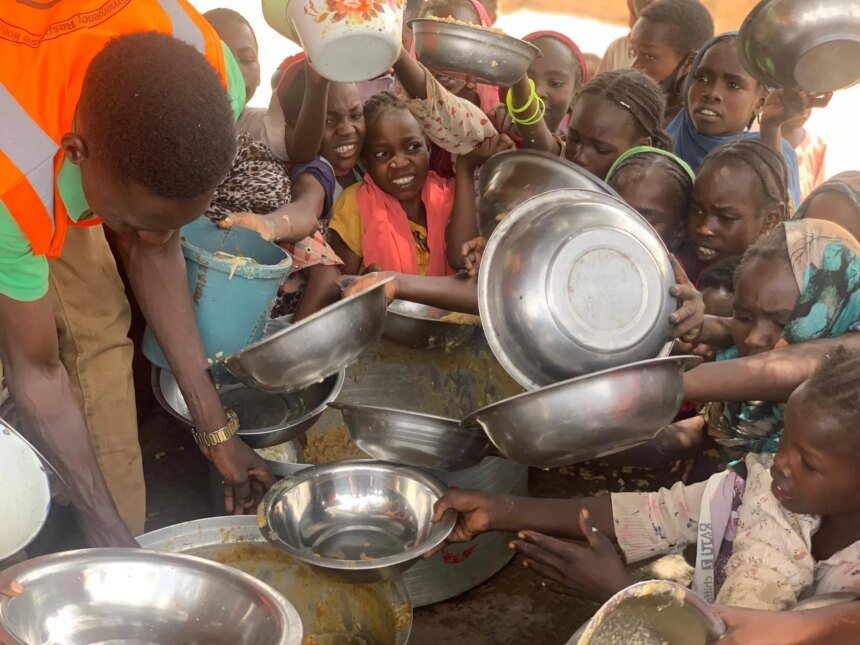
Darfur- With each new sunrise in the crowded displacement camps in the Tawila area, west of El Fasher, hundreds of children and women line up in front of the charity kitchens, carrying worn out iron pots, their eyes fixed on the pots from which the faint smell of porridge rises. These are not exceptional scenes, but rather recurring chapters of a human tragedy experienced by the largest spot hosting displaced people in the Darfur region.
Since its fall in October 2025, Tawila, which is 68 kilometers west of El Fasher, has turned into a safe haven for more than 700,000 displaced people who fled the scourge of war, the majority of whom were from El Fasher and the Zamzam and Abu Shouk camps. They were originally displaced before the conflict forced them to flee again. According to the International Organization for Migration, more than 127,000 people have been displaced from El Fasher alone since the Rapid Support Forces took control of it.
The United Nations says that Sudan is experiencing “the largest humanitarian crisis in the world,” with 34 million people, or about two-thirds of the population, in need of urgent aid. Although the Integrated Phase Classification for Food Security (IPC) confirmed in April 2026 a famine in the cities of El Fasher and Kadugli, with 20 other areas in Darfur and Kordofan threatening the same fate, the world “remains preoccupied with other issues.”

An unspeakable tragedy
In one of the neighborhoods of Tawila camp, Fatima (28 years old) lies next to her child, Maryam (4 years old). The girl’s body had turned into a skeleton, and her sunken eyes were staring at the ceiling of the tent. The mother whispered in an intermittent voice, “We were in El Fasher, eating tree leaves and animal fodder. We thought that salvation would be in escaping here. But hunger preceded us. Maryam no longer cried, she did not even have the energy to do so. The aid that used to come was scarce and was completely cut off.”
In turn, Firdous Saleh, the mother of an infant girl suffering from measles and malnutrition, told Al Jazeera Net, “My baby was born 10 days ago and I have not tasted food for 4 days. We both suffer from symptoms of acute malnutrition.”
In the Tawila emergency room, which manages relief affairs in the field, its media officer, Hamza Hassan, confirmed that the tragedy experienced by the displaced is indescribable. He told Al Jazeera Net, “Most of those affected by the war are women and children, making up 70% of the total displaced people. There are clear indicators of cases of severe malnutrition, with an acute shortage of nutritional supplements for affected children.”

He added that the lack of funding provided to organizations contributed significantly to the increase in hunger, and that the weak provision of food supplies by humanitarian organizations exacerbates the crisis. The disruption and delay in the arrival of supplies also added to the “already catastrophic” situation.
Local and international sources indicate that the use of hunger as a weapon of war was part of a systematic strategy during the siege of El Fasher, as the Rapid Support Forces cut off supply and trade routes to the city, forcing residents to eat tree leaves and animal fodder, which is known locally as “Ambaz.” The UN fact-finding mission documented “the use of starvation as a weapon of war, with direct and widespread attacks on civilians.”
Al Jazeera Net tried to contact the Rapid Support Forces to comment on these accusations, but did not receive a response until the moment of preparing this report.
Severe malnutrition
United Nations experts warned that a thousand children die of hunger every week in the country. Eva Hinds, Head of Communications at the United Nations Children’s Fund (UNICEF) in Sudan, said during a media briefing in Geneva on April 14, 2026, “The reality for children in Sudan is getting darker by the hour. Children who survive violence die of hunger and disease.”
According to the organization’s latest reports, the number of cases of acute malnutrition in Sudan is expected to rise to 4.2 million cases during the year 2026, including 825,000 children suffering from “severe acute malnutrition.” In North Darfur, the percentage in some localities exceeded 50%, three times the global emergency threshold.
For his part, Hamza Hassan, media officer in a Tawila emergency room, described the scene, saying, “Nutritional supplements for malnourished children are almost non-existent. Children die silently, and many families do not find anything to satisfy their needs.”
The Chamber launched 17 collective kitchens, which it distributed in the camps of Barqo, Ronda, Tawila al-Umda, Dali, Daba Naira, Kanjara, and Khazan Tunjur, to provide one meal a day to the displaced, in addition to special meals for pregnant and breastfeeding women.
Hassan explained that these kitchens barely provide meals for 5,100 families per day, at a rate of 25,000 individuals per day. But it suffers from a scarcity of funding, delayed arrival of supplies, and an almost complete weakness in resources. He added that the numbers of displaced people are increasing daily, while kitchens are “groaning under the burden. The humanitarian aid provided is insufficient due to severe overcrowding.”

A forgotten crisis
Action Against Hunger reports confirm that millions in Sudan live on only one meal a day. In the most affected areas, such as North Darfur, families spend entire days without any food at all.
The humanitarian aid arriving in Sudan does not rise to the level of a disaster. In 2025, the Humanitarian Response Plan is only 35% funded. In 2026, only 16% of the $2.9 billion humanitarian appeal is funded. In a press statement, Clementine Nkweta Salami, the United Nations official for humanitarian affairs in Sudan, described the crisis as “abandoned.”
For his part, Tom Fletcher, the United Nations Emergency Relief Coordinator, said in a previous statement, “The thirst of people in Sudan is man-made. It is the bombs that destroy the water stations. The bombing prevents humanitarian workers from arriving. This is the worst humanitarian crisis in the world, and the most ignored.”
For his part, Haroun Saleh, a local relief activist, criticized the international community, and told Al Jazeera Net, “All these discussions about the names of classifications do not concern the hungry. What is important is that they die. There are stray cats and dogs that find food in the streets of our city of El Fasher, which we left behind. But human children only find graves.”
As for Hamza Hassan, he confirmed, “We have registered more than 2,000 missing people, and 1,650 are still without a trace. Local initiatives cannot bear this burden alone. We are here on the brink of the abyss. We have no food, no medicine, and no shelter. Every day that passes, we lose children who could have been saved with a simple meal. Hunger does not wait. Where is the world regarding our tragedy?”
With each start of a new day in long camps, the displaced people of El Fasher begin a new struggle with hunger and obtaining a living, in light of “an indifferent global silence.”