In politics, governments do not usually fall in one fell swoop, but rather slowly erode from within, until they reach a moment when staying in power becomes more of an irony than an accomplishment.
This is the scene that looms over the British government today, as its leader, Keir Starmer, finds himself trapped between a clear desire to continue, and growing doubts within his party about his ability to rule.
Power is the most valuable asset a politician has; If it is lost, it becomes almost impossible to recover it. When Boris Johnson’s ministers lost confidence in his ability to run an effective government, his days were numbered
The Mandelson Crisis: The Straw That Broke Trust’s Back
The leadership crisis in the Prime Minister’s Office in London was covered by three British newspapers, the Times, the Independent, and iPaper, with critical readings that reflect their political orientations and the settling of scores going on in the corridors of government.
Read also
list of 2 itemsend of list
In dealing with this topic, The Times of London drew a comparison to similar positions of former British prime ministers, such as the one to which Keir Starmer is currently exposed.
The newspaper began its editorial by saying that power is the most valuable asset a politician possesses; If it is lost, it becomes almost impossible to recover it. When Boris Johnson’s ministers lost confidence in his ability to run an effective government, his days were numbered. The same is true of former Prime Minister Liz Truss, and may also prove true of Sir Keir Starmer.

The editorial described the current situation as being closer to a “politically expired prime minister,” while the question is no longer about his ability to remain in office, but rather when he will leave it.
The roots of the crisis, as told by The Times, go back to the issue of appointing Lord Peter Mandelson as British ambassador to Washington, which turned from a mere administrative decision into a “strategic headache” that threatens to undermine the entire pillars of the government.
Alarm bells
According to the right-leaning newspaper, the testimony of Sir Olly Robbins, former Permanent Secretary of the Foreign Office, before the Foreign Affairs Committee was a “political earthquake.”
Robbins revealed enormous pressure exerted by the Prime Minister to pass the appointment despite the presence of red “security warnings” related to Mandelson’s previous business activities and his controversial international relations.
This testimony was directly reflected in the cohesion of the government. Instead of ministers lining up in defense of their president, conservative positions emerged, and even implicit and explicit criticism, as the Times editorial reported.

The newspaper explained that some ministers contented themselves with repeating that the decision to appoint Mandelson “is up to the prime minister,” while others expressed their concern about its repercussions, which reflects a clear decline in collective discipline within the government.
In light of this position of his ministers, there is an overwhelming feeling that Starmer has become something of a “politically dead walking” prime minister. Therefore, in the Times’ opinion, the question is no longer whether he will be forced to leave, but rather when the curtain will fall on his era.
Samer’s retreat
As for the Independent newspaper, which is affiliated with the center-left movement, it published an analytical article by its chief political commentator, John Rintoul, characterized by a relatively different reading of Starmer’s performance.
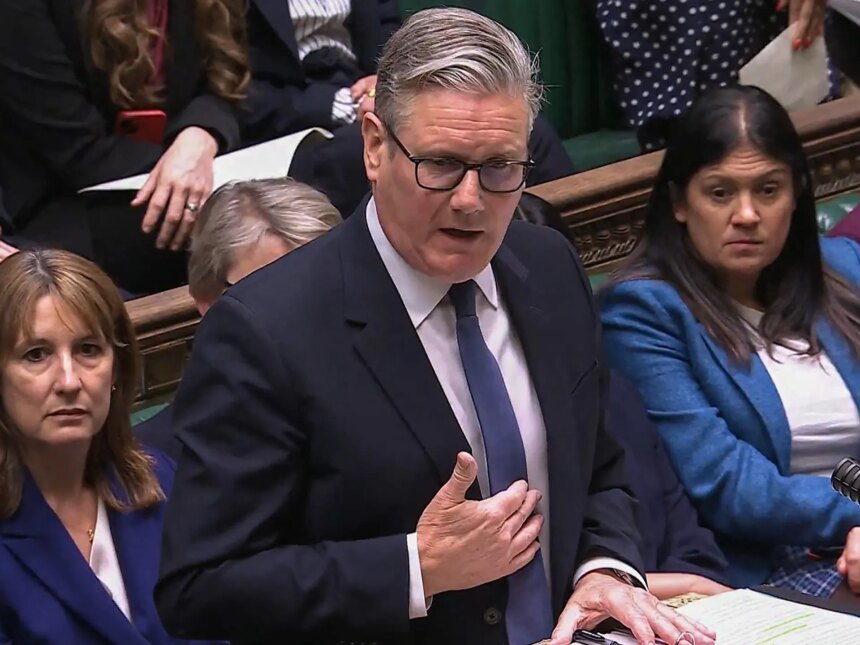
The writer discussed what happened in the weekly British Parliament session, saying that Starmer appeared during it “detached from reality” in his excessive optimism, a behavior he described as close to “delusion.”
Indications of cracks within the Labor Party’s parliamentary bloc are increasing, as a number of MPs expressed their dissatisfaction publicly, and some of them went on to say that Starmer’s departure has become a matter of time.
Rintoul added that Starmer appeared more confident and controlled during the session, making use of his legal background in defending his government, as he focused on the procedural aspects, trying to prove that the steps followed were correct from a formal standpoint.
But he noticed that the faces of his ministers were “stiff” and devoid of any expression behind him, a clear indication of the collapse of the spirit of ministerial solidarity.
Despite his apparent cohesion, the Prime Minister did not succeed – according to The Independent – in changing the general mood within the ruling Labor Party or among public opinion. Rather, some observers considered him evidence of the leadership’s separation from political reality, as focusing on procedural details does not address the essence of the crisis, which is political miscalculation.
The newspaper noted that Starmer appears to be clinging to the position not only out of duty, but also out of a deep personal desire to continue, which explains his rejection of the idea of resigning despite the increasing pressure.
However, this insistence may turn into an additional factor to exacerbate the crisis, if it is interpreted within the party as ignoring its concerns, according to the analysis.
At the same time, signs of cracks within the Labor Party’s parliamentary bloc are increasing, with a number of MPs expressing their dissatisfaction publicly, and some of them saying that Starmer’s departure has become a matter of time. Criticism also emerged from figures who were considered loyal, which reflects the depth of the crisis, according to the newspaper.

Alliances in the ashes
The challenges are not limited to the internal political aspect, as Starmer also faces increasing economic pressures, in light of the repercussions of regional tensions and the high cost of living. This is what the iPaper newspaper covered in an article by Katie Donaldson.
Donaldson, the newspaper’s chief political analyst, stated that betting on foreign policy to improve his internal image did not achieve the desired results, and might even increase the economic burden on his government.
She revealed that there are movements within the corridors of the Labor Party to conclude a “charter” or agreement between Health Minister Wes Streeting and former Deputy Prime Minister Angela Rayner, to ensure a smooth transfer of power that prevents the party from entering into “bitter” conflicts.
The author pointed out that the proposed idea is to form a tripartite leadership for the transitional phase, headed by Secretary of State Yvette Cooper, as she is a “balanced” personality.
However, the newspaper believes that these plans are risky; Angela Rainer is still awaiting the IRS’s decision on her financial situation, and Wes Streeting is facing criticism over his past connections to Mendelson. This leadership vacuum is what currently keeps Starmer in office; It survives not because of its strength, but because of the weakness and dispersion of its alternatives.
Many rank-and-file MPs in Labor believe that Starmer will not lead the party in the next election, and that his departure has become inevitable after the results of the local elections in May.
The continuation of parliamentary investigations and the summoning of officials to testify about the Mandelson case ensures that the crisis remains at the forefront of the scene, which limits the government’s ability to move on other issues.
Eating into the flesh of the party
According to the I-Paper newspaper, opinion polls indicate that the expected results of those elections may be disastrous for the party, as it “eats up” the Reform Party in its right-wing base and the Green Party in its left-wing base.
The continuation of parliamentary investigations and the summoning of officials to testify about the Mandelson case ensures that the crisis remains at the forefront of the scene, which limits the government’s ability to move on other issues.
This has led to a general impression that the government is more concerned with defending itself than managing the country’s affairs.
Despite all this, Starmer adheres to a speech in which he affirms that his government is continuing to implement its program, and that “nothing will distract it” from achieving its goals.
However, his critics believe that this rhetoric contradicts a political reality that indicates the opposite, as the crisis dominates all aspects of government work, according to the I-Paper newspaper.
In sum, it appears that Starmer’s premiership has entered a delicate phase, characterized by a fragile balance between staying and leaving. He remains in his position, supported by the absence of a clear alternative, but at the same time he faces a continuing erosion in his authority.