

Published On 7/6/2026
Days after the expiry of the June 30 “deadline” set by anti-immigration groups for irregular foreigners to leave South Africa, thousands of immigrants are living between daily persecution in the streets and accelerating government deportations, while relief organizations, including Islamic institutions, are coming forward to fill the humanitarian vacuum in the camps for the stranded.
1/ Outcome of the “deadline” day
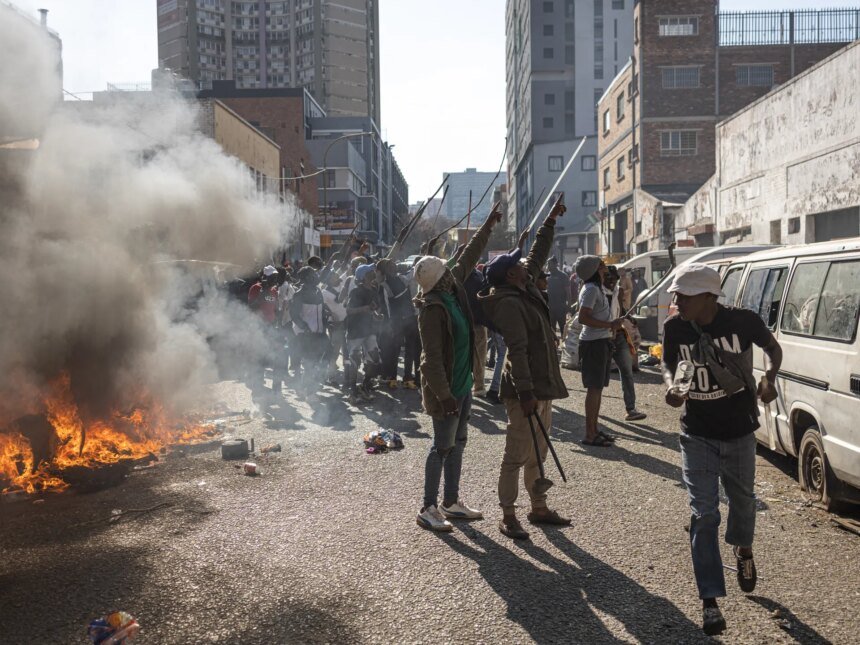
The police arrested more than 900 people during the anti-immigrant protests that swept the country last Tuesday, as Tepelo Mosekele, Deputy National Police Commissioner, reported that 108 out of 120 marches took place peacefully, while the police intervened in 12 of them, according to Reuters and the French press.
Police confirmed that a person was shot dead in the Alexandra district of Johannesburg during the looting of small stores owned by foreigners, and soldiers were deployed in the Hillbrow neighborhood in the city center after a shooting injured two people. President Cyril Ramaphosa also held an emergency meeting with protest organizers, saying that South Africans’ fears of illegal immigration are “real and deserve to be heard,” but he stressed that “taking the law into one’s hands is demagogic chaos that has no place in our constitutional democracy.”
2/ The migrant is the “plug” of crises?
Human rights organizations, including Amnesty International’s branch in South Africa, held the campaign targeting migrants responsible for turning them into “scapegoats” for deeper social and economic failures, such as high unemployment and a backlogged asylum system.
The Turkish newspaper Daily Sabah pointed out that researchers have consistently found little evidence of immigration being responsible for the country’s economic hardships, despite widespread perceptions linking immigrants to unemployment and crime. It explained that South Africa hosts more than 167,000 refugees and asylum seekers, according to the United Nations, which is a low percentage compared to Uganda, which hosts about 1.8 million refugees, and Chad, which hosts more than 1.2 million.
The same source stated that migrants are subjected to repeated harassment, regardless of their legal status, as civilians stop them in the streets and demand identity documents, despite the authorities repeatedly confirming that only the police are legally authorized to request residency papers. In Cape Town, police said that Ghanya was shot dead inside a barbershop in what investigators believe was an extortion attempt, after unknown gunmen stormed the shop, demanded money, then opened fire and fled. His killing sparked a diplomatic crisis, as Accra officially protested, saying that he had been killed during the protests, while Pretoria denied recording deaths on the day of the marches, and Justice Minister Mamoloko Kupayi accused the Ghanaian authorities of “spreading false information.”

3/ Solidarity of the Muslim community
In Durban, there are between 7,000 and 10,000 migrants from neighboring Malawi in a camp in the courtyard of Sherwood Hall, under conditions that the Mail & Guardian newspaper described as miserable. وقد شهد الموقع ولادة امرأة ونقل ست أخريات إلى المستشفى. In the face of the severe shortage of municipal facilities, Islamic relief organizations, including “Gift of the Givers,” “Gift of the Needy,” and local representatives of the “Al-Maimon International Organization,” intervened to provide vital infrastructure, including large tents, food, water, and temporary toilets from the first night, according to the newspaper.
In parallel, the Ministry of Justice established a virtual court linking the camp hall to the Durban court to expedite immigration files. Deputy Minister Andres Nel said that 1,876 people were found to be without documents and that 676 were returned voluntarily with the help of the Malawi government, while the rest are subject to deportation procedures.
4/ Where is the crisis heading?
Jacinta Ngobezi Zuma, leader of the anti-immigrant March and March movement, announced that she will continue demonstrating every Thursday until the government tightens border controls, while media reports indicated that politicians are employing anti-immigrant rhetoric as the elections approach next November. Alanna Pew Jones Baranoff, director of HIAS in South Africa, warned that what distinguishes the current wave from previous ones is “the weaponization of social media to create fear, spread misinformation, and coordinate violence quickly and widely,” saying that the fragile social cohesion in the country may become “a powder keg ignited by the smallest spark… and it is already burning, and what happens next depends on whether people choose to act.”