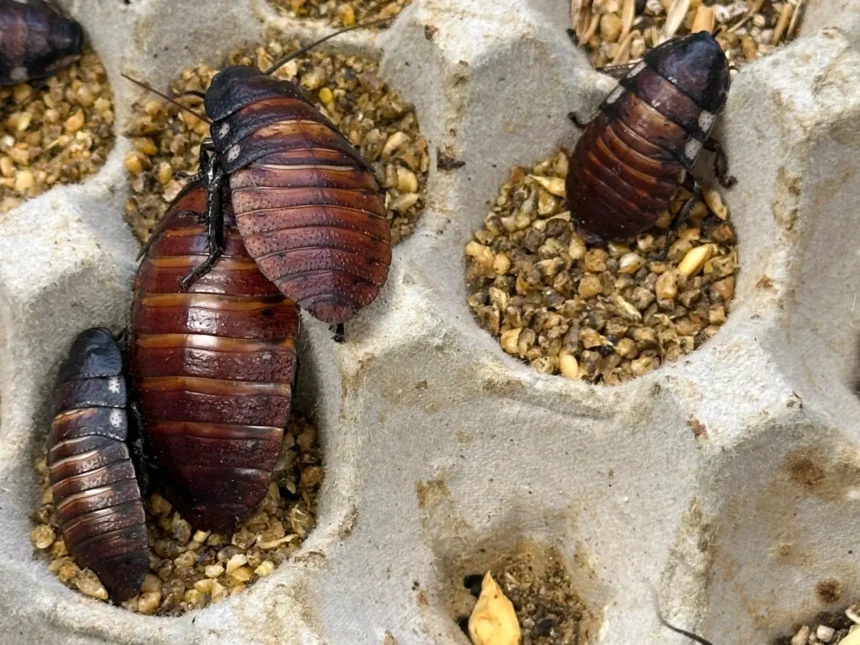
The cockroach is associated in people’s minds with that disgusting household insect, but the situation seems different with the Madagascar roaring cockroach (Gromfadorrhina portentosa), which has become one of the most famous insects sought after by hobbyists who breed rare insects, in addition to its importance in scientific research, which has created an illegal market for the trade in that insect.
In early June 2026, the Australian authorities announced the confiscation of more than 100,000 exotic cockroaches from a breeding facility in the state of New South Wales, including large numbers of Madagascar cockroaches, with a market value estimated at approximately 200,000 Australian dollars (about 142,000 US dollars).
According to the famous insect and animal selling platform “TC Insects,” the price of an adult cockroach, whether male or female, is about $8. As for nymphs, which are immature babies, that is, the stage after hatching and before full growth, and whose size ranges between three-eighths of an inch and half an inch, their price, according to the prices of the same site, is about $3 per person.
Dr. Amr Abdel Samie, Professor of Entomology at the Faculty of Science, Cairo University, told Al Jazeera Net, “This creature, which has no wings and lives peacefully among the leaves of the fallen forest on the island of Madagascar, is like a living, mobile laboratory that provides valuable answers to major questions in immunity, behavior, evolution, and coexistence with microbes, which creates a popular market for it in the scientific research community, in addition to its distinctive characteristics in breeding, which increases the demand for it in the insect collector market.”
This demand is not related to biological scarcity, but rather to the ease of raising it, its suitability for educational purposes, and its ability to live in stable colonies within families, which makes it an ideal model, compared to other experimental organisms, as Amr explains.

Longer life…distinctive features
The Madagascar cockroach belongs to the “Blaberidae” family, within the “Blatodia” cockroach order, and is an exclusive settler of the island of Madagascar. One of its most prominent features is that it does not fly, because both sexes lack wings, even in the adult stage. The male has two clear protrusions behind the head that resemble small horns, which he uses in competitive fights.
The length of an adult individual ranges between 5 and 7 centimeters, and it lives a longer period than many insects, as the life of a nymph extends for five to seven months until maturity, while an adult may live between one and two and a half years in ideal laboratory conditions (temperature of 25-30 degrees Celsius, and relative humidity exceeding 60%).
In nature, it scavenges organic matter on the forest floor, decomposing fallen leaves and rotting wood, and contributing to the nutrient cycle critical to its environment.

Voicemail unlike others
When we hear the term “insect communication,” images of the vibrating dance of honeybees or the chemical pheromones released by moths come to mind, but the Madagascar cockroach chose a rare path, which is sound.
Amr says, “It does not emit a hissing by rubbing its body parts as locusts or beetles do, but rather by forcefully pushing air out of specialized respiratory openings on both sides of the abdomen known as modified spiracles.”
The anatomy of these stomata and the study of airflow revealed that they are equipped with strong muscles that enable the cockroach to produce a broad-frequency sound wave that it uses in four distinct contexts: an alarm call during disturbance, a courtship hiss for females, and two different aggressive sounds between males during battles for dominance.
What is most interesting is that these sounds have a biological “truth” connotation. Deborah Clark, from the Department of Biology at Middle Tennessee State University, and Allen Moore, from the Department of Entomology at the Center for Ecology, Evolution, and Behavior at the University of Kentucky, demonstrated in a behavioral study that the characteristics of the aggressive hiss, “its intensity, duration, and purity,” are closely related to the size and mass of the male, and thus to his social rank in the herd.
The dominant male hisses longer and louder, which is a reliable signal that smaller males cannot easily fake, and this type of “honest signal” makes this cockroach an ideal system for studying the evolution of vocal communication and social dominance, phenomena that are often studied in vertebrates rather than insects.

A laboratory on six legs
In addition to these distinctive behaviors that make the Madagascar cockroach exciting for collectors of rare insects, it is also a living laboratory that walks on six legs.
Perhaps what most draws the attention of immunologists is that insects lack adaptive immunity (antibodies, B and T cells), and rely entirely on a powerful innate system that is similar in many of its molecular principles to its counterpart in mammals.
In this context, the Madagascar cockroach stands out as a good dissection platform thanks to its large size, which allows the withdrawal of appropriate amounts of the fluid that acts like blood in insects and most arthropods (hemolymph) and the study of its components.
Studies on insect blood cells (haemocytes) in this species and related species have contributed to understanding the mechanisms of autophagy and the inflammatory response, including the formation of nodules around foreign bodies.
The formation of nodules is one of the immune mechanisms in insects, where immune cells, such as hemocytes, gather around a foreign body that has entered the insect’s body, such as a bacteria, fungus, or parasite, to form a small mass or “knot” that isolates it from the rest of the body.
The cockroach has also become a useful model for studying innate immune responses and interactions with pathogens, helping to reduce reliance on mammalian models.
This trend is in line with a law issued by the European Union in 2010 to regulate the use of animals in scientific experiments, with the aim of reducing pain and suffering as much as possible, and obliging researchers to replace vertebrates with invertebrates whenever possible.
Dialogues with microbes
This cockroach does not live alone. Inside its intestines is a very complex bacterial community that includes hundreds of species that help in digestion and recycling nutrients.
In a pioneering study, the research of Juan Guzman, from the Fraunhofer Institute for Molecular Biology and Applied Ecology in Germany in 2022, revealed a unique microbial diversity in the intestine of the Madagascar cockroach, where the composition of the bacterial community differs significantly between different parts of the intestine and the surrounding environment, which indicates biological selection by the host.
There is also a symbiotic relationship with Platabacterium bacteria, which play an important role in providing essential amino acids. This close relationship makes the Madagascar cockroach an important model for studying evolutionary symbiosis between insects and their microbes.
Expensive experiments
While the price of an adult cockroach is $8, and a nymph is $3, establishing a high-quality research farm or carrying out complex experiments may be very expensive, for four main reasons that Amr mentions.
The first of these reasons is that this cockroach has a slow life cycle and strict environmental requirements. While house cockroaches reproduce within weeks, Madagascar cockroach nymphs need more than half a year to mature, and they must be kept at relatively high temperatures and high humidity with careful ventilation to prevent fungal diseases. Any defect in these conditions leads to the death of the colony, which requires expensive climate control equipment and continuous monitoring labor.
The second reason is “biosterilization research.” To study the role of commensal bacteria, scientists are forced to produce cockroaches that are free of germs (noobiotics) or without bacterial symbioses (aposymbiotics). This requires treating insects with antibiotics for several generations, and feeding them sterile foods inside positive pressure isolators, a procedure that is complex, expensive, and fraught with failure, as described in detailed reviews of sterile insect rearing methods.
The third reason is “regulatory and distribution barriers,” as importing or transporting live cockroaches between countries is subject to strict phytosanitary licenses. In the United States, for example, the Animal and Plant Health Inspection Service classifies non-native insects as potential pests and charges special permits and inspection fees that can raise the final cost of a single batch to hundreds of dollars.
Finally, the “scarcity of standard strains” increases the cost. In contrast to the fruit fly, which has genetically standardized strains cataloged for decades, the Madagascar cockroach has no commercially available pure laboratory lines, and each research group is forced to establish and maintain its own colonies, which doubles the initial expense and makes it difficult to compare results between laboratories.
In the balance of science and the environment
Aside from the hobby and the laboratory table, this cockroach plays a significant environmental role in forests, as it directly recycles carbon and nutrients, as Amr explains.
On the cognitive level, it represents a rare evolutionary link that allows understanding how complex communication systems and hierarchical social structures arise outside the scope of vertebrates, which contributes to drawing the evolutionary tree of behavior on the planet.
At the level of biomedical research, there is increasing reliance on this organism as a primary drug screening platform for studying innate immune responses, in order to avoid the high moral and financial costs of mammalian models. Compared to a laboratory mouse, the cockroach does not require large areas or veterinary staff, and is not subject to complex animal care protocols. However, it provides rich data on its evolutionarily conserved cellular and chemical defense mechanisms. The release of its complete genome has enhanced the opportunities for its use in functional biology and translational pharmacology.
Based on all of the above, Amr concludes by saying: “The price of $8 per cockroach may be much less than the scientific benefits that can be gained from this small organism, which reminds us that scientific treasures do not always come from the complexity of the living organism, but rather from its unique ability to answer central questions with relatively simple tools.”