

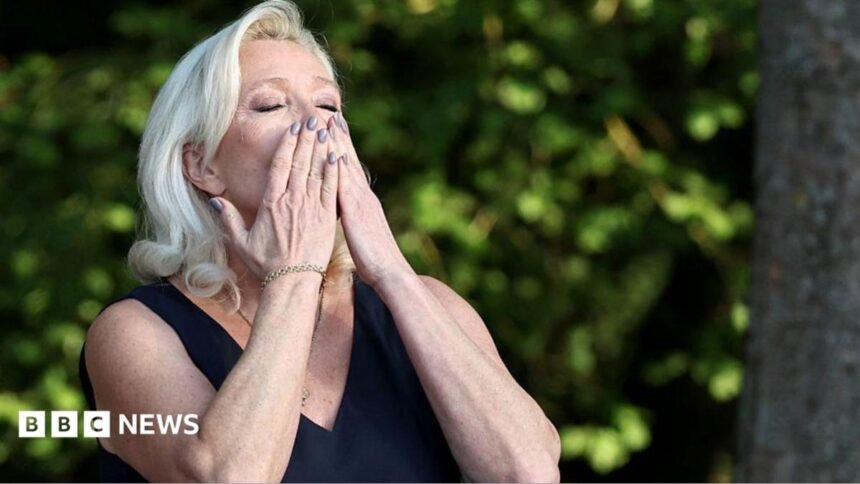

Marine Le Pen put on a united front with Jordan Bardella ahead of Tuesday’s verdict
Marine Le Pen put on a united front with Jordan Bardella ahead of Tuesday’s verdict
Marine Le Pen has tasted defeat before, but if the Paris appeal court bars her from running in the 2027 presidential election, it could bring down the curtain on her long political career as leader of France’s nationalist right.
Le Pen, 57, told supporters at the weekend in Liévin, in the heart of her constituency in the Pas-de-Calais, that “if the judiciary bars me from running for the presidency”, she would instead devote her energy to supporting her young protege Jordan Bardella.
A trained lawyer and an accredited cat-breeder, she does have alternatives beyond frontline politics, but Marine Le Pen has been seeped in it since childhood, and it is hard to envisage her taking a backseat role.
She came third in the 2012 presidential race and was then runner-up to Emmanuel Macron in 2017 and 2022. Ahead in the polls for next year’s election, and with Macron not running, this would be her best chance yet of winning the presidency.

Le Pen was twice defeated by Emmanuel Macron in the presidential race, but Macron will not be running in 2027
Le Pen was twice defeated by Emmanuel Macron in the presidential race, but Macron will not be running in 2027
Instead, to some observers in Liévin, it felt as if she was preparing to pass the baton to the next generation.
Le Pen was seen singing along to the words of a popular 1980s song by female singer Dalida in the twilight of her career called Mourir sur scène, with the chorus “I want to die on stage in front of the spotlights”.
For 15 years she has been the most powerful figure in France’s anti-immigration politics.
What happens next could draw a line under a family era that began with her father Jean-Marie Le Pen’s National Front (FN) in the 1970s and continued under her from 2011, as she gradually removed all trace of him, first in the FN, and then under a renamed Rassemblement National – or National Rally.

The Le Pen family were lucky to survive the 1976 blast with minor injuries
The Le Pen family were lucky to survive the 1976 blast with minor injuries
Marine Le Pen was eight years old when she and her two elder sisters survived a November 1976 bomb attack that destroyed their family’s flat in central Paris
She, her sisters Marie-Caroline and Yann and her parents escaped with a few scratches, in what she later called a “night of horror” that made her realise her father was in politics.
Eight years on, her mother Pierette left the family home with Le Pen’s biographer in September 1984 and later posed for Playboy.
While all three sisters took their father’s side, it was Marine, the youngest, who adopted his political legacy.
Still protective of her father, she said on French TV in 2004: “You’re born Le Pen’s daughter, you die Le Pen’s daughter. He’s the man of my life. He’s made me the woman I am.”

For years Marine Le Pen saw her father as the man she wanted to live up to (file pic 1987)
For years Marine Le Pen saw her father as the man she wanted to live up to (file pic 1987)
By the early 1990s, Marine Le Pen had graduated as a lawyer in Paris and entered politics.
Her family background meant other lawyers would boycott her and she focused on her career in the National Front, eventually becoming vice-president of the party in 2003 and winning a seat in the European Parliament in 2004.
Her father reached his political peak in 2002, coming second to Jacques Chirac in the presidential race with 18% of the vote, but it was not for another nine years that his daughter became party leader.
Jordan Bardella: The ‘blank canvas’ who could be France’s youngest president
Marine Le Pen appeal verdict: Why this moment matters for France
French far-right leader tells BBC he shares US warnings on Europe ‘for most part’
She remained a Euro MP until 2017, and the fake jobs conviction against her last year found that she had played a “central role” in a scheme to use €1.4m (£1.2m) of European Parliament funds to pay party assistants.
For years, the National Front struggled to raise money, as French banks would not lend the party money because of its racist and antisemitic past.
That meant that Marine Le Pen’s party went cap in hand to a Russian-Czech bank linked to the Kremlin, in the very year that Vladimir Putin staged his illegal annexation of Ukraine’s Crimea. Le Pen repeatedly backed Putin’s occupation, and on the eve of the 2017 presidential race visited him at the Kremlin.
Over time, she had expressed her admiration for the Russian leader, but that image of the pair shaking hands came back to haunt her.
Although she won almost 11 million votes in 2017, a record for the National Front, Macron told her in an ill-tempered televised debate that “France deserves better than you” and went on to win over two-thirds of the electorate.
Five years later, and with another presidential vote looming, Putin was on the cusp of sending Russian troops into a full-scale invasion of Ukraine in February 2022. “I do not believe at all that Russia wishes to invade Ukraine,” she told the BBC, before going on to say that if it did indeed happen she would back Ukraine’s sovereignty.
Her biggest success has been in the detoxification or dédiabolisation (de-demonisation) of what her father had created in her bid to join the political mainstream.

In October 2025, Marine Le Pen walked into the prime minister’s residence holding a cat carrier behind her back
In October 2025, Marine Le Pen walked into the prime minister’s residence holding a cat carrier behind her back
Although the anti-immigration policies are intact, with promises to prioritise homes, jobs and benefits for French nationals, gone is the overt racism and antisemitism of her father, who died last year.
Marine Le Pen has been taken to court herself but ultimately she was acquitted in 2015 of inciting racial hatred for comparing the sight of Muslims praying in the streets to the Nazi occupation of France in World War Two.
Her expulsion of Jean-Marie Le Pen from the National Front in August 2015 marked the culmination of a family feud, and at one point he suggested “Marine Le Pen may want me dead”. After his death, she said she would “never forgive myself for this decision, because I know it caused him immense pain”.
In 2018, a year after she came second to Emmanuel Macron in the presidential election, she rebranded the party entirely.
The purge did not end there. When an old family friend, Steeve Briois, who is still mayor of the National Rally northern stronghold of Hénin-Beaumont, was ousted from the party’s executive, he complained of a shift towards “immigration and identity” at the expense of everyday social issues.
With less than a year before the next presidential vote, that rebranding appears complete.
But the next political moment for National Rally may not fall to her but Jordan Bardella.
A life outside politics seems unlikely for Marine Le Pen, but not inconceivable.
In 2015, after suffering defeat in regional elections she told Le Parisien she could “stop everything, do something else – breed cats for example”.
Five years later she passed a diploma in cat breeding. For a short period she even made a little money from it, listing the names of her six cats in an interview.
Although that venture appears to have fizzled out, only last year she was seen carrying a kitten in a pet crate while on a visit to the Prime Minister’s residence.