


Carney is boosting Canada’s military spending and seeking stronger ties with Europe
Carney is boosting Canada’s military spending and seeking stronger ties with Europe
The Canadian government has chosen a German defence company to build its navy’s new submarine fleet, in one of Canada’s largest ever military procurement deals.
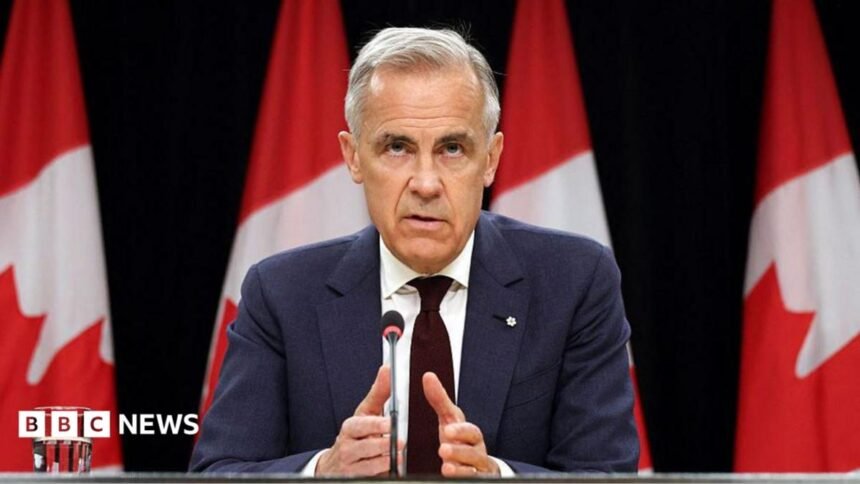
Prime Minister Mark Carney announced on Monday that the government had chosen the company TKMS for the multi-billion dollar, 12-vessel contract.
The announcement comes just before Carney leaves for a Nato summit in Turkey, where members are expect to face pressure to show they are boosting defence investment.
Since taking office, Carney has bumped Canada’s defence spending to 2% of gross domestic product (GDP), and has committed to reaching 5% by 2035.
In Halifax, Novia Scotia, on Monday, Carney said the government would enter into negotiations with TKMS to sign a contract, which could take several months.
“This project is about much more than acquiring submarines,” Carney said. “It builds Canadian industrial capacity.”
TKMS – the world’s largest non-nuclear submarine manufacturer – was competing with South Korea’s Hanwha Ocean shipbuilding company for the submarine bid.
The latest fleet of submarines is a part of Carney’s effort to increase military spending and intended to bolster the country’s maritime sovereignty, especially in the Arctic.
US President Donald Trump has put pressure on 32 members of Nato’s military pact to increase defence spending.
Canada announced in July 2024 that it was seeking a contractor to build the new fleet of submarines, with Carney saying he would decide the winner to replace the country’s aging Victoria-class vessels, bought in 1998, by this June.
The submarine contract gives Carney “significant credibility” in his efforts to prove he is bumping up defence spending, said David Perry, the president of the Canadian Global Affairs Institute.
“He committed to move the project on a very expedited schedule – astonishingly fast by Canadian standards, and appears to have delivered,” he said. “This project will push our core defence speeding up consequentially.”
Perry said the Canadian government was focused on awarding the contract to a country with whom it wanted to create a strategic partnership. Carney has sought to strengthen economic and security ties with Europe, as Canada faces trade tensions with the US, its longtime ally to the south.
TKMS has said its bid, a joint partnership with Norway, offered “Canada a low-risk, Nato-aligned, and economically transformative solution” in an agreement that allows for shared maintenance and repair, training, logistics, and operations.
Perry added that the new ships will give Canada a “massive increase” in maritime capabilities.
“It should allow for a fleet of three submarines being reliably operational at any given time,” Perry said. “That’s a huge increase in capability over one occasionally operational submarine, which has been our reality for several years.”
The Canadian government has said the new submarines – which will be conventionally-powered and have under-ice capabilities – are critical for the security and sovereignty of a nation with the largest coastline in the world.
Related topics
How much do Nato members spend on defence?
Why Canada is seeing its biggest military recruitment surge in 30 years